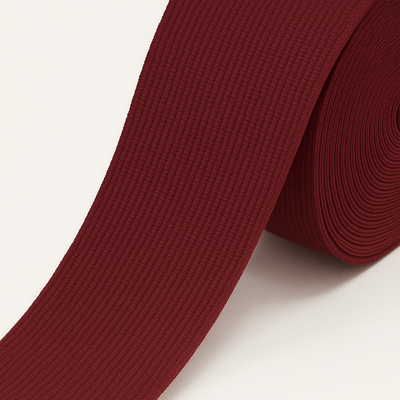
Choosing a trims supplier: Europe vs China isn't an ideological question but an arithmetic one. Unit prices from Asia are often lower, but they're only one of at least eight factors that decide your real cost and risk. This article compares the two options honestly – with the pros and cons of each – and sets out scenarios for when each one makes sense.
Where trims are made
Trims manufacturing is highly specialised. Japan and China dominate zips, Italy and Turkey are traditional centres for buttons, and labels are made in Hong Kong, India, Portugal and many European countries, including Bulgaria. So "China vs Europe" is rarely one decision for every trim – more often it's a decision per category.
 Metal tags E-2302 Nickel 1.5 x 1 x 1 cm – Triangular 3D shape, for laser branding
 Metal buttons with a pink finish 6104047 Col 255 – 22 mm handmade
 Satin label 14 cm x 5 cm - satin print
Comparison on eight criteria
| Criterion | Supplier in China | Local/EU manufacturer |
|---|---|---|
| Unit price | Often lower at high volumes | Higher on commodity items, competitive on small runs |
| Minimum order | Usually high (e.g. 500 m of elastic per colour) | More flexible, often with stock available |
| Lead time | Production + 30–45 days by sea; around a month on average for trims alone | Days to a few weeks; stock items immediately |
| Transport | Sea (slow) or air (expensive) | Courier within the EU |
| Duty and VAT | Duty per tariff + import VAT; from 1 July 2026 the EU scrapped the duty exemption for consignments up to €150 | No customs within the EU; VAT under normal rules |
| Compliance responsibility | The EU importer is responsible for REACH (e.g. nickel) | The manufacturer is in the EU, under the same rules |
| Samples and corrections | Weeks per round | Days; meeting in person is possible |
| Communication | Time difference, language nuances | Same time zone, quicker decisions |
The hidden costs of a "cheap" trim
- MOQ surplus. If you need 150 m of elastic and the minimum is 500 m per colour, you're really paying for 500 m.
- Cash tied up in stock. A large order freezes money for months.
- The cost of delay. A month's delay on trims stops the whole run – and a missed season costs more than any price difference.
- Repeat orders. If the run sells fast, the extra trims are waiting for a ship again.
- Claims. A defective lot from a distant supplier is hard to send back.
- Testing. As the importer, you have to prove REACH compliance, and lab tests are an extra cost.
When China makes sense
- Large, stable volumes of the same item – tens of thousands of pieces.
- Standard, unbranded trims where price is decisive.
- A long planning cycle – you order four to six months ahead.
- Specialised products that simply aren't made in Europe.
- You have an agent or your own quality control on the ground.
When a local manufacturer wins
- Small and mid-sized runs – from a few hundred to a few thousand pieces.
- Branded trims that need iterations – logo labels where the sample is corrected two or three times.
- Fast replenishment – you sell online and reorder in waves.
- Childrenswear and anything where REACH and safety compliance is critical.
- You manufacture in Europe – trims reach the factory in days, not after the ship docks.
Tip: compare not the unit price but the "landed, fitted cost" – unit price plus freight, duty, MOQ surplus and the cost of time, divided by the number of garments.
Example: two calculations for the same run
Picture a brand making 300 hoodies in Bulgaria that needs a woven main label, elastic in a specific colour and metal hardware. Option A: order from Asia – a lower unit price, but a minimum of several thousand labels and 500 m of elastic per colour, sea freight, duty and import VAT, and one round of sample corrections that takes three weeks. Option B: a local manufacturer – a higher unit price, but quantities close to what's actually needed, samples in days and delivery straight to the sewing factory.
On a run this size, option B often works out cheaper overall, because the brand isn't paying for thousands of unused labels or risking the season. At 30,000 pieces the maths may flip. So run the numbers for your volume, not a rule of thumb.
A hybrid strategy
Many European brands mix both: standard high-volume trims (plain black zips, say) from distant suppliers with long planning, and branded or time-critical trims – labels, logo buttons, elastics in a specific colour – from a local manufacturer. That balances cost and flexibility without betting the whole collection on one container.
Questions to ask any supplier
- What is the minimum per item and per colour?
- What's the lead time for samples and for bulk – to your door, not to the port?
- Are there test reports for nickel and other REACH substances?
- What happens if a lot is defective?
- Can I reorder a small top-up quantity a month later?
FAQ
Is a Chinese supplier responsible for REACH?
Not in the eyes of EU authorities. Responsibility lies with whoever places the goods on the EU market – usually the importer. So ask for test reports and, if in doubt, test yourself.
Does an OEKO-TEX certificate matter?
It's voluntary and can be issued to manufacturers anywhere in the world. Check that the certificate is valid and that it covers that exact item.
Can I start with a local supplier and move to Asia later?
Yes, it's a common strategy: launch with small runs locally, and once volumes for a given item become large and stable, get a separate quote for it.
Bul-tex: a manufacturer and supplier in Bulgaria
Bul-tex manufactures and supplies garment trims from Bulgaria – labels, buttons, elastics, zips and hardware – and takes custom orders from brands. We ship across the EU with DHL Express. If you're comparing quotes, send us an enquiry with quantities and your deadline. More brand guides are in our production articles.