Bias tape, single vs double fold, is one of the first things sewists get confused about. Bias tape is a narrow strip of fabric cut at 45° to the grain, used to finish necklines, armholes, hems, quilt edges and wrap closures. Because it is cut on the bias, it stretches and bends around curves without pleating – something no straight-grain tape can do. The two most common questions are what the difference is between single and double fold, and whether to buy it ready-made or make your own. We answer both here, with concrete maths for widths and yardage.
Why it's cut on the diagonal
Woven fabric barely stretches along the warp or weft, but on the diagonal it has noticeable give. A strip cut at 45° can bend around a curved edge – a neckline, an armhole, the corner of a wrap – and lie flat. A straight-grain tape would pucker along the inner edge of the curve. So for straight edges you can use any tape, but for curves you need true bias tape.
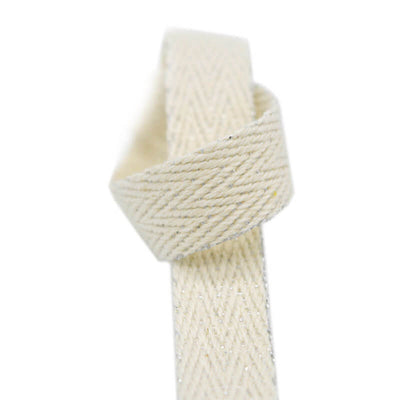
 Cotton herringbone tape white HR0001
 Black herringbone cotton tape HR0017
 Cotton herringbone tape ecru HR0002
Single fold or double fold
| Single fold | Double fold | |
|---|---|---|
| How it's folded | Both raw edges folded to the centre | Single fold folded in half again |
| How it shows | Usually turned to the inside, invisible | Wraps the edge, visible on both sides |
| Typical use | Facing for necklines and armholes, elastic casings | Visible binding, quilts, aprons, childrenswear |
| Strip width | 2 × finished width | 4 × finished width |
Double fold bias tape is simply single fold folded and pressed in half. So the same strip can give you either type.
The width maths
- Single fold: strip width = 2 × finished width. For a 12 mm finished tape, cut 24 mm.
- Double fold: strip width = 4 × finished width. For a 6 mm finished binding, cut 24 mm; for 12 mm, cut 48 mm.
- With thick fabrics add 2–3 mm to make up for what's lost in the folds.
Bias tape makers come in 6, 12, 18 and 25 mm sizes – the number is the finished width of the single fold tape. With a 12 mm maker, cut 24 mm strips.
How much bias tape you get from a piece of fabric
A handy formula for continuous bias cut from a square: length ≈ area of the square ÷ strip width.
- A 50 × 50 cm square = 2,500 cm². With 4 cm strips: 2,500 ÷ 4 ≈ 625 cm, so about 6 m of tape minus a few centimetres for seams.
- A 70 × 70 cm square with 5 cm strips: 4,900 ÷ 5 ≈ 9.8 m.
For reference: a women's blouse neckline needs about 60–70 cm, two armholes on a tank top about 100 cm, and the edge of a 75 × 75 cm baby blanket about 3.2 m.
Which fabric to make bias tape from
The easiest fabrics to work with are light to mid-weight wovens: cotton poplin, lawn, tightly woven linen. They press well and hold a fold. Slippery fabrics such as satin and chiffon give lovely results but need spray starch before cutting. Avoid knits – they stretch in every direction and don't need bias; their edges are finished with strips of the same knit.
Buy or make: a decision tree
- Need tape in exactly the garment fabric (matching colour or print)? → make it.
- Sewing a run of dozens of pieces with identical binding? → buy ready-made – consistent width, speed, no fabric waste.
- Very fine fabric (chiffon, silk)? → make it from the same or a lighter fabric; ready-made cotton will be too stiff.
- Is the edge straight (apron hem, bag edge, pocket)? → you don't need bias – use a straight tape.
- Want contrast decorative binding in lots of colours? → buy ready-made, or combine it with straight tape on the straight sections.
Step by step: binding a neckline with double fold bias tape
- Trim off the neckline seam allowance – the bias binding replaces it.
- Steam-press the tape into the shape of the neckline before sewing. It will "remember" the curve.
- Unfold one side and stitch it right side to the wrong side of the garment along the first fold line.
- Wrap the tape around to the right side so it encloses the edge and covers the first stitching line.
- Edgestitch 1–2 mm from the fold. On curves, don't stretch the tape along the outer edge – ease it slightly along the inner one.
- Steam-press through a cloth.
Tip: join strips with a diagonal seam (on the straight grain of the fabric) rather than straight across. The seam is less visible and doesn't create a lump in the fold.
When you need straight tape instead
Not every edge calls for bias. For straight edges, stabilising shoulder seams, elastic casings, ties and hanging loops, a straight woven tape is more stable and won't stretch out. Bul-tex doesn't sell bias tape, but our ribbons and tapes collection includes 100% cotton herringbone tape from 0.6 to 5 cm – the classic choice for stay-tape, ties and straight-edge binding – and grosgrain ribbon from 0.3 to 7 cm for visible decorative trims. For elastic casings, browse our elastics, and for more ideas see the ribbons section of the blog.
FAQ
Can grosgrain replace bias tape?
Only on straight edges. Grosgrain doesn't stretch and will pucker on a curve.
What's the most versatile bias tape width?
Double fold with a 10–12 mm finished width – suitable for necklines, armholes and childrenswear.
Should I wash the fabric before cutting strips?
Yes, if the garment is cotton or linen. Otherwise the tape and fabric may shrink at different rates and the edge will pucker after the first wash.