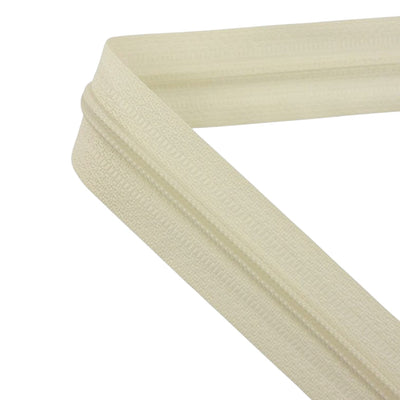
The parts of a zipper seem obvious until you need to order a replacement slider, specify a zip in a tech pack or explain to a sewing room why a jacket "won't start". Suddenly the "teeth", the "tab" and "that bit at the bottom" turn out to have precise names, and using the right one is the difference between getting the correct part and getting a bag of useless spares. This glossary puts every key term in one place, from the tape to the retainer box, and explains why each part matters. Treat it as the reference for the rest of our zipper articles.
The zipper at a glance
Every zipper consists of two halves, called stringers, joined by a slider. When the halves are closed they form the chain. At the top sit the top stops; at the bottom there is either a bottom stop (on a closed-end zip) or an insertion pin and retainer box (on a separating zip). Everything else is detail, but the details decide how the zip works and what it costs.
 Metal zipper closed-end brown / gold teeth T5 PMZ1008
 Beige coil zippers #3 TAT TF334 – 10, 11, 13, 14, 15 cm non-separable
 Metal zipper non-separable red / silver teeth T5 PMZ0005
Zipper parts glossary
Tape
The textile strip the teeth are attached to. It is usually woven polyester, occasionally cotton. On standard garment zips each side is roughly 12–16 mm wide. The tape is what you stitch through, so its colour should match the fabric or contrast on purpose. On water-resistant zips the tape is laminated with a polyurethane film.
Teeth (elements)
The individual links that interlock. By material, zippers fall into three families:
- coil – a continuous nylon or polyester spiral, light and flexible; the most common type for trousers, skirts and dresses;
- metal – separate teeth in brass, aluminium or nickel-plated alloy; strong, with the classic look of jeans, jackets and bags;
- moulded plastic – plastic teeth injection-moulded onto the tape; light, corrosion-proof and popular on sportswear.
Chain
Both stringers locked together, without slider or stops. Manufacturers also sell "chain by the metre" for making zips to length. The zip gauge (#3, #5, #8, #10) roughly describes the width of the closed chain in millimetres – a higher number means a chunkier, stronger zip.
Slider
The metal body that travels along the chain and either meshes or separates the teeth. Inside it are wedge-shaped channels that guide each half. The slider must match the chain in both gauge and type: a #5 metal-zip slider will not run on a #5 coil. Sliders come with different mechanisms – auto-lock, non-lock, reversible and more – which we cover in our guide to slider types.
Pull (puller, pull tab)
The part you grip to move the slider. It can be a plain metal tab, rubber, a cord loop or a decorative puller with a logo. Because it is the first thing anyone sees, the pull is prime branding space. On some sliders it is detachable and hooks onto a ring.
Bridge
The small arch on the slider body that holds the pull. On locking sliders the lock pin or spring sits under the bridge.
Top stops
Two small clamps at the top of each stringer that keep the slider from running off the chain. A standard closed-end zip has two top stops and one bottom stop. If a top stop falls off, the slider simply comes away – which is why repairs always start with checking this part.
Bottom stop
A clamp at the lower end of a closed-end zip that keeps both halves permanently joined. Typical on trousers, skirts, dresses, cushions and pockets.
Insertion pin and retainer box
On a separating (open-end) zip the bottom stop is replaced by two parts: the insertion pin (a slim tab at the end of one stringer) and the retainer box (a socket at the end of the other stringer, where the slider rests). You push the pin into the box to start closing a jacket. A bent pin or a cracked box means the zip cannot be started and usually needs replacing.
Reinforcement film
A thin plastic film bonded to the end of the tape around the pin and box. It stiffens the tape so the pin enters cleanly. When it peels away, the start of the zip begins to twist and misalign.
Two-way zip
A zip with two sliders that travel towards each other. It is used on long coats, sleeping bags and luggage, so you can open the lower part to sit down without undoing the whole garment.
Closed-end vs separating zip
| Feature | Closed-end | Separating (open-end) |
|---|---|---|
| Lower end | Bottom stop | Insertion pin and retainer box |
| Halves separate fully | No | Yes |
| Typical use | Trousers, skirts, dresses, pockets | Jackets, hoodies, cardigans |
| What to specify | Type, gauge, length, colour | Type, gauge, length, colour, end type |
How to specify a zip when ordering
With the right vocabulary an order fits on one line. State:
- Tooth type – coil, metal or moulded plastic.
- Gauge – #3 for lightweight garments, #5 for jeans and jackets, #8 and above for coats, bags and backpacks.
- End – closed-end, separating or two-way.
- Length – measured from the top stop to the bottom of the chain, excluding the tape extension.
- Tape and tooth colour – on metal zips these are chosen separately, for example black tape with gold teeth.
- Slider and pull – especially if you need a lock or a branded puller.
Tip: on jeans and trousers the zip is usually 1–2 cm shorter than the fly opening so the top can be caught into the waistband. Check the pattern before you order.
What we offer
Our zippers range includes #3 coil zips in a wide colour palette, invisible zips for dresses and skirts, and #5 metal zips with gold or silver teeth, plus decorative zip pullers. Bul-tex manufactures and supplies garment trims and takes orders from brands – if you need zips to length, special colours or logo pullers, get in touch and we will suggest a solution. You will find more practical advice in our zipper articles.
FAQ
What does #5 mean on a zipper?
The number indicates the approximate width of the closed chain in millimetres. A #5 is about 5 mm and is the standard for jeans and light jackets.
Can I replace just the slider?
Yes, as long as the teeth are intact. The new slider must match the chain's gauge and type, and new top stops are fitted afterwards.
Why does my zip split open behind the slider?
Usually the slider has worn or loosened and no longer squeezes the teeth together firmly. The fix is normally a new slider, not a new zip.