Thick hang tags announce themselves before you read a word: you pick one up and it has the heft of a business card from an expensive hotel, with a fine line of brand colour running around the edge. A tag like that is not cut from one heavy sheet. It is built from two or three sheets of board bonded together. In this article we look at exactly how it is made, where the coloured edge comes from, why foil and embossing look better on it, and when the extra cost genuinely earns its keep.
Why not just use heavier board?
Most printing boards top out at around 350–450 gsm. Beyond that, sheet-fed presses struggle to handle them and the choice of textures and colours shrinks fast. So when a brand wants a tag at 600, 800 or 1200 gsm, the maker takes two or three separate sheets, prints them individually and laminates them together. That gives three advantages over a single thick sheet:
- each side can be a different board – say, coated on the front and kraft on the back;
- the middle layer can be a contrasting colour that shows along the edge;
- front and back are printed separately, with no compromise on quality.
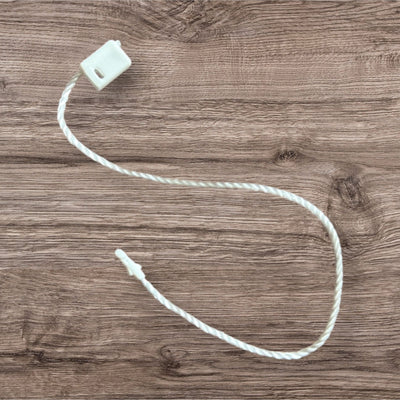
 String fasteners for cardboard tags 01
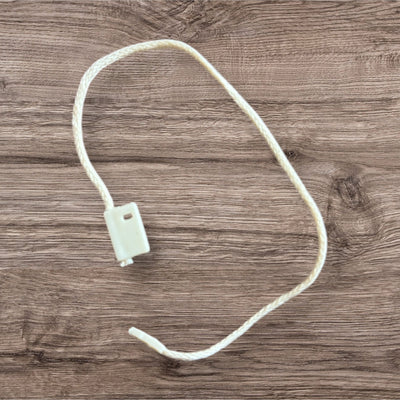
 String ties for cardboard tags 02
 Jacquard woven label LBL 0029 10 x 9 cm – soft gold style, premium design, with logo
How it's made, step by step
- Choosing the layers. Duplex means two sheets, triplex three. A typical build is 2 x 350 gsm (about 700 gsm in total) or 3 x 350–400 gsm (over 1000 gsm).
- Printing the outer sheets. Front and back are printed on separate sheets, each with the most suitable process.
- Laminating. The sheets are glued together by machine or under a press. Registration is critical here, or the back print drifts relative to the front.
- Finishing. Foil, embossing or debossing usually happen after lamination, because the thick stack takes pressure better.
- Die cutting. A thick stack needs a sharp rule and more pressure. At 1.5–2 mm some makers switch to laser cutting, which leaves a slightly darkened edge.
- Edge painting (optional). Tags are clamped in a tight block and the edges are painted in one go with a roller or spray gun, giving even colour all the way round.
- Punching the hole and fitting an eyelet, if one is specified.
The coloured edge: two different effects
| Coloured core | Painted edge | |
|---|---|---|
| How it's done | A through-dyed board is sandwiched between the two outer sheets | The edge of the finished tag is painted or foiled |
| Look | A fine line of colour through the middle of the edge | The whole edge is coloured |
| Durability | Will not rub off – the colour is in the board itself | Can scuff slightly with friction |
| Best for | Triplex from about 900 gsm up | Duplex and triplex |
You can combine both, but most brands pick one. The classic approach is a white or black tag with a core in the brand's signature colour.
Why foil and embossing look better
Thin board bulges out at the back when embossed, leaving the reverse uneven. On a thick tag the inner layers absorb the pressure: the relief is deeper and the back stays flat. A deboss on soft cotton board gives a crisp, almost sculpted effect that simply is not achievable at 350 gsm. Foil also lies flatter, because the surface does not give under the block.
How thick is it in millimetres?
Paper weight is not the same as thickness, but as a rough guide:
- 400–500 gsm – about 0.5–0.6 mm; noticeable substance without premium pricing;
- 600–700 gsm – about 0.7–0.9 mm; where the luxury feel begins;
- 800–1000 gsm – about 1–1.3 mm;
- 1200 gsm – about 1.5–2 mm, closer to thin board.
The exact figure depends on the stock – cotton and textured boards are bulkier than coated board at the same weight.
When it is worth it, and when it isn't
A multi-layer tag makes sense when:
- the garment sits in the upper price bracket and the tag is part of the unboxing;
- the brand has a strong signature colour that can show in the edge;
- the product is heavy (coats, denim, knitwear) and a thin tag would look out of proportion;
- customers are likely to keep the tag like a card or a collectible.
It is not worth it for high-volume basic T-shirts, for small tags (under roughly 40 x 60 mm, where the edge barely shows), or when the budget only covers one finishing technique. In that last case 450 gsm with good foil usually beats 900 gsm with nothing on it.
Cost and quantities
A multi-layer tag costs noticeably more than a single-layer one: at least two print passes, lamination, slower die cutting and often manual edge work. Minimum quantities tend to be higher and lead times longer. It is therefore smart to design one tag for the whole collection and differentiate styles with a second, cheaper tag or a size-and-price sticker.
Practical design tips
- Keep fine lines at least 3–4 mm from the edge – die tolerance is wider on a thick stack.
- Think about the string: a heavy tag needs a substantial cord, and a thin loop looks out of proportion.
- Match the edge colour to your brand Pantone and ask for a sample on the real board.
- Pair the tag with your inside label – for example a jacquard woven label in the same palette.
FAQ
Is a thick tag too heavy for lightweight garments?
A 50 x 90 mm tag at 900 gsm weighs about 4 g. On a shirt or a dress you feel it, so for light garments 500–600 gsm is usually enough.
Can a multi-layer tag be eco-friendly?
Yes, if the layers are recycled or FSC board and the adhesive is water-based. Painted edges and plastic foil do make recycling harder, though.
Does Bul-tex make tags like these?
Bul-tex manufactures labels for brands to the customer's own design. For multi-layer hang tags, contact us with the size, weight and finishes you have in mind and we will talk through the options. More on board types and weights is in the Labels section of our blog.