A two-way zipper has two sliders running on the same chain, so it can be opened from the top, from the bottom or from the middle. It sounds like a small detail, but on a long coat, a parka, a coverall, a sleeping bag or a holdall it solves real problems: you can sit down without the garment pulling, vent heat, or reach into a bag from whichever end is closest. This guide covers the configurations, how not to confuse them with other "double" sliders, and how to choose and fit the right one.
What exactly is a two-way zipper?
A standard zip has one slider that closes the teeth in one direction. A two-way zip carries two separate sliders. Either one can open or close the chain, leaving a gap exactly where you want it.
There are two main families:
- Two-way separating (open-end) zip – it has an insertion pin and retainer box at the bottom and comes apart completely. The top slider faces up, the bottom slider faces down. Used on long jackets, coats, parkas, ski wear and sleeping bags that need to open fully.
- Two-way closed-end zip – both ends are fixed with stops and the zip never separates. The sliders can be set "head to head" (they meet in the middle, typical of suitcases and holdalls) or "tail to tail" (they sit at the ends and open the centre, as on garment bags and vent openings).
 Metal zipper closed-end brown / gold teeth T5 PMZ1008
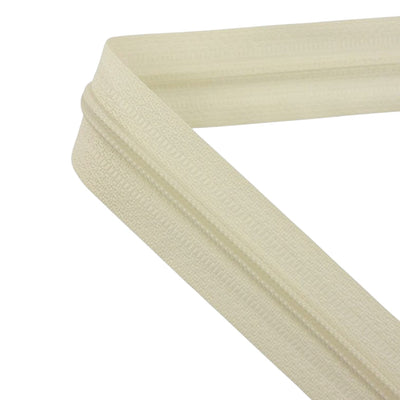
 Beige coil zippers #3 TAT TF334 – 10, 11, 13, 14, 15 cm non-separable
 Metal zipper non-separable red / silver teeth T5 PMZ0005
Two-way is not the same as reversible or double-pull
This is the most common ordering mistake, so here is a quick comparison:
| Option | Sliders | What it does | Typical use |
|---|---|---|---|
| Two-way zipper | 2 | Opens from either end or from the middle | Coats, parkas, sleeping bags, luggage, tents |
| Reversible slider | 1 | The pull flips so the zip works from both faces | Reversible jackets |
| Double-pull slider | 1 | A pull on each side of the zip, operated from inside and outside | Tents, covers, bags |
If your tech pack just says "double zip", a supplier could read it as any of the three. Spell it out: "two-way separating, 2 sliders" or "two-way closed-end, head to head".
When a two-way zipper makes sense
Long coats and parkas
Once a garment is longer than about 70–75 cm, a single-slider zip starts to get in the way. When you sit, cycle or drive, the hem pulls tight and the chain is strained, sometimes splitting behind the slider. A two-way zip lets you open 15–20 cm from the bottom while the top stays closed.
Coveralls and workwear
Wearers can open the lower part without undressing, and ventilate during physical work.
Sleeping bags
A two-way separating zip lets you vent your feet without opening the whole bag, and lets you join two bags if they share the same zip type and gauge.
Bags, holdalls, suitcases and covers
Closed-end two-way zips in a head-to-head setup dominate here: the sliders meet at the top, where they can be secured with a small padlock.
Tents and awnings
A door that opens from the top for air or from the bottom for access is the classic double-slider application.
Choosing the gauge
The zip number (#3, #5, #8, #10) roughly matches the width of the closed teeth in millimetres. As a guide:
- #3 – light jackets, cardigans, dresses; rarely made two-way because the sliders are small and fiddly.
- #5 – the standard for jackets, coats and parkas, in coil, moulded plastic or metal.
- #8–#10 – sleeping bags, holdalls, tents and heavy workwear.
Separating zip length is measured from the top stop to the bottom of the retainer box. On a coat, choose a length that leaves the lower slider 1–2 cm above the hem, so it doesn't scrape on the ground when you sit or take the strain when the coat is folded away.
Fitting a two-way separating zip, step by step
- Check orientation. The top slider has its pull facing up, the bottom one facing down. If both face the same way, the zip has been assembled wrongly and won't work.
- Run both sliders down to the box before inserting the pin. The pin passes through both sliders before it seats in the box; that is the main handling difference from a standard zip.
- Pin or tape the zip in place, leaving about 3 mm between the edge of the teeth and the seam so the sliders run freely.
- Sew with a zipper foot, moving the sliders out of the way as you reach them rather than stitching around them.
- Reinforce the bottom. The box area takes the most force; a bartack or double row of stitching there adds years to the zip.
- Test the action: both sliders should travel the full length without catching, and the lower slider should open and close smoothly.
Tip: on a lined coat, add a small flap or interfacing behind the lower slider. It stops the metal rubbing through the lining and makes it more comfortable to sit on.
Common problems
- "The zip splits below the bottom slider" – that's normal, the lower slider is meant to open from below. If it splits between the two sliders when closed, the sliders are worn and need tightening or replacing.
- The pin won't go in – usually the top slider hasn't been run all the way down.
- The slider catches at the end – the seam is too close to the teeth, or the hem has caught the tape.
- Mismatched sliders – replacements must match the chain type and gauge, or the teeth won't mesh.
Two-way zip or a simpler solution?
Sometimes a two-way zip is the wrong call. On short jackets, sweatshirts and hip-length cardigans, a single-slider separating zip does the job for less money. On bags that simply need a wide opening, a longer single-slider closed-end zip may be easier to use. A two-way zip earns its place when people really will open it from both ends; otherwise it just adds weight, cost and one more slider that can fail.
Zippers from Bul-tex
In our zipper collection you'll find closed-end #3 coil zips and T5 metal zips in a range of lengths and colours, plus accessories and hardware to finish the piece. If you need two-way or separating zips in a specific length and colour for a production run, get in touch with the gauge, length, tape colour and quantity and we'll check what we can supply. There is more practical advice in our zipper articles.
FAQ
Can a standard zip be converted into a two-way zip?
On a closed-end zip, sometimes: remove the top stop and feed on a second slider of the same type. On a separating zip, no – the box and pin are built for a single slider.
Is a two-way zip weaker?
No, the chain is the same. The weak points are the sliders, so on heavy garments choose metal auto-lock sliders.
What zip for a sleeping bag?
Usually a #5 or #8 two-way separating coil zip: coil is flexible, light and doesn't get as cold as metal.