

Matching hardware finishes is one of those requirements that sounds simple – "everything in antique brass" – and turns out to be hard in production. The button comes from one supplier, the zipper from another, the rivets from a third, and the metal plate is made to order. All of them are "antique brass" and no two look the same. This article explains where the differences come from, which are physically unavoidable, what tolerance is realistic, and how to organise your order so that buttons, zipper, rivets and plate read as one set.
Why the same "gold" looks different
1. A finish name is not a standard
Nickel, gunmetal, antique brass, light gold – these are trade names, not colour codes. Every plating shop has its own recipe: bath chemistry, layer thickness, lacquer tint. One supplier's "antique brass" can be closer to another's "bronze".
2. One casting, many colours
The same zinc alloy or brass base can be finished in dozens of colours simply by changing the final plating layer. The reverse is true as well: the same final layer looks different on a different base and with different preparation. A polished surface gives a bright tone; a satin one a darker, softer tone.
3. The geometry of the part
In electroplating, raised edges attract more current and get a thicker layer, while recesses get a thinner one. That is why the flat face of a rivet and a relief button from the same bath show different depth of colour.
4. Zippers are their own world
Metal zipper teeth are usually brass or another alloy and are often not electroplated, while the slider is a zinc die-casting with plating. So even within one zipper, teeth and slider can differ in tone. Compare your buttons with the slider and the teeth.
5. Antique finishes are handwork
For antique effects the whole part is darkened and the high points are then rubbed back mechanically. How much bright metal shows depends on tumbling time, abrasive and shape. High points therefore vary by nature – two buttons from one batch are not identical, and that is not a defect.
6. Batch and time
Baths age, lacquer arrives from a new delivery, the operator changes. A repeat order six months later is rarely exactly the same tone as the first.
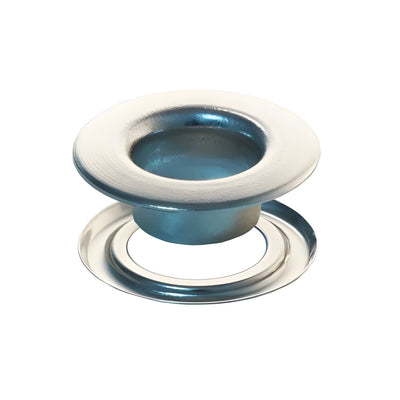
 Round metal rivets 10967L08 – 5 mm decorative
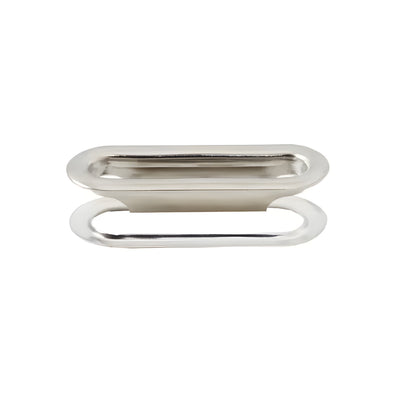
 Metal eyelets PE 0003 – oval
 Luxury decorative metal rivet R0145113 – Gun Metal
What tolerance is realistic
| Situation | Realistic expectation | How to specify it |
|---|---|---|
| Smooth finish (nickel, gold), one supplier, one batch | Practically identical | One order, one finish, one code |
| Smooth finish, different suppliers | Visible difference in warmth | Physical standard sent to everyone |
| Antique / patinated effect | Variation in contrast between pieces | Three limit samples: light, standard, dark |
| Matte / satin | Difference in degree of matting | Standard plus texture description |
| Repeat order months later | Slight tone shift | Compare with retained sample before approval |
Getting one tone: step by step
- Choose the lead part. Usually the most visible piece – the jeans button, the bag plate, the zipper slider. Everything else is matched to it, not the other way round.
- Create a physical standard. Not a description, not a photo, but an actual part in the approved finish. Keep it away from light and moisture in a sealed bag.
- Use codes, not words. In the spec, record each supplier's finish code ("gunmetal, code X at supplier A"), not just "gunmetal".
- Set critical zones. Parts that sit side by side (button and rivet on a waistband, slider and eyelet on a collar) need the tightest tolerance. Parts in different areas of the garment can have a wider one.
- Order in one go. All metal parts for the season – with overage for repairs and reorders – from one batch. It is the cheapest way to secure consistency.
- Compare under proper light. Daylight plus at least one other source – a tone that matches under cool LED can split under warm light.
- Approve the set, not the pieces. Lay the button, rivet, eyelet, slider and plate together on the fabric.
Tip: when a perfect match is impossible, go for deliberate contrast – for example gunmetal on all functional parts and gold only on one accent plate. A clear difference looks like a design decision; an almost-matching tone looks like a mistake.
Common mistakes
- Approving from a photo. Cameras and screens shift the warmth of metal tones – gold most of all.
- Mixing gloss and matte in one set. Even in the same colour, a glossy button beside a matte eyelet looks different.
- Different base metals. A brass button and a steel eyelet with "the same" finish age differently: brass darkens, steel may rust.
- Topping up from another supplier halfway through production.
- Antique finish without limit samples. Without an agreed range, every variation becomes a dispute.
FAQ
Can a zipper and a button be an exact match?
With smooth finishes from one plating shop – very close. With different materials (brass teeth, zinc slider) and different suppliers there is always a small difference; the goal is that it is not visible from normal viewing distance.
Why do the sample and bulk differ?
Samples are often made in a small batch or by hand, bulk in a large barrel. Compare bulk with the retained standard, not with your memory.
Which finish is easiest to match?
Smooth nickel and black nickel are the most predictable. Light gold and antique effects are the hardest.
Matching hardware from one source
The surest route to one tone is to source as many metal parts as possible from one supplier. At Bul-tex you can combine snap fasteners, jeans buttons, rivets and eyelets, as well as metal labels, and compare them in advance. If you are building a collection with one finish across all parts, contact us with your standard or finish code. For more on approvals, see our production articles.