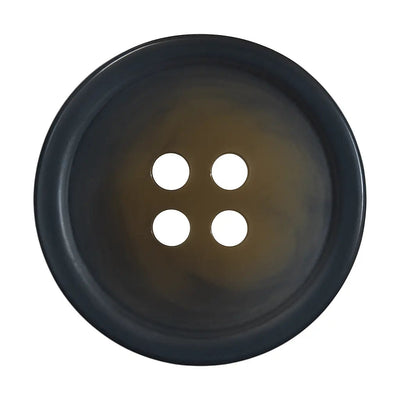
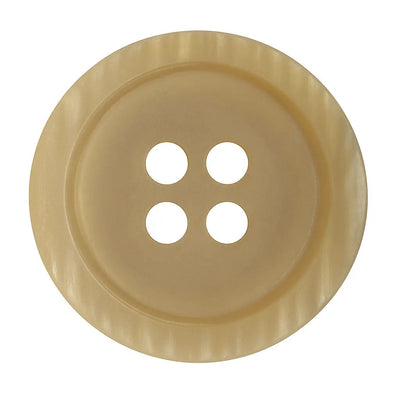
Are horn buttons ethical? Small and mid-sized brands hear this question from customers more and more often: "Was an animal killed for this button?", "Is horn a sustainable material?", "Can I call this garment ethical?". The answers are not black and white, but they are clear once you know where the raw material comes from and how to describe it. This article gathers the facts, the typical misleading claims and the questions to put to your supplier.
The short answer
Horn buttons are mostly made from the horns of water buffalo and cattle raised for meat and milk. The animals are not bred or slaughtered for their horns; horn is a by-product that would otherwise be thrown away. In that sense, horn buttons make use of waste. But horn is not a vegan material, and how ethical it is depends on farming conditions that can rarely be traced all the way back.
 Set of horn buttons made of natural buffalo horn ECOP 14610 – Black with leather accessory
 Set of natural wood horn toggles with cord CQT 1038 – Black
 Brown corozo buttons CB5001 with 4 holes
Where the horn comes from
Horn is made of keratin, the same protein as fingernails and hair, growing around a bony core. After slaughter the horn sheath is separated from the core, cleaned and sold to processors. The main sources are:
- Water buffalo: kept in large numbers across South and Southeast Asia for milk, meat and draught work. The horn is dark and dense and supplies most horn buttons.
- Cattle: pale, honey to cream horn with gradients; less common for buttons.
- Sheep and goats: used less often, mainly for handles and small items.
The horn is cut into plates, softened with heat and flattened in a press. Blanks are then cut out, turned, drilled and polished.
Careful: horn is not "naturally shed"
Marketing copy sometimes claims horn is "naturally shed" or "collected without harm to the animal". That confuses horn with deer antlers, which are bone and are dropped and regrown every year. Buffalo and cattle horns are never shed; they grow throughout the animal's life. So almost all button horn comes from slaughtered animals. If a supplier promises you "shed" buffalo horn, ask them to explain.
Protected species and CITES
Domestic cattle and domesticated water buffalo are not listed under the Convention on International Trade in Endangered Species (CITES). Rhino horn, ivory and the horns of some wild hoofed species, however, are tightly regulated or banned. In practice: accept only horn with a clearly stated species and steer clear of "exotic horn" offers without paperwork. In the EU, animal by-products, including unprocessed horn, fall under Regulation (EC) No 1069/2009; this mainly concerns imports of raw material rather than finished buttons.
Arguments for and against
| For | Against |
|---|---|
| uses a by-product that would otherwise be waste | not vegan; tied to livestock farming |
| plastic-free and biodegradable | animal welfare conditions are usually untraceable |
| very durable; the button outlives the garment | some buttons are bleached, dyed or lacquered, which reduces how "natural" they are |
| every button is unique | shipping from Asia and labour-intensive processing |
How to communicate honestly
The safest wording is specific wording. State the species, the origin if you know it, and that the material is a by-product. Avoid sweeping labels like "ethical", "cruelty-free" or "zero impact".
Good: "Natural water buffalo horn buttons, a by-product of the meat industry. Every button has a unique pattern."
Avoid: "Ethical buttons made from naturally shed horn, with no harm to animals."
The EU Directive on empowering consumers for the green transition restricts generic environmental claims that cannot be substantiated, so the more specific you are, the better protected your brand is.
Horn and the circular economy: what is realistic
Horn is often held up as an example of the circular economy, and there is truth in that: a material that would otherwise go to landfill or into fertiliser becomes an object that lasts for decades. A horn button can be taken off a worn-out garment and sewn onto a new one, and at the end of its life it breaks down without leaving microplastics behind.
The realistic picture also includes processing. The plates are softened with heat, and the buttons are tumble-polished for hours. Some are dyed, bleached or lacquered, and lacquer is not biodegradable. If you want to talk about biodegradability, make sure the button is untreated or at least free of a plastic coating.
Scale matters too. Horn is a finite resource: you cannot simply produce more of it when demand rises, as you can with resin. So for large runs, price and availability fluctuate more than with synthetic materials, and demand for lighter, uniform buttons leads to more rejects. The wider the tone range you accept, the less waste your order creates.
Checklist of questions for your supplier
- Which animal is the horn from: buffalo, cattle or something else?
- Which country does the raw material come from, and where is it processed?
- Can the supplier confirm in writing that the horn is a by-product?
- Is the horn dyed, bleached or lacquered? With what?
- Is there a REACH compliance statement, for example covering dyes and lacquers?
- How much natural colour variation is there, and how is the batch sorted?
Alternatives for vegan collections
If your brand is vegan, or you simply want to sidestep the question, several materials give a similar look. Corozo buttons are plant-based, warm to the touch and softly matte, and their brown and black shades sit close to horn. Polyester buttons with a horn effect imitate the streaks and translucency and can be coloured to an exact shade. You will find more comparisons in our button articles.
The Bul-tex catalogue includes the ECOP 14610 toggle set in natural buffalo horn with a leather accessory, the classic fastening for duffle coats and outerwear, plus the CQT 1038 version in natural wood with cord. For other horn items or a production order, contact us and we will check the options.