Labels for bags and backpacks are often the only place your brand is visible from the outside, so they need to look good after years of wear, rain and shoulder rub. Bags follow their own logic: materials are heavier, seams carry more load, and there is often nowhere obvious to hide a care label. This guide covers textile labels for bags – woven and canvas – where to place them, how to attach them to canvas, denim and nylon, and when it makes sense to pair them with metal hardware.
Which label for which bag
| Bag type | Suitable label | Why |
|---|---|---|
| Cotton tote | Printed canvas or woven label in the side seam | Natural look, soft, easy to catch in a seam |
| Canvas or waxed bag | Woven label outside, sewn on four sides; metal accent | Withstands abrasion, underlines the craft look |
| Nylon/polyester backpack | Woven label or flag in the seam; satin info label inside | Synthetics take stitching well but not heat |
| Leather or faux leather | Metal label or leather patch; woven label in the lining only | Textile outside clashes with leather |
| Cosmetic pouch | Small flag label in the zip seam | Visible without taking up space |
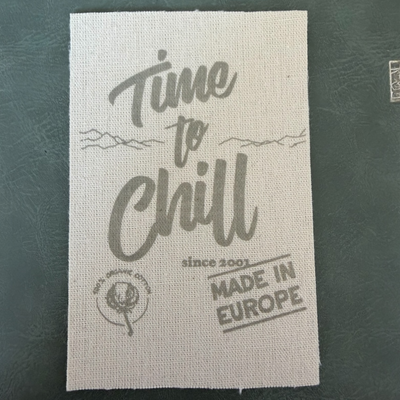
 Printed canvas label LBL 0070 10.5 x 7 cm – with grey print, soft premium design, with logo
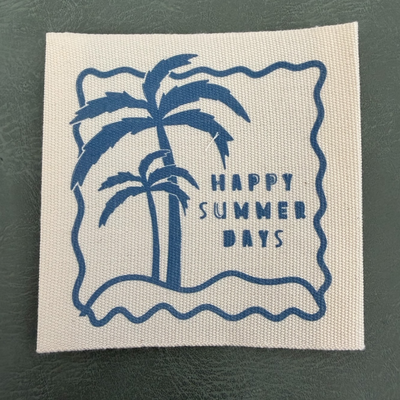
 Printed canvas label LBL 0068 6 x 6 cm – with blue print, soft premium design, with logo
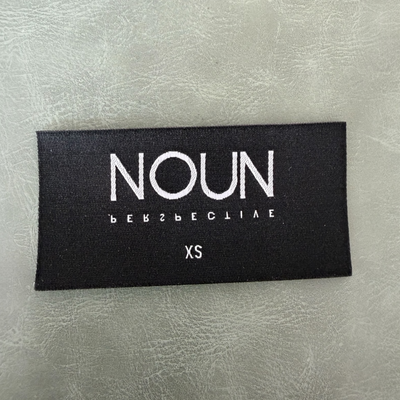
 Jacquard woven label LBL 0029 10 x 9 cm – soft gold style, premium design, with logo
Where to place the label
Outside – for the brand
- Front panel – a woven or canvas label sewn on all four sides, in the lower or upper third. The classic choice for outdoor and city backpacks.
- Flag in a seam – a slim label folded in half and caught in the side seam. No extra stitching on the face, and the cheapest option.
- Backpack lid – highly visible, but this is where labels rub most; choose a dense woven label, not print.
Inside – for the information
In the lining or the seam of an inner pocket, add a label with materials, cleaning instructions and maker details. Even where composition labelling is not mandatory for a particular bag, buyers want to know how to clean it.
How to sew a label onto heavy material
- Position it before assembly. Sew the label onto the panel while it is still flat. Once the bag is assembled, getting it under the machine is almost impossible.
- Choose the needle. For canvas and denim, a 100/16 to 110/18 heavy-duty needle; for 600D–1000D nylon, a sharp 90/14 to 100/16 so you pierce rather than tear the yarns.
- Choose the thread. Strong polyester thread – bags generally use heavier thread than garments. Match it to the label if you do not want the stitching to show; see our threads collection.
- Sew all four sides. Start at a corner, stitch 1.5–2 mm from the edge and pivot with the needle down. Lengthen the stitch to 3–3.5 mm – on heavy fabric a short stitch perforates and weakens the cloth.
- Secure the ends. Backtack two or three stitches or tie the threads off inside; never rely on a single point.
- Back thin fabrics. On thin nylon, put a piece of reinforcing fabric behind so the material does not pucker around the label.
Tip: do not iron-on labels onto nylon or polyester. The heat the adhesive needs can distort the fabric or leave a shiny mark on synthetics, and on a bag carried full, the glue gives way at the corners first.
Pairing with metal hardware
Bags can carry more metal than garments, and brands make the most of it:
- Woven label + rivets. A front-panel woven label can be reinforced with two decorative rivets in the top corners – it creates a workwear, denim-like look and stops the label lifting.
- Woven label + metal plate. A small metal label with a laser-engraved logo next to the woven label is a premium touch. We cover metal labels on bags in a separate article in our labels section.
- Canvas label + eyelets. On drawstring bags and totes, place the label near the metal eyelets in the same metal finish so the details read as a system.
- Leather patch with rivets. The classic for canvas backpacks – the leather patch is fixed with rivets through punched holes. Leather labels are not a stock item for us; contact us about them.
Durability: what to watch for
- UV. Backpacks spend hours in the sun. Polyester threads in a woven label hold their colour better than cotton.
- Water. On waterproof bags, every seam through the front panel is a potential leak. Tape the seams inside, or use a flag label in a seam instead of stitching through the face.
- Abrasion. A label on the back panel rubs against clothing; print wears off there quickly, woven labels do not.
- Washing. If the bag is meant to be machine-washed (cotton totes), check that the canvas and print handle the temperature on the care instructions.
Composition labelling on bags
Regulation (EU) 1007/2011 applies to textile products, and its annexes contain exemptions and special rules for certain items, including some textile travel goods and accessories. If you are unsure whether your bag falls within scope, the simplest answer is to add a composition and care label voluntarily – it costs little and answers the buyer's questions.
FAQ
What label size suits a backpack?
For a front panel, labels around 6–10 cm long are typical; for a seam flag, slim labels 1.5–2.5 cm wide, folded in half.
Canvas or jacquard for a bag?
Canvas gives a natural, handmade look; jacquard is more detailed and more abrasion-resistant. For a backpack lid, choose jacquard.
Labels and trims from Bul-tex
In our labels collection you will find LBL woven jacquard labels, printed canvas labels and E-series metal labels for laser branding, and in accessories there is bag hardware. Bul-tex makes labels to the customer's design; for bag labels in a special size, contact us through the contact page.