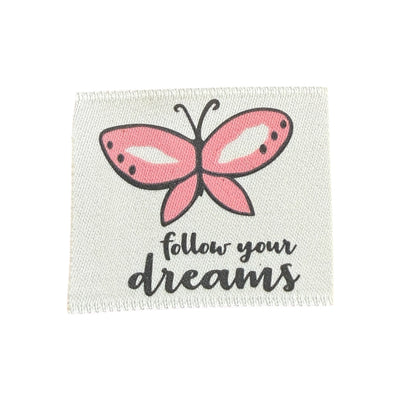
Plush toy label requirements look like a small detail, yet the sewn-in label is where toy safety rules, traceability and care instructions all meet. For handmade toy makers, small studios and brands adding soft toys to a collection, the rules are often unclear – not least because they differ from the rules for clothing. This article explains what the marking must include, how textile gifts differ, and how to choose a label that is durable and safe for children.
Toy or textile product: the first question
Regulation (EU) 1007/2011 on textile fibre names and labelling covers products with at least 80% textile fibres by weight, but Annex V explicitly lists toys among the products for which fibre composition labelling is not mandatory. Toys follow the toy safety rules instead.
- A teddy bear, bunny or rag doll – a toy. The core requirements come from the Toy Safety Directive 2009/48/EC.
- An embroidered cushion, a tote bag, a gift scarf – a textile product. A composition label under 1007/2011 is required.
- Borderline cases (an animal-shaped cushion meant for children) – intended use decides. If the product is designed or intended for play by children under 14, it is a toy.
 Woven label 6 cm x 6 cm – logo printing
 Woven label 4.5 cm x 3.5 cm - logo printing
 Satin label 14 cm x 5 cm - satin print
What the toy marking must include
Under the toy safety rules, the marking includes:
- CE marking – the manufacturer declares conformity after assessing safety, usually through testing to the EN 71 series of standards.
- Name, registered trade name or trade mark of the manufacturer.
- A contact address – a postal address where the manufacturer can be reached.
- A type, batch or serial number to identify the toy.
- Warnings in a language easily understood by consumers in the country of sale.
Some of this can sit on the packaging or hang tag, but the sewn-in label stays with the toy after the packaging is thrown away. It makes sense to keep the essentials – brand, batch, CE, care – on the sewn label.
Note: if a toy is not suitable for children under 36 months (because of small parts, for example), a specific age-warning symbol with an indication of the hazard is used. Plush toys intended for babies must be safe for that age, not carry a warning.
The EN 71 standards in brief
- EN 71-1 – mechanical and physical properties: seam strength, detachable small parts, long cords.
- EN 71-2 – flammability.
- EN 71-3 – migration of certain elements from materials.
The label is part of the toy and must comply too: it should not tear off easily, should have no sharp edges and must not contain restricted substances.
Which label is safe for children
| Requirement | Why | Practical solution |
|---|---|---|
| Soft material and soft edge | Children cuddle the toy and hold it to their face | Satin label with ultrasonic cut, or a folded label |
| Secure attachment | A torn-off label is a small object | Caught in a structural seam with a double straight stitch |
| No metal or hard parts | A risk for under-threes | No metal plates, eyelets or plastic seals |
| Short free end | A long ribbon can twist | A flag label sticking out 2–4 cm from the seam |
| Safe inks | Children suck on fabric | Inks free of phthalates and restricted azo dyes; ask for a declaration |
Metal labels, great on jackets and bags, are not suitable for toys for small children. Choose a textile label.
Where to sew it
The classic spot is a side or bottom seam of the body – the label is caught in the seam during assembly and sticks out like a flag. It is firmly anchored, out of the way and easy to find. Avoid the hand-closed seam (the stuffing opening), as hand stitching is weaker.
Care instructions
They are not legally mandatory for toys, but parents look for them. There are usually three options: machine wash at 30 °C in a mesh bag, hand wash, or surface clean only. The choice depends on the filling – polyester fibrefill tolerates washing, while natural fillings or built-in mechanisms usually do not. Use ISO 3758 symbols and test the actual toy.
Sample label content
- Front: brand logo, CE.
- Back: "Batch 2026-10/03", manufacturer name and address, care symbols.
- On the hang tag: age guidance, warnings, more detail, a QR code to your website.
Textile gifts: what is different
If you also make textile gifts – cushions, pouches, towels, scarves – textile labelling applies to them. Composition must be given using the regulation's fibre names with percentages, in the local language, on a durable label. Care symbols are strongly recommended. No CE mark goes on them, since they fall outside the toy rules, but the general product safety requirements and the duty to identify who places the product on the market still apply.
What is coming
The new Toy Safety Regulation (EU) 2025/2509 replaces the directive and will apply in full from 1 August 2030. It brings stricter chemical requirements and a digital product passport for every toy, accessed through a data carrier such as a QR code. Small makers have time, but it is wise to start keeping batch records and technical documentation now.
FAQ
Do the rules apply to handmade toys sold online?
Yes. Whoever places a toy on the market under their own name is its manufacturer under the rules – whatever the run size.
Does fabric composition have to be on the label?
For toys it is not required under 1007/2011, but it helps parents and people with allergies. For textile gifts that are not toys, it is mandatory.
What labels does Bul-tex offer?
You will find satin and woven labels in our labels collection; a label to your own design can be ordered through our contact page. For choosing other trims, see our accessories section.