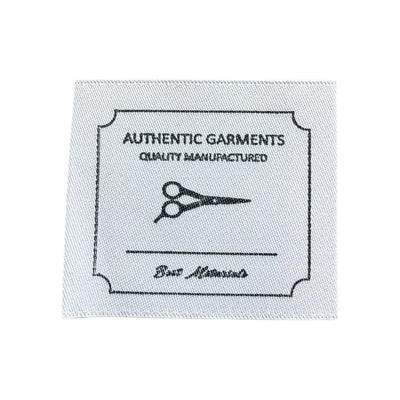
Size labels for clothing are the smallest labels in a garment, yet the ones people look at most. Shoppers check them in store, in the wardrobe and when returning an online order. For a brand they are also a production decision: how many separate labels to order, in what material, how to attach them and which sizes to print. This buyer's guide covers the types of size label, the materials, and the European standard EN 13402, which offers a clearer way of sizing than the familiar S, M and L.
Types of size label
1. A separate small label
The most common solution: a little tab, usually around 10 to 15 mm wide, folded in half and sewn under the brand label at the neck or into a side seam. The advantage is flexibility. The same brand label works for every size, and size tabs are ordered separately for each size.
2. Size woven into the brand label
The size is part of the main label design. It looks cleaner, but needs a separate design per size, and therefore a separate minimum order per size. It suits larger runs with only a few sizes.
3. Size on the composition and care label
The size is printed on the satin composition label in the side seam. An economical option, especially for jersey and underwear, where the neck label is often replaced by a print.
4. Printed directly on the fabric
A tagless alternative using heat transfer or screen print at the neck. It never scratches, but not every fabric accepts it, and with some methods the print fades.
 Jacquard woven label LBL 0059 5 x 3.5 cm – white background with blue letters, soft premium design, with logo
 Square woven label 5 x 5 cm PLBL 0001 – custom design production
 Jacquard woven label LBL 0025 6 x 4.5 cm – soft premium design, customized with logo
Materials: what to choose
| Material | Pros | Cons | Best for |
|---|---|---|---|
| Woven (damask) | Durable, legible after hundreds of washes, premium look | Separate design and MOQ per size | Jackets, trousers, outerwear, denim |
| Printed satin | Soft, smooth, easy to change text | Print can wear with harsh washing | Underwear, childrenswear, shirts |
| Printed cotton tape or canvas | Natural look, soft hand | Edges fray unless folded | Eco brands, handmade goods |
| Print on fabric | No label, no itch | Fabric-dependent, limited design | T-shirts, sportswear |
Our catalogue includes woven, satin and printed labels, including small formats, which Bul-tex manufactures to customer designs.
EN 13402 in brief
EN 13402 is the European standard for size designation of clothes. Its core idea is simple: instead of arbitrary letters or numbers, size is expressed through the body measurements of the person the garment is meant for, in centimetres. Body measurements, not garment measurements.
Primary and secondary dimensions
The standard specifies which measurement is primary for each garment type:
- men's jackets and tops: chest girth;
- women's dresses and tops: bust girth;
- trousers: waist girth (plus hip for women's styles), with inside leg as a secondary dimension;
- childrenswear: height;
- bras: underbust and bust girth.
The pictogram
EN 13402 describes a language-neutral pictogram: a schematic human figure with the relevant girths marked in centimetres. The label reads the same in Germany, Italy or Bulgaria, with no translation needed.
Example: an EN 13402 size label on a men's jacket shows the figure with chest 100 and height 182, rather than "52" or "L". The customer knows exactly what body the garment fits.
Letter sizes
The standard does not ban XS, S, M, L and XL. It links them to ranges of chest or hip girth, so you can print "M" with the matching centimetres underneath.
Current status
Parts 1 and 2 of EN 13402 (terms and primary dimensions) have been replaced by the international standards ISO 8559-1:2020 and ISO 8559-2:2020. The body-measurement-in-centimetres logic is unchanged; it now lives within ISO.
Which system suits your collection
- Selling mainly online? A letter size plus centimetres (chest or waist) noticeably cuts returns.
- Tailoring or classic menswear? Numeric sizes (46, 48, 50) are what suit buyers expect, but add centimetres to your size chart.
- Childrenswear? Use height in centimetres (86, 92, 98 and so on). More on that in our other articles about labels.
- Exporting to several countries? The EN 13402 pictogram or dual marking (EU/UK/US) saves translating.
Practical ordering tips
- Calculate quantities by size curve, not evenly: M and L usually sell most.
- Order 5 to 10% extra to cover spoilage and rework.
- Use a different colour per size if tabs are inserted by hand. It reduces mix-ups on the factory floor.
- Sew with thread matched to the label; you will find suitable options in our threads collection.
- Check seam allowance: the size tab should sit at least about 5 mm into the seam so it cannot pull out.
Frequently asked questions
Is a size label mandatory?
In the EU, size is not part of the mandatory labelling under Regulation 1007/2011, which covers fibre composition. In practice, though, a garment without a size is hard to sell and harder to return, so every brand includes one.
Can I combine letter and numeric sizes?
Yes. "M / 48" or "M / chest 96-100 cm" is common and helps buyers from different countries. Just make sure the size chart on your website uses the same values.
How big should a size label be?
Folded in half, a typical size tab is about 10 to 15 mm wide and 15 to 20 mm tall in its visible part. You only need more room if you add centimetres or a pictogram.
Why do some brands' website sizes and label sizes not match?
Usually because the size chart describes garment measurements while the label describes the size category. State clearly in your chart whether the figures are body or garment measurements.
Preparing size labels for a new collection? Contact us and we will help with material, format and quantities per size.