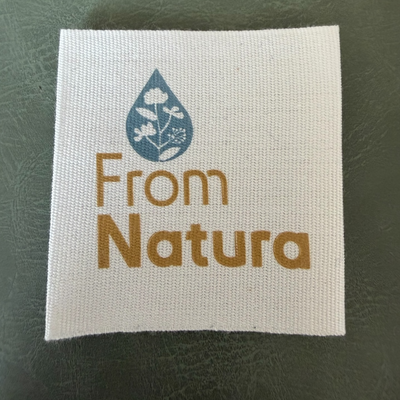
Organic cotton labels are the natural choice for brands that make clothes from organic cotton and want every detail to tell the same story. Put a GOTS-certified organic cotton T-shirt on the shelf with a shiny polyester label in the neck, and an attentive customer will notice the mismatch. But cotton labels have limits of their own: less detail, more shrinkage, a narrower colour range. This article helps you decide when organic cotton is the right call, when another material makes more sense, and what GOTS certification actually guarantees.
What GOTS is
GOTS (Global Organic Textile Standard) is the leading international standard for textiles made from organic fibres. Unlike narrower standards, it covers the whole chain – from growing cotton without synthetic pesticides or GMOs, through spinning, weaving and dyeing, to sewing and labelling. It also restricts chemicals and dyes, sets wastewater treatment requirements and includes social criteria.
The standard has two label grades for finished products:
- "organic" – at least 95% certified organic fibres;
- "made with organic" – at least 70% certified organic fibres.
Does the label itself have to be GOTS?
Not necessarily. GOTS has separate rules for accessories – labels, threads, elastics, buttons. They don't always have to be organic material, but they must meet the standard's chemical and substance requirements. Confirm the exact conditions for your certification with your certification body. Many brands, though, choose organic cotton for the label not because of the rule but for a consistent message – customers who pay more for organic tend to read every detail.
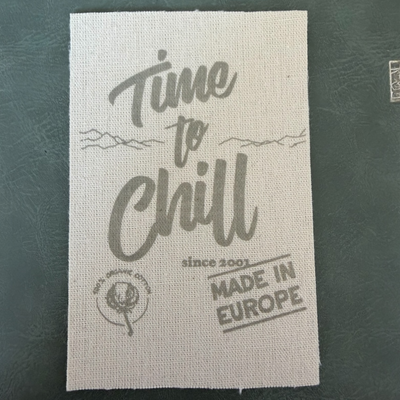
 Printed canvas label LBL 0070 10.5 x 7 cm – with grey print, soft premium design, with logo
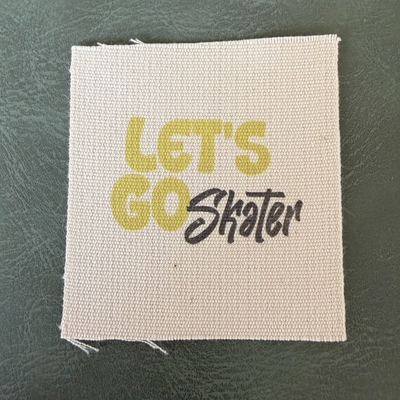
 Printed canvas label LBL 0075 4 x 3 cm – brown base with color print, soft premium design, with logo, MOQ 1000 pcs
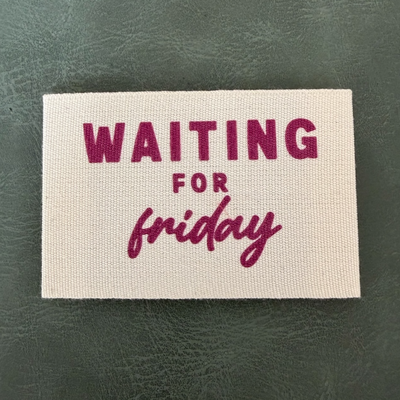
 Printed canvas label LBL 0065 6.5 x 4 cm – with purple lettering, soft premium design, with logo
Pros and cons of cotton labels
| Pros | Cons |
|---|---|
| Natural, matte look that suits organic and minimalist collections | Less fine detail when woven – cotton yarn is thicker and fuzzier |
| Soft and breathable – pleasant against skin | Shrinkage on first wash unless pre-treated |
| Consistent with an organic brand's positioning | Narrower colour range, dark shades fade sooner |
| Biodegradable material | Usually pricier and slower to source than polyester |
| Excellent for printing with water-based inks | Edges can fray unless folded or sealed |
Woven or printed cotton label?
A woven cotton label has a characteristic, slightly textured surface and a crafted feel. It suits simple logos with clear shapes – a brand name in a confident typeface, a monogram. Fine lines and small text get lost more easily than on polyester damask.
A printed cotton label – on cotton tape or canvas – gives more freedom for detail and is especially soft. It uses water-based inks; for organic collections, inks certified to OEKO-TEX or approved under GOTS are preferred. Printing also suits composition and care labels, which carry a lot of text.
Tip: if you want a natural look but need finer detail, consider a printed canvas label on a beige or ecru base – it delivers the "organic" aesthetic and handles small text better.
Alternatives to organic cotton
- Recycled polyester (GRS) – finer detail and greater durability, with documented recycled content.
- Tencel (lyocell) – a regenerated cellulose fibre from wood pulp, smooth and soft, with finer detail than cotton.
- Bamboo viscose – very soft, but production processes vary; check certifications.
- Linen and hemp tapes – for brands with a deliberately raw, natural aesthetic.
- Recycled board swing tags – for outward communication, paired with a minimal inside label.
When an organic cotton label is the right choice
- The garment fabric is organic cotton and you want full consistency.
- Your logo is simple and can handle a coarser resolution.
- The clothes are for babies or sensitive skin, and softness comes first.
- Your brand sits in the natural, handmade or minimalist segment.
When another material is better
- Your logo has fine detail or many colours.
- The garments are washed often at high temperatures and the label needs to stay vivid for years.
- You need a fast turnaround and a large run at a competitive price.
Example: a small brand with an organic collection
Picture a babywear brand making bodysuits and leggings from GOTS-certified cotton. The logo is simple – a name in a solid sans-serif and a small icon. The set-up could look like this:
- Main label – printed on soft ecru tape or canvas with water-based inks, sewn into the side seam rather than the back neck so it doesn’t irritate skin.
- Care label – a separate soft printed label stating "100% organic cotton" with washing instructions; the word "organic" is used only if the fabric has a valid certificate.
- Swing tag – recycled board, explaining the standard and quoting the fabric supplier’s certificate number where the certification body allows it.
- Buttons – natural materials with no metal touching skin, or snaps marked nickel free.
That way every component supports the same message, without making claims that can’t be backed up.
Keeping a cotton label looking good
- Sew it on with cotton or polyester thread in a matching shade.
- Allow for seam allowance and folded edges so it doesn't fray.
- If the garment isn't pre-washed, test how label and fabric shrink together.
- On the care label, recommend washing at 30–40 °C – it protects both fabric and label.
Labels and trims for natural collections
In our catalogue you'll find printed canvas and woven labels in natural shades such as ecru and brown, made to customers' designs. Organic collections also pair well with natural buttons – coconut, corozo and wood. If you need a label specifically in certified organic cotton, describe your requirements in an enquiry and we'll check what's possible for your project. For more on sustainable materials, see our labels blog.