Labels for hats, beanies and accessories are the smallest pieces of branding you will ever order, yet they are often the most visible. A knitted beanie is worn with its label front and centre on the cuff, a baseball cap shows its logo above the back strap, and a scarf or tote bag is recognised by the small woven flag in its seam. None of these products has a neck seam where you can hide a large label, so size, fold and placement have to be decided at the design stage. This guide walks through the most common accessories and gives concrete measurements that work in production.
Why accessories need a different label than garments
On a T-shirt or dress the label sits inside and its only job is to stay out of the way. On headwear the label is frequently on the outside and becomes part of the design. That changes three things:
- Size. A beanie cuff is usually 5–8 cm deep, and the back of a cap above the strap is roughly 3–4 cm high. The label has to fit with at least 5 mm of clear space on every side.
- Both faces. An outside label on a turn-up cuff is also seen from the reverse side when the cuff is folded. Woven, folded labels look better here than prints on single-sided tape.
- Stretch. Knitwear stretches, labels do not. A wide label stitched on all four sides kills the elasticity of the cuff and causes puckering.
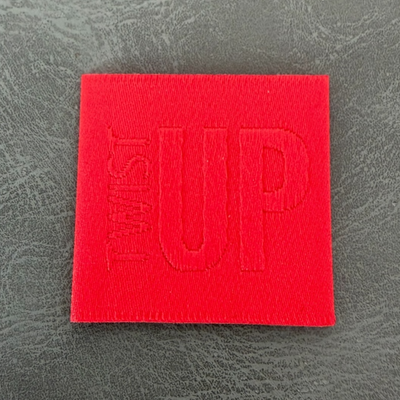
 Jacquard woven label LBL 0034 3 x 3 cm – embossed letters, soft premium design, with logo
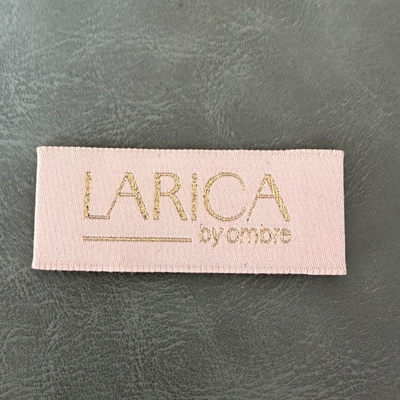
 Jacquard woven label LBL 0060 5 x 2 cm – ecru base with gold lettering, soft premium design, with logo
 Jacquard woven label LBL 0061 5 x 2.5 cm – purple base with gold letters, soft premium design, with logo
Sizes and folds by accessory
| Product | Position | Typical size | Best fold |
|---|---|---|---|
| Knitted beanie | Front of the cuff | 4–6 × 2–3 cm | End fold, or straight cut with heat-sealed edges |
| Bobble hat | Flag in the cuff seam | 1.5–2 × 3–5 cm folded | Centre (loop) fold |
| Baseball cap | Sweatband inside / above the back strap | 5–7 × 1.5–2.5 cm | End fold or straight |
| Scarf | One end, in the hem | 2–3 × 4–6 cm folded | Centre fold as a flag |
| Gloves | Inside the cuff | 2–3 × 1–1.5 cm | Straight or centre fold |
| Fabric bag | Outside on a seam or pocket | 5–8 × 2–4 cm | End fold or book cover fold |
An end fold gives a clean, professional look for square and vertical designs because both ends tuck under the stitching and no loose threads show. A book cover fold is useful when the label is seen from outside and you want a solid, slightly thicker look, almost like a small patch. If you are unsure which fold to choose, our label articles cover the differences in detail.
Beanies: how not to ruin the cuff
The classic beanie mistake is stitching the label on all four sides through one layer of the cuff. When the cuff is turned up, it contracts and the label ripples. Better options are:
- Stitch only the two short ends. An end-fold label is tacked on the left and right. The knit in between keeps its stretch.
- Seam flag. A centre-fold label is caught in the side seam when the hat is closed. It does not affect elasticity and costs almost nothing to apply.
- Small metal plate. A metal label of about 1.5–2 × 0.5 cm attached with prongs through the knit barely affects stretch, looks premium and survives washing.
Tip: before bulk sewing, stretch the cuff to the maximum it will take when worn and check whether the label distorts. If it does, shorten the stitched area or switch to a seam flag.
Caps: inside and outside labels
A cap usually carries two labels. The inner one, with brand, size and care, is sewn to the sweatband or the back seam. It has to be soft, so satin or fine-woven labels with heat-cut edges that will not scratch the forehead are preferred. The outer label is pure branding: a small woven side flag, a metal plate, or a woven label above the strap. On caps with curved panels, avoid labels longer than 6–7 cm because the curve lifts their ends.
Scarves, gloves and bags
Scarves are seen from both sides, which makes double-sided jacquard labels the best choice: the logo reads correctly front and back. For thin viscose or silk scarves choose a lighter base such as taffeta or satin so the end does not stiffen or crease. Glove labels are small and go inside the cuff; sizes are often under 3 cm, so keep lettering at least 2 mm high to stay legible.
Fabric bags wear their label outside as a design element. Larger end-fold woven labels sewn onto a pocket or side seam work well, as do metal plates attached with prongs or rivets.
Mandatory information on accessories
Hats, scarves and gloves are textile products, so in the EU they fall under Regulation (EU) 1007/2011 and must state their fibre composition. Because the items are small, the practical answer is a separate soft composition and care label inside and the brand label outside. Annex V of the regulation lists products that do not require a composition label (for example textile travel goods and watch straps), but hats and scarves are not on that list. When selling in a given country, consumer information also has to be in that country's language.
Pre-order checklist
- Measure the real stitching area and subtract 5 mm of margin on each side.
- Decide whether the label is seen from outside and inside; if so, choose woven or double-sided.
- Match the fold to the attachment: end fold for tacking two ends, centre fold for a seam flag.
- Check minimum letter height; on small labels keep it at 2–2.5 mm or more.
- Keep the composition and care label separate from the branding label.
- Order a sample and sew it onto a prototype before running the batch.
Bul-tex manufactures woven and printed labels and stocks ready designs in many sizes in the labels collection. For headwear and accessories they are often combined with metal accessories and ribbons for flags and hems. If you need a label with your logo in an exact size for a cuff or cap, get in touch with dimensions and a sketch and we will suggest the right base and fold. More ideas are in our label articles.