

A hem tag or flag label is the smallest way to make your brand visible from the outside. The neck label stays hidden, but a little flag in the side seam of a T-shirt, on a sleeve or on a pocket shows every time the garment is worn: on the street, in photos, on social media. This guide covers exactly where these labels go, which sizes and folds work best, and how different styles use them, from streetwear to childrenswear.
Flag labels and hem tags defined
A flag label is a small label folded in half and inserted into a seam so that it sticks out like a little flag. A hem tag is a broader term for any small exterior label sewn into a side seam or onto a sleeve, leg or waistband hem. In practice, the two terms are often used interchangeably.
What they share: they are visible from the outside and act as a discreet but constant brand mark.
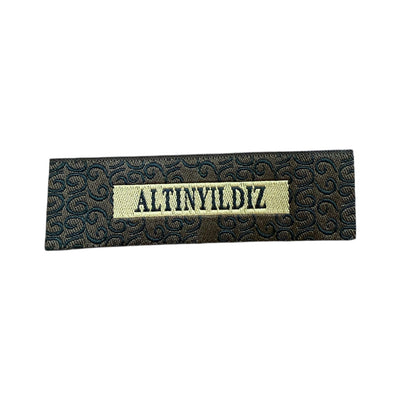
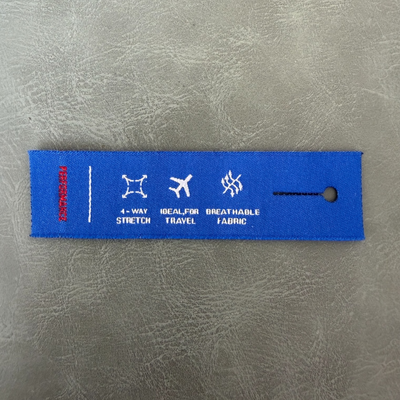
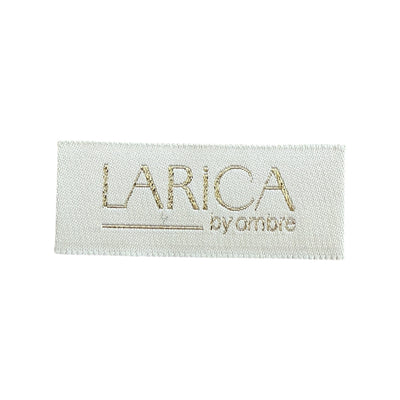
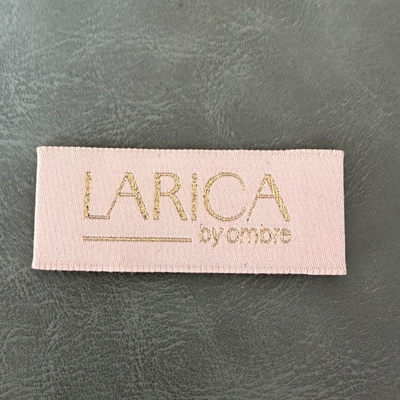
 Woven label 8.5 cm x 1.7 cm - clothing labels
 Jacquard woven label LBL 0031 8.5 x 1.7 cm – multicolor style, soft premium design, with logo
 Woven label 7 cm x 2 cm - logo branding for clothing
Where to place them
| Position | Typical for | Note |
|---|---|---|
| Side seam, bottom left, just above the hem | T-shirts, sweatshirts, skirts | The most practical spot: visible but understated, usually about 5 to 8 cm above the bottom edge |
| Sleeve hem | T-shirts, shirts, blouses | A flat fold without extra bulk works well |
| Pocket, side or top edge | Jeans, shirts, workwear | A denim classic |
| Waistband | Trousers, skirts, shorts | In the waistband seam, near the button or back pocket |
| Hood or drawcord | Sweatshirts, jackets | A flag in the hood seam is a streetwear signature |
Tip: keep the position consistent across your collection. Once customers get used to seeing the flag in the same place, it becomes a recognisable mark even before anyone reads the name.
Sizes: small is better
Exterior labels need to be small to read as a detail rather than an advert. As a rough guide:
- Side seam flag: visible part around 10 to 20 mm wide, sticking out 10 to 15 mm from the seam. Unfolded, the label is usually 30 to 50 mm long.
- Sleeve label sewn flat: about 30 to 50 mm long and 10 to 15 mm high.
- Pocket or waistband label: about 40 to 70 mm long and 15 to 20 mm high.
Labels this small need precise weaving. If your logo has thin lines or small text, consider HD weaving or a simplified logo.
Folds for exterior labels
Centre fold (loop)
The label is folded in half and both ends go into the seam. This is the classic flag. Both sides show, so the logo can appear on the front and the back.
Manhattan fold
Similar to a centre fold but with an extra fold that gives a soft, rounded look without extra bulk. It suits sleeve hems and lightweight jersey.
Book cover fold
Both ends are turned under, leaving neat folded edges to stitch along. The label is sewn flat onto a sleeve or pocket. It is bulkier than a centre fold but looks finished and highly visible.
End fold
The ends are folded under and the label is stitched flat on both sides. Common on pockets and waistbands.
For more on every fold type, see our other articles about labels.
Style examples
Streetwear
Contrasting colours, a bold logo, sometimes a neon accent. A flag in the side seam of a tee or sweatshirt is close to mandatory. Some brands use a different flag colour for each drop.
Denim
A label on the back pocket or in the waistband, often red, black or ecru. It pairs well with metal jeans buttons and rivets carrying the brand's logo.
Childrenswear
Soft colours, small sizes, a soft ultrasonic-cut edge. A flag a child can hold often becomes a "favourite detail". Important: the label must be securely sewn and free of hard edges.
Minimalist and eco brands
Ecru or natural base, a one-colour logo, sometimes just an initial. The exterior label replaces a bigger logo or print.
Common mistakes with exterior labels
- A flag that is too big. Beyond about 25 mm of visible length, the label starts to bend, flip over and look like it was left there by accident.
- A hard, hot-cut edge. It will not scratch skin from the outside, but it rubs against hands and other clothes. Ultrasonic cutting fixes that.
- Too little in the seam. If the ends go less than about 5 mm into the seam, the flag can be torn out with the first tug.
- Colour that bleeds. An exterior label sits against the face fabric, so a saturated red flag on a white tee must be colourfast.
- A different position on every style. You lose the recognisable-mark effect.
Ordering checklist
- Choose the position and record it on the style's tech sheet.
- Define the visible size and add the seam allowance (usually around 5 mm on each side that goes into the seam).
- Choose the fold to suit the position.
- Choose the material: woven damask for durability, satin for softness, canvas for a natural look.
- Choose the cut: ultrasonic for a soft edge.
- Request a sample and sew it onto the prototype before ordering the run.
Frequently asked questions
Can a flag label replace the composition label?
No. Fibre composition goes on a separate durable label, usually in the inside side seam. The flag is branding.
Can the label have a buttonhole?
Yes. Woven labels with a buttonhole are used as a decorative tab or sleeve mark, and our catalogue includes such styles.
Isn't it too small to notice?
That is exactly its strength. A discreet mark repeated on every garment is remembered better than a big logo that many shoppers avoid.
Browse the small woven labels in our catalogue: Bul-tex manufactures labels to customer designs. For flags with your logo, get in touch.