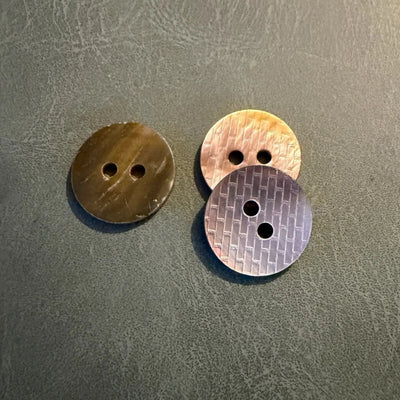
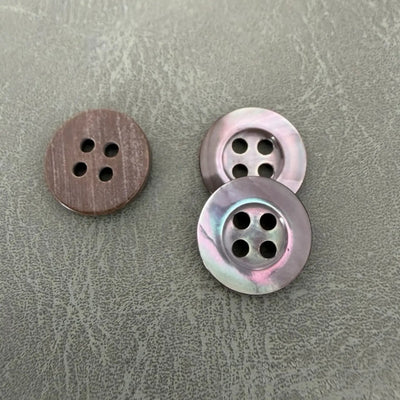
The history of buttons begins around 5,000 years ago with a small curved piece of shell found at Mohenjo-daro in the Indus Valley, and runs all the way to today's mother-of-pearl, corozo and custom metal buttons. The surprising part is that for most of that history the button did not fasten anything at all: it was an ornament and a status symbol. Here we trace its development stage by stage and show why the materials fashion is returning to today are in fact the oldest ones.
Stage 1: Ornament, not fastener (c. 2800–2600 BC)
The oldest known button was found at Mohenjo-daro, one of the cities of the Harappan civilisation in present-day Pakistan. It is made of curved shell, carved with decorative motifs and pierced with two holes so it could be sewn to a garment. Researchers believe it was ornamental. Similar finds in shell, bone and stone come from ancient China and the Middle East. The irony is that the first button in history was essentially a shell button, the same idea as today's trocas and agoya buttons.
 SHELL 09 SMOKE / GRAY – Trocas mother-of-pearl buttons with double thin rim, designer buttons for men's shirts
 SHELL 03 WHITE – Luxurious square Trocas mother-of-pearl shank buttons, designer for men's and women's clothing
 Wooden buttons PB9010
Stage 2: Antiquity, the age of the fibula
The Greeks and Romans fastened their clothing mainly with fibulae, metal brooch-pins, and with ties. Buttons and toggles passed through loops existed but were not the main solution. Classical dress was largely draped and did not need to close snugly to the body.
Stage 3: The buttonhole changes everything (13th century)
The functional button with a buttonhole appeared in Germany in the 13th century. It was a small technical revolution: a buttonhole lets a garment close tightly to the body and open again and again without damaging pins or ties. Fashion responded immediately. Fitted garments appeared, and rows of buttons on sleeves and fronts became a sign of wealth.
Stage 4: Medieval Europe, buttons everywhere (13th–14th century)
By the 13th and 14th centuries buttons were widespread across Europe. Close-fitting outer garments were fastened with dozens of small buttons in metal, bone or fabric. Button-makers' guilds grew influential, and some cities even passed sumptuary laws limiting the number and material of buttons by social rank.
Stage 5: Renaissance and Baroque, the button as jewellery (15th–17th century)
Aristocrats wore buttons of gold, silver, enamel and gemstones. A button was portable wealth that could be cut off and sold if needed. Alongside them, more affordable options developed: buttons in horn, bone, wood, and hand-worked thread buttons.
Stage 6: Industrialisation (18th–19th century)
Birmingham in England became the centre of stamped metal button production, putting buttons within reach of the middle class. In the 19th century the town of Muscatine, Iowa, built a huge industry around freshwater mussel shells from the Mississippi, the forerunners of today's river shell buttons. Towards the end of the century corozo won a large market too: the tagua nut, nicknamed "vegetable ivory", was imported in bulk from South America because it is hard, turns cleanly on a lathe and takes dye well.
Stage 7: The plastics era (20th century)
Bakelite, patented in 1907, and casein produced the first synthetic buttons. After the Second World War, plastics almost entirely displaced corozo: they were cheaper, more uniform and could be made in enormous runs. Polyester resin became the standard for shirt, coat and suit buttons, while metal snaps and rivets spread with workwear and denim. The zip took over some of the button's jobs but never replaced it. On shirts, jackets and coats the button remains irreplaceable.
Stage 8: Mass production and standard units
The industry settled on shared units: size is measured in lignes (1 ligne = 0.635 mm), and buttons are sold by the gross, 144 pieces. These conventions, inherited from the 19th century, still appear in every tech pack today. Shirt buttons are typically 16–18L (10–11.5 mm), while a jacket usually takes around 32L (20 mm) on the front and 24L (15 mm) on the cuffs.
Stage 9: The return of natural materials (21st century)
In recent years the button has once again become a detail that tells a story. Brands are seeking natural and renewable materials (shell, corozo, coconut and wood) for three reasons: sustainability, touch and perceived value. Corozo is returning to jackets and coats, shell is standard on premium shirts, and coconut and wood define linen and summer clothing. At the same time, metal logo buttons have become a branding tool. The circle closes: the first button was made of shell, and today natural buttons are the most sought-after in the premium segment.
Timeline at a glance
| Period | Milestone | Material |
|---|---|---|
| c. 2800–2600 BC | Ornamental button at Mohenjo-daro | Shell |
| Antiquity | Fibulae, ties, toggles | Bronze, bone |
| 13th century | Functional button and buttonhole in Germany | Metal, bone |
| 13th–14th century | Buttons spread across Europe | Metal, fabric |
| 15th–17th century | The button as jewellery | Gold, silver, enamel |
| 18th–19th century | Industrial production | Stamped metal, river shell, corozo |
| 20th century | Plastics and mass runs | Bakelite, casein, polyester |
| 21st century | Sustainable revival | Shell, corozo, coconut, wood |
What this means for a modern brand
History is more than trivia. It explains why certain materials signal quality: shell and corozo carry centuries of association with well-made clothing, while metal buttons recall uniforms and workwear. When you choose buttons for a collection, you are choosing that association as well.
- For a classic shirt: shirt buttons in mother-of-pearl or river shell.
- For jackets and coats: corozo buttons or polyester with a natural-look finish.
- For linen and summer clothing: coconut and wood.
- For denim and workwear: metal buttons and rivets.
You will find more practical guides to choosing buttons in our buttons section. If you want a button with a story for your own label, whether a natural material, a laser-engraved logo or a custom metal button, get in touch with Bul-tex.