Casein buttons, also known by the trade name galalith, are made from something you would hardly connect with fashion: milk. In the early 20th century this "milk plastic" was one of the most popular button materials in Europe: brightly coloured, easy to work and able to stand up to the iron. Today casein buttons are sought after by vintage collectors and are being discussed again as a bio-based material. Here is the history, the properties and the weaknesses of galalith, and what they mean for designers today.
How you make plastic from milk
Casein is the main protein in milk, about 80% of the protein in cow's milk. To make galalith, skimmed milk is treated with rennet or acid, and the casein curdles out. It is washed, dried and ground to a powder. The powder is then kneaded with water, plus pigments if needed, and pressed or extruded into sheets and rods.
At this point the material is still soft and sensitive to water. The crucial step is hardening with formaldehyde: sheets and rods are soaked in a formalin solution for weeks, and thick sections for months. Formaldehyde links the protein chains together, and the material becomes hard and horn-like. Only then are buttons cut and turned from the sheets, drilled and polished.
The name galalith comes from the Greek gala (milk) and lithos (stone): literally "milk stone".
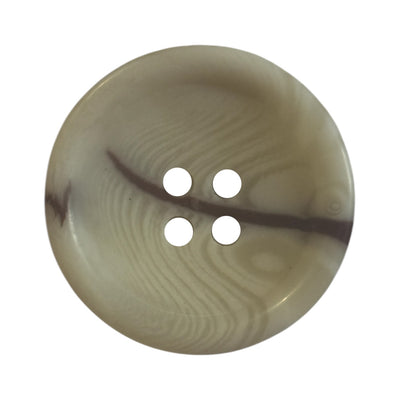
 Melange polyester buttons PG 265 Col 7 – shiny brown with a light pattern
 Polyester buttons PPB 0022
 Dark grey corozo buttons CB5001 with 4 holes
A short history
The material was developed in Germany at the end of the 19th century by the chemists Adolf Spitteler and Wilhelm Krische, and it was quickly adopted as a substitute for more expensive horn, bone and ivory. It also comes with a popular legend: a cat knocked a bottle of formaldehyde into its saucer of milk, and by morning there was a hard, horn-like mass. The story is almost certainly more anecdote than fact, but it explains the chemistry rather well.
Galalith was widely used for buttons from the early 1900s. Its peak came in the 1920s and 30s, the Art Deco era, when fashion wanted bright colours, geometric shapes and marbled effects. Casein buttons could be dyed any colour, from ivory to deep red, green and blue, and combined in multicoloured layers. Beyond buttons, galalith was made into combs, hair slides, fountain pens, jewellery and handles.
After World War II, casein gradually gave way. Synthetic plastics such as polyester and urea, and later others, could be cast and moulded far faster, needed no months of curing and did not depend on milk. Galalith survived in small quantities and in design history.
Strengths and weaknesses
| Strengths | Weaknesses |
|---|---|
| withstood iron heat better than other plastics of the 1920s and 30s | absorbs moisture: swells, warps and crazes |
| takes bright, saturated colours | not resistant to acids and alkalis |
| warm, horn-like feel | long production cycle of weeks to months |
| turns well on a lathe and polishes to a shine | cannot be melted and recast; machining only |
| made from a renewable raw material | formaldehyde hardening raises chemistry and safety questions |
Caring for vintage garments with casein buttons
If you own a vintage coat, cardigan or dress with galalith buttons, the main rule is simple: keep them away from water. Casein swells and warps when soaked and can develop a fine network of cracks once it dries.
- Prefer hand washing or spot cleaning, without soaking the area around the buttons.
- If the whole garment must be washed, remove the buttons and sew them back on afterwards.
- Avoid alkaline detergents and vinegar; acids and alkalis break the material down.
- Ironing: go around the button, not over it, even though casein copes with heat better than other early plastics.
- Storage: somewhere dry, without sudden changes in humidity.
- Cleaning the button itself: use a barely damp cloth, then dry it straight away.
Tip: if one vintage button is missing, do not hunt for an exact twin. It is more realistic to replace the whole set with a new, similar button. The garment will look coherent, and you can keep the originals.
A comeback as a bio-based material?
As the search for alternatives to oil-based plastics continues, casein is attracting attention again. The raw material is renewable and often a by-product of the dairy industry, and the material is biodegradable under the right conditions. There are two important caveats, though. First, traditional hardening requires formaldehyde, a substance that is strictly regulated in textiles. Second, casein is an animal product, so it is not vegan. That is why casein buttons are made only in small quantities today, and talk of a "new galalith" centres mainly on new hardening methods that use safer substances.
Modern alternatives
If you love the look of galalith but need buttons for production:
- Corozo: plant-based, vegan, with a similarly warm touch and the ability to take dye. See the Bul-tex corozo buttons in eleven colours.
- Polyester: for bright colours and marbled, layered Art Deco-style effects. Browse our polyester buttons.
- Urea: when heat and wash resistance matter. You will find it in our main button collection.
Casein buttons are not part of the Bul-tex range. If you are preparing a vintage or retro collection and want buttons with a similar look, get in touch and we will suggest the closest option from our materials. You will find more on button history and materials in our button articles.
Frequently asked questions
How can I tell if a button is casein?
Galalith buttons are heavier than modern polyester, warm to the touch and often come in saturated, slightly milky colours. When warmed, for instance by rubbing, some give off a faint smell reminiscent of burnt milk. Be careful with any test that could damage the button.
Are vintage casein buttons safe?
For wearing, yes, under normal use. Keep them away from small children and do not use them on new babywear.
Are galalith and Bakelite the same thing?
No. Bakelite is a phenol-formaldehyde resin and fully synthetic. Galalith is based on milk protein.