
Button quality inspection starts long before a garment reaches the customer – it starts the moment a carton of buttons lands in your workroom. A single button with a sharp edge inside a hole can cut through the thread after three washes, and a lot that is half a shade off becomes obvious the second those buttons are sewn next to each other down a coat front. This guide covers the most common button defects, how they are classified, how AQL sampling works and how even a small label can run a sensible goods-in check without a laboratory.
If you are specifically after pull-off strength or colour fastness testing, browse our other articles in the Manufacturing section. Here we concentrate on visual and dimensional defects and on the logic of sampling.
The three defect classes
In garment and accessory inspection, defects fall into three groups. The classification is not paperwork for its own sake – it decides how many faulty pieces you are prepared to accept in a lot.
- Critical defect – creates a safety risk for the wearer or breaks a legal requirement. Classic examples are sharp edges, burrs or cracks that could cut skin, and small parts that detach easily from children's wear. Sharp points and burrs are among the most common reasons products get recalled.
- Major defect – makes the item unsaleable or seriously impairs its function: a cracked button, misdrilled holes, a size outside tolerance, a clearly different colour.
- Minor defect – a deviation that does not affect function and is unlikely to cause a return: a light scratch on the back, a slight difference in gloss, a tiny speck in the material.
Standard practice in apparel is AQL 0 for critical defects, 2.5 for major and 4.0 for minor. Put simply: not one button with a sharp edge is acceptable, while cosmetic variation is tolerated at a small percentage.
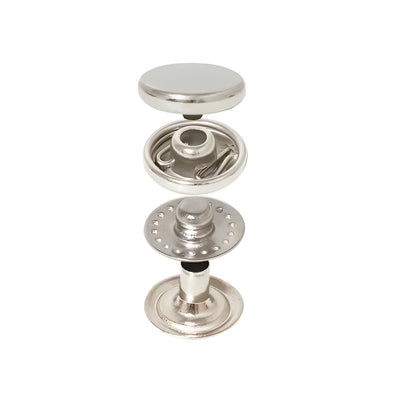
 Snap fasteners 0006 – mini, with a flat cap
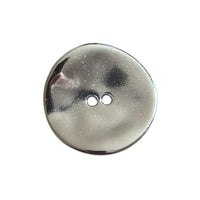
 Metal buttons with a pink finish 6104047 Col 255 – 22 mm handmade
 Classic sew-on snap buttons SP517 – 15 and 23 mm Nickel Free
A catalogue of button defects
| Defect | What it looks like | Usual class | Why it matters |
|---|---|---|---|
| Burr or sharp edge in the hole | Unpolished edge you can feel with a fingernail | Critical | Cuts the thread and can injure skin |
| Crack | Fine line, often visible against the light | Major | Button breaks in the wash or when fastened |
| Chipped rim | A missing piece of the edge | Major | Visible, and can snag fabric |
| Misdrilled holes | Off-centre, uneven or undrilled holes | Major | Automatic button sewers miss the holes |
| Uneven thickness | Variation beyond tolerance, typically ±0.2 mm | Major | Buttonholes end up too tight or too loose |
| Off-shade | Colour does not match the approved sample | Major/minor | Shows on the finished garment |
| Spot, scratch, speck | Cosmetic flaw on the face | Minor | Appearance, especially on pale buttons |
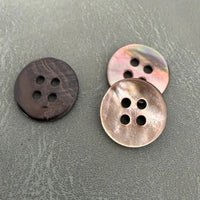
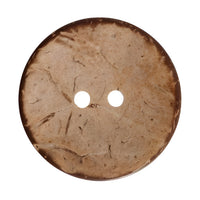
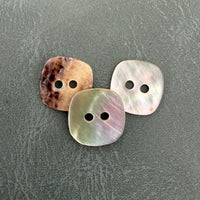
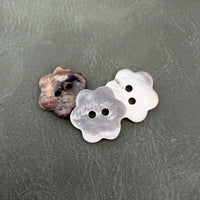
With natural materials you must separate a defect from a characteristic. Shell has a natural play of colour, corozo shows grain, coconut and wood have a texture that differs on every button. Write down in your specification what counts as acceptable natural variation, and approve a physical sample rather than a photo.
How AQL sampling works
AQL (Acceptable Quality Limit) is a method based on ISO 2859-1: instead of checking every button, you inspect a random sample. The sample size depends on the lot size, and the outcome is a simple accept or reject. At general inspection level II, the one used most often, the numbers look like this:
| Lot size (pcs) | Sample | AQL 2.5 accept/reject | AQL 4.0 accept/reject |
|---|---|---|---|
| 281–500 | 50 | 3 / 4 | 5 / 6 |
| 501–1,200 | 80 | 5 / 6 | 7 / 8 |
| 1,201–3,200 | 125 | 7 / 8 | 10 / 11 |
| 3,201–10,000 | 200 | 10 / 11 | 14 / 15 |
| 10,001–35,000 | 315 | 14 / 15 | 21 / 22 |
Example: you ordered 2,000 shirt buttons. You inspect 125 picked at random. Up to 7 major defects and the lot passes on majors; 8 or more and it fails. For minor defects the threshold is 10. Find even a single critical defect and the lot is rejected, whatever the other counts say.
Tip: pull your sample from different places – top, middle and bottom of the carton and from several bags. Taking 125 buttons from the top bag only tells you about one moment in production, not the whole lot.
Goods-in checklist for a small workroom
- Paperwork. Check article number, colour, size in lignes or mm and quantity against the order. Quantities are often counted in gross (144 pcs).
- Reference sample. Place the approved button next to the sample in daylight or under a standard D65 lamp. Judge the buttons on the garment fabric, not on a white table.
- Dimensions. Use calipers to measure diameter and thickness on at least 10 buttons. One ligne is 0.635 mm, so a 20L button is about 12.7 mm; tolerance is usually up to ±0.2–0.3 mm.
- Holes. Check the hole spacing (essential if you use an automatic button sewer) and pass a needle or thread through every hole – nothing should catch.
- Edges. Run a finger and fingernail around the rim and the holes. Anything that scratches is a critical defect.
- Strength. Squeeze a few buttons between your fingers to check for cracking; for children's wear also pull-test a button that has already been sewn on.
- Record. Fill in a short report: date, lot, sample size, defects by class, decision. You will need it if you make a claim.
What to do when a lot fails
Rejection does not necessarily mean sending the whole delivery back. There are three routes: full sorting (100% inspection and removal of faulty pieces), replacement of the defective quantity by the supplier, or acceptance at a discount when the defects are purely cosmetic. Whichever you choose, photograph defects next to a ruler and keep the samples – a good supplier will want evidence so they can fix the process.
Root causes are usually easy to trace. Burrs in the holes come from a worn drill bit or too little tumble polishing. Off-shade polyester buttons usually mean a new sheet or rod cast on a different day; with natural buttons it is a different batch of raw material. When you order in instalments, ask for all buttons for one collection to come from a single production lot.
When to inspect more strictly
- Baby and children's wear – a small button is a choking hazard and sharp edges are unacceptable.
- Expensive garments with visible buttons – coats, jackets, shirts with contrast buttons.
- A first delivery from a new supplier or in a new material.
- Buttons that will be sewn on automatically – the machine does not forgive misplaced holes.
At Bul-tex you can browse what is in stock in our buttons, natural buttons and polyester buttons collections. For production orders we are happy to agree the specification, tolerances and sample approval up front – get in touch with your quantities and requirements.