Buffalo horn vs ox horn buttons: both are natural keratin, but they look and behave quite differently. Buffalo horn is the classic choice for a man's suit and overcoat, while ox (cattle) horn brings a completely different palette, from pale yellow and honey to creamy white with soft streaks. This comparison shows which horn suits which garment and how to plan an order in which no two buttons are alike.
The two main types at a glance
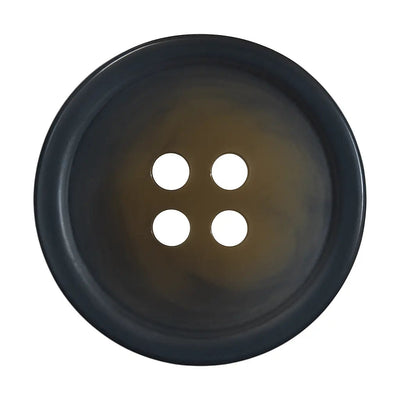
Buffalo horn comes from the water buffalo. It is dense and dark, from graphite to black-brown, often with lighter grey or beige streaks and translucent patches at the rim. Polished, it has a deep, almost wet-looking lustre.
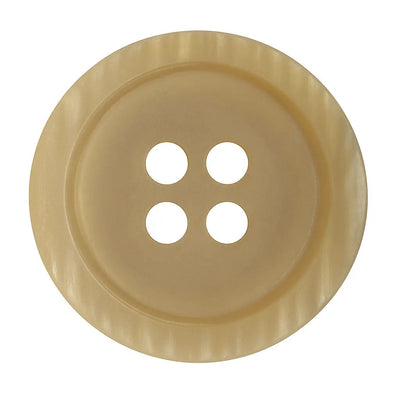
Ox horn comes from domestic cattle. Shades range from pale yellow and honey to cream, frequently with smooth gradients and grey-brown veining. It is more translucent than buffalo horn and seems to glow from within when held to the light.
Buttons are occasionally made from sheep and goat horn, but these horns are smaller and more fibrous and go mainly into handles and small items.
 Set of horn buttons made of natural buffalo horn ECOP 14610 – Black with leather accessory
 Brown corozo buttons CB5001 with 4 holes
 Black corozo buttons CB5001 with 4 holes
Comparison table
| Feature | Buffalo horn | Ox horn |
|---|---|---|
| Base colour | black, black-brown, graphite | pale yellow, honey, cream |
| Pattern | light streaks and patches on a dark ground | smooth gradients, dark veining |
| Translucency | low, mostly at the rim | medium to high |
| Availability | the most common horn for buttons | less common, especially pale tones |
| Typical use | suits, jackets, coats, toggles | summer jackets, linen and cotton, tweed |
| Style | classic, urban, formal | warm, relaxed, country |
Which horn for which garment
Navy and grey suits
Dark buffalo horn with fine light streaks. From a distance the button blends into the cloth; up close it reveals its natural pattern. Standard sizes: 20 mm (32L) on the front and 15 mm (24L) on the sleeves.
Tweed, flannel and earth-tone wool jackets
Brown buffalo horn with pronounced mottling, or a darker ox horn. The mottled pattern echoes the texture of tweed.
Linen or cotton summer jackets
Pale ox horn in honey and cream tones. Dark horn on beige linen looks heavy; light horn gives a soft, holiday-style contrast.
Camel coats
Two options work: honey-brown horn that blends with the cloth, or dark buffalo horn for a clear contrast. Coat sizes: 25–30 mm (40L–48L).
Duffle coats and casual outerwear
Buffalo horn toggles with leather or rope loops: the traditional fastening, easy to use even with gloves on.
Natural variation: how to build it into an order
Horn is organic, so no two horns, and no two buttons, are identical. That is part of its appeal, but in production it needs planning:
- Approve a range, not one button. Ask for samples that show the lightest and the darkest button in the batch.
- Sort by garment. The front buttons on one jacket should be the closest match; the odd ones go on the sleeves.
- Order spares. 10–15% extra from the same batch covers sorting, rejects and future replacements.
- Do not mix batches. A top-up order months later may have a visibly different tone.
- Tell the customer. A short line on the product page ("every button has a unique pattern") prevents returns.
Tip: if the design needs perfectly identical buttons, for uniforms for instance, natural horn is the wrong choice. Go for horn-effect polyester or dark corozo instead.
Sizes and thickness: a guide by garment
The type of horn sets the look, but size and thickness decide whether the button actually works. Typical values for horn buttons:
- Shirts and polos: 10–11 mm (16L–18L), 2–2.5 mm thick. Horn is rare here; shell is the usual choice.
- Jacket sleeves: 15 mm (24L), around 3 mm thick, four per sleeve on a classic suit.
- Jacket fronts: 20 mm (32L), 3–4 mm thick.
- Coats: 25–30 mm (40L–48L), 4–5 mm thick; for heavy wool melton, lean towards the upper end.
- Toggles: 40–60 mm long, depending on the loop and the thickness of the cloth.
If you use the same horn on the front and the sleeves, order both sizes together from one batch. The tones will then be close and the set will look coherent. You will find more on converting millimetres to lignes in our button glossary.
How to spot dyed horn
To get more even or fashion colours, horn is sometimes bleached or dyed. Dyed horn has a more uniform tone, and its streaks look paler and blurred. Natural light ox horn shows gradients that follow the direction of growth. If it matters to you, ask your supplier in writing.
Care
Keratin absorbs moisture. Do not soak garments with horn buttons for long, do not dry them on a radiator, and iron around the button rather than over it. For dry cleaning, have the buttons covered. If horn looks dry and dull, a drop of neutral oil rubbed in with a soft cloth brings the shine back.
Frequently asked questions
Is ox horn weaker than buffalo horn?
Not significantly. Both are keratin, and at a normal thickness (about 3–4 mm for a jacket button) both last for years of daily wear.
What horn items does Bul-tex offer?
Our catalogue includes the ECOP 14610 toggle set in natural black buffalo horn with a leather accessory. For a plant-based alternative with a similar look, see our corozo buttons in brown and black, and for an exact colour, our polyester coat buttons. More on materials in our button articles.
Can I order horn buttons for my collection?
For production orders and specific sizes, get in touch and we will check what is possible.