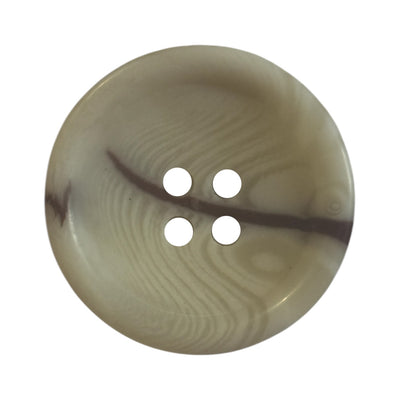
Horn vs bone buttons is a comparison many designers get wrong, because both materials are animal-derived, range from cream to brown and show natural patterns. In practice they differ in structure, weight, brittleness and how they take dye — which is why they were historically used on different kinds of garments. This article compares the two, explains why bone buttons are rare today, and shows which modern materials give a similar look with more predictable behaviour in production. A note up front: Bul-tex does not sell horn or bone buttons — the topic is here as background to help you choose an alternative.
The two materials in brief
Horn
Horn is made of keratin — the same protein as fingernails and hair. It is fibrous and slightly flexible, so it absorbs knocks without cracking easily. When heated it can be bent and pressed. It shows characteristic streaks and translucent areas, and every piece is unique. Traditionally it is used on jackets, coats and suits.
Bone
Bone is mineralised tissue — a combination of collagen and calcium phosphate — with a spongy, honeycomb internal structure. It is harder but more brittle than horn. Under a loupe you can see tiny dots and channels, its tell-tale signature. It dyes unevenly and often looks speckled after colouring.


Side-by-side comparison
| Property | Horn | Bone |
|---|---|---|
| Base | Keratin (protein) | Collagen plus minerals |
| Structure | Fibrous, layered | Spongy, with micro-channels |
| Flexibility | Slightly flexible, absorbs impact | Hard but brittle |
| Look | Streaks, translucency, depth | Matt, creamy, speckled |
| Dyeing | Takes dye fairly evenly | Uneven, mottled effect |
| Typical use | Jackets, coats, suits | Sweaters, cardigans, casual and workwear |
| Availability today | Limited, premium | Rare, niche |
Why bone is rarer than horn
There are several reasons. First, brittleness: on the front of a jacket or coat, buttons knock against tables, chair backs and washing-machine drums, and bone chips more easily. Second, uneven dyeing makes it hard to hit an exact colour across a production run. Third, processing is slow and wasteful because of the spongy structure. As a result, bone has ended up in niche, retro or workwear styles, while horn stayed in classic tailoring. Both raise traceability questions that modern brands increasingly prefer to avoid.
A short history
Before plastics took over in the twentieth century, buttons were made mostly from whatever natural materials were at hand: wood, metal, shell, horn and bone. Bone was a cheap by-product, so it ended up on underwear, work shirts and uniforms — often as a plain four-hole button with a very simple profile. Horn was valued more for its depth and lustre and gradually became the material of the tailoring workshop. With the arrival of casein and later polyester, both lost ground to cheaper, more uniform buttons. Today interest in natural materials is back, but brands tend to prefer plant-based, traceable options such as corozo, coconut and wood.
Modern alternatives: which material for which garment
If you like the look of horn or bone but want predictable colour, durability and easier sourcing, here is a practical guide:
- Corozo instead of horn on jackets and coats. This plant-based material is hard, pleasant to the touch and dyes into warm tones. Light corozo buttons give the soft creamy look many people associate with bone, while dark ones offer the depth of horn.
- Horn-effect polyester. When polyester sheets are cast, pigments can be swirled together to create streaks and melange that mimic horn. Matt melange polyester buttons are tough, wash easily and keep a consistent colour across the whole order.
- Coconut for casualwear and knits. Coconut buttons have a warm brown tone and natural texture — a logical swap wherever bone was historically used: sweaters, cardigans, linen shirts.
- Wood for a rustic look. Wooden buttons bring natural grain and lightness, well suited to childrenswear and knitwear.
Decision tree
- Is it a jacket, coat or suit and you want a classic "horn" look? → dark corozo or horn-effect polyester.
- Will it be washed often (uniforms, workwear)? → polyester, the most resistant to washing and dry cleaning.
- Is it a knit or a casual shirt with a natural feel? → coconut or wood.
- Looking for a pale creamy tone that recalls bone? → white or beige corozo, or matt ecru polyester.
- Want a logo on the button? → corozo, coconut and wood laser-engrave well; to order, contact us.
Tip: when choosing a substitute, compare thickness and weight as well as colour. A thin polyester button on a heavy coat looks cheap even if the colour is perfect. For coats, look at 25 mm and up with a thickness of at least 4 mm.
How to identify the material on an old garment
If you are restoring a vintage piece and need to match replacements, these quick checks help:
- Light: held up to a lamp, horn often lets light through at the edges; bone and corozo are opaque.
- Loupe: bone shows dots and tiny channels; corozo shows fine parallel lines; polyester shows an even or "flowing" pattern with no structure.
- Temperature: natural materials feel cooler to the touch at first than plastic.
- Sound: tapped gently together, natural materials sound duller than hard plastic.
Frequently asked questions
Which is stronger, horn or bone?
Horn is more impact-resistant because it is more flexible. Bone is hard but more brittle and chips more easily.
Can bone buttons be washed?
They tolerate hand washing, but long soaking and high temperatures dry them out and can crack them. That is why polyester is preferred on garments that are washed often.
What should I use instead of horn on a jacket?
Corozo is the closest natural option; horn-effect polyester is the most practical.
You'll find more on choosing materials in our button advice section. If you are preparing a collection and need a specific colour or size, get in touch and we'll suggest suitable alternatives.