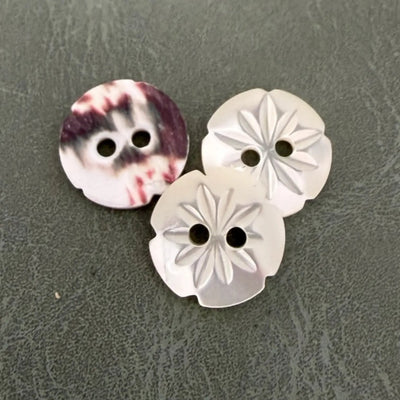
Wedding dress buttons are probably the most visible buttons an atelier will ever sew: a row of twenty or more small buttons down the back is a classic detail every guest sees during the ceremony. They have to be beautiful, but they also have to survive a full day of movement, dancing and hugs. This guide covers the materials (mother-of-pearl, pearl-look and fabric-covered), sizes, how many to plan, the kinds of loops, and how to attach them so not a single one comes off.
The three main material choices
Mother-of-pearl
Genuine shell has something a pearl imitation cannot copy: play of colour. As the wearer moves and the light changes, the surface shifts into pink, green and blue. A plastic pearl has an even, flat shine. Against satin, crepe or lace in white, ivory or champagne, white shell looks natural and luxurious. Agoya has the strongest iridescence, trocas a dense creamy white, river shell a clean, more matte white. Shell is light, tolerates ironing around the button and does not yellow.
Pearl-look buttons
Spherical or half-dome pearl-effect buttons are the most recognisably bridal look. They usually have a shank, which lets them stand upright in a loop. They cost less than shell and come in precise, uniform sizes, an advantage on long rows.
Fabric-covered
Buttons covered in the same satin or crepe as the dress are the classic choice when you want them to blend in tone-on-tone. They are made over a metal or plastic blank and suit light to medium-weight fabrics. Ateliers usually make them in-house with a blank kit or order them from a specialist workshop.
 SHELL AGOYA CLASSIC 2H – Classic 2-hole Akoya mother-of-pearl buttons, durable and elegant
 SHELL 07 WHITE – White mother-of-pearl shirt button with 4 holes, thin rim, luxurious and natural
 SHELL 10 WHITE – White mother-of-pearl button, 2 holes with rim, luxurious and jewelry-style
Comparison
| Criterion | Shell | Pearl-look | Fabric-covered |
|---|---|---|---|
| Look | Natural iridescence | Even shine | Tone-on-tone with fabric |
| Attachment | Holes, sometimes shank | Usually shank | Shank |
| Uniformity | Natural variation | Very high | High |
| Durability | High | Medium (coating can rub off) | Medium (fabric wears) |
| Dry cleaning | Fine | Depends on coating | As per fabric |
Size: small is beautiful
For a back row the typical size is 9–12 mm (14–20L). Smaller buttons (9–10 mm) look more delicate and allow a denser row; 11–12 mm buttons are easier to fasten and better on heavier fabrics. Sleeve closures to the wrist use 9–10 mm. A 20–22 mm pearl-look shank button can work as a single accent, at the waist or on a strap.
How many buttons to plan
The count depends on closure length and spacing:
- 1.5 cm spacing: very dense, the classic pearl row.
- 2–2.5 cm spacing: balanced and quicker to fasten.
Example: a back opening from neck to below the waist of around 45 cm gives 30 buttons at 1.5 cm spacing, or about 23 at 2 cm. Add 2–4 for sleeves if needed, and always 3–5 spares. Natural shell varies, so order all buttons from one batch at once.
Tip: a truly functional row of 30 buttons takes 10–15 minutes to fasten. Many ateliers sew a decorative row over a concealed zip or a hidden hook-and-eye tape, so the look stays but dressing takes seconds.
Loops or buttonholes
Rouleau loops
Thin tubes of the dress fabric sewn along the edge. The classic for satin and silk gowns. They need a shank button or a sew-through button with a long enough thread shank.
Elastic loop tape
Ready-made tape with evenly spaced elastic loops. Quick to sew and forgiving of small changes in fit through the day.
Classic buttonholes
Suitable on heavier fabrics, but on satin and lace they show and risk fraying.
Hidden support
Back buttons are largely decorative; the strain should be taken by an inner closure. A good solution is hook-and-eye tape, for example our white hook-and-eye tape, 2.5 cm wide with 2 cm spacing, sewn to the inner bodice. The outer buttons then never pull and never tear away.
How to sew them on
- Mark positions with a template, not by eye; across 30 buttons a small error adds up.
- Use strong polyester thread in the fabric colour, doubled.
- On sew-through buttons, make a 2–3 mm thread shank so the loop sits comfortably.
- Reinforce behind each button with a small piece of organza or fusible interfacing on the inside.
- Tie off each button separately, so if one comes loose the row does not unravel.
Care and storage
After the wedding a dress is often cleaned and stored for years. Before dry cleaning, tell the cleaner about the buttons; some prefer to cover pearl-look buttons with foil or remove them. Store the dress in a cotton garment bag, not plastic, somewhere dark and dry. Shell does not yellow, but the metal blanks in fabric-covered buttons can rust in damp conditions and pearl coatings can scratch with rubbing. If the dress will be altered later, spare buttons from the same batch will save you a search.
Finishing touches
Satin ribbon is a natural companion to a wedding dress, for a sash, a bow at the back or a trim. Our catalogue has satin, organza and grosgrain ribbons in white and cream, from 3 mm to 7 cm wide.
FAQ
Shell or pearl: which is better?
For a classic satin or crepe gown, shell or a pearl-look shank button. For lace, shell, because its fine shapes sit well with the pattern.
Can the buttons be washed or dry cleaned?
Shell tolerates dry cleaning. Pearl coatings and fabric-covered buttons depend on the material, so check with the cleaner.
Does it have to be real mother-of-pearl?
Not necessarily, but for a dress that will appear in photographs for a lifetime, natural iridescence is worth it.
Browse our natural shell buttons and all buttons, including pearl-look styles. For ateliers ordering bridal trims regularly, drop us a line.