

Fabric-covered buttons are the surest way to make a button match the garment perfectly – same cloth, same print, same leather. Behind the soft surface, though, sits a metal structure, and that is what decides whether the button is smooth, whether it survives washing and whether, a year later, it leaves a rust mark. This article is a working spec for ateliers, brands and upholsterers: what the blank is made of, how sizes are read, which fabric suits which size, how the press works and how to protect the metal under the fabric.
Anatomy of the blank
An industrial cover button blank has two parts:
- Top (shell). A domed metal cup. Hand kits often have small teeth on the inner rim to grip the fabric. Industrial blanks for presses usually have a smooth rim – the die tucks the fabric in.
- Back. A disc that is pressed into the shell and locks the fabric between them. The back determines how the button is attached:
- wire shank (loop) – the classic for apparel; the button sits above the fabric with room for the buttonhole thickness;
- plastic shank – lighter, rust-free, suited to lingerie and dresses;
- prong or nail back – for upholstery and tufting, where the button is pushed or pulled through the padding.
 Fabric or leather covered buttons for a small chair
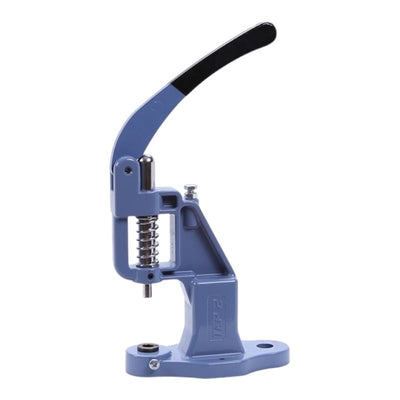
 TEP2 button covering machine
 DEP2K button attaching / covering machine
Sizes: ligne, millimetres and the fabric circle
Buttons are traditionally measured in ligne: 1 ligne = 0.635 mm. The table shows the most common sizes and an approximate fabric circle diameter for medium-weight cloth.
| Ligne | Diameter | Fabric circle (guide) | Typical use |
|---|---|---|---|
| 16L | ~10 mm | ~20 mm | Bridal gowns, blouse backs, cuffs |
| 18–20L | ~11–13 mm | ~23–25 mm | Blouses, dresses, shirts |
| 24L | ~15 mm | ~29 mm | Dresses, light jackets, sleeves |
| 28–30L | ~18–19 mm | ~34–36 mm | Jackets, waistcoats |
| 36L | ~23 mm | ~42 mm | Coats, decoration |
| 40–45L | ~25–28 mm | ~46–50 mm | Coats, upholstery |
| 48–52L | ~30–33 mm | ~54–58 mm | Upholstery, cushions, statement coats |
The rule of thumb: the circle is about 1.8–2 times the blank diameter. With a higher dome and thicker fabric add 2–4 mm; with very fine fabric reduce it so excess does not bunch under the back.
Fabric by size
- Up to 13 mm: only light and medium fabrics up to about 150 gsm – poplin, batiste, satin, crepe, fine silk. Thick cloth will not tuck into a small shell.
- 15–19 mm: fabrics up to about 250–300 gsm – linen, suiting wool, fine velvet, faux leather.
- 23 mm and up: heavy wools, bouclé, upholstery fabrics, leather up to about 1 mm.
- Sheer and pale fabrics: the metal shows through and greys the colour. Add a white underlayer of batiste or light interfacing.
- Leather: skive it thinner at the edge and work a size up – leather does not gather the way cloth does.
The press and dies
Production covering is not done by hand but with a press and a set of dies for each size. The process is always the same:
- Cutting. Circles are cut with a punch or knife to the exact diameter – scissors give a ragged edge.
- Positioning. The circle goes face down into the lower die with the shell on top. On prints, the motif is centred.
- First stroke. The shell is pushed into the die with the fabric, and the fabric edge is tucked inside.
- Setting the back. The back is placed in the upper tool and locked into the shell with a second stroke.
- Check. Look for creases on the dome, fabric cut by the rim and a back that spins.
A manual bench press is perfectly adequate for an atelier covering hundreds of buttons a week. What matters is having the right dies for every size – you cannot cover a 15 mm button in an 18 mm die.
Tip: make the first three buttons from every new fabric as a test. Fabrics behave differently in the same die – slippery satin wants a slower stroke, stretch jersey wants interfacing.
Rust under the fabric: the hidden risk
Most inexpensive blanks are thin plated steel. Fabric holds moisture during washing and steam pressing, and if the plating is scratched the steel rusts – and the stain comes through pale cloth. How to avoid it:
- choose aluminium or brass blanks, or steel with good plating, for garments that will be washed;
- never cover damp fabric – let it dry fully after pre-shrinking;
- wash garments inside out and dry them quickly, without leaving buttons wet for long;
- do not steam directly over the buttons;
- for upholstery cleaned with wet foam, prefer stainless or plastic backs.
Quantities and planning for a run
When covering a production run, plan the fabric separately in the marker. For 100 buttons of 19 mm with a circle of about 36 mm you need roughly 0.15–0.2 m² of fabric, allowing for waste between circles. Add 5–10% for rejects on the first pieces and for spare buttons sewn inside the garment. With prints where the motif must be centred, consumption can double. If a supplier covers the buttons, send the fabric with a clear spec: size, back type, quantity and instructions for centring the motif.
Covered buttons in upholstery
In tufting, the button is pulled through the padding with strong thread or cord and carries constant tension. That is why upholstery uses larger sizes (23–33 mm), stronger backs and dense fabrics. Test one tufting point before the run – over-tightening can pull the back out of the shell.
Covered buttons and machines at Bul-tex
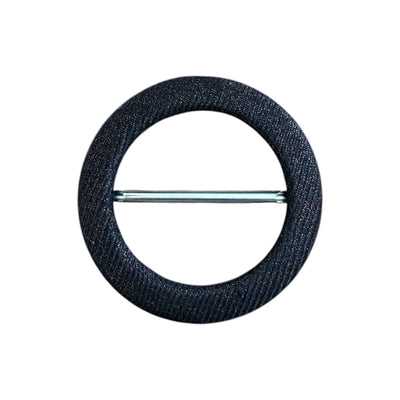
We offer covered shank buttons in sizes from 10 to 33 mm, which we cover to order in the fabric or leather you choose, plus fabric-covered buckles in our buckles collection. For ateliers that want to cover in-house, our accessories include the TEP2 and DEP2K button covering machines. If you have an unusual fabric or a large quantity, get in touch. For more on button materials, see our buttons articles.