

Uniform buttons carry a surprising amount of responsibility: they have to look identical on the hotel receptionist, the security officer and the school blazer – and keep looking that way after hundreds of wash cycles and years of repeat orders. This is a practical guide for uniform managers, workwear manufacturers and corporate collection designers: what differs from sector to sector, how to choose metal and finish, and how to plan supply so that the button you buy in year three matches the one from year one.
Why a uniform button is not a fashion button
A fashion button lives for a season or two. A uniform button has to:
- survive industrial laundering – often 60–75 °C, alkaline detergents and tunnel drying;
- be reordered identically for years while staff constantly rotate;
- handle heavy use – fastened dozens of times a day, rubbed against desks, belts and equipment;
- carry the organisation's identity – a logo, crest or initials recognisable at a distance.
 Metal buttons with logo 0076 Col 101926 – 18 mm with matte grey finish
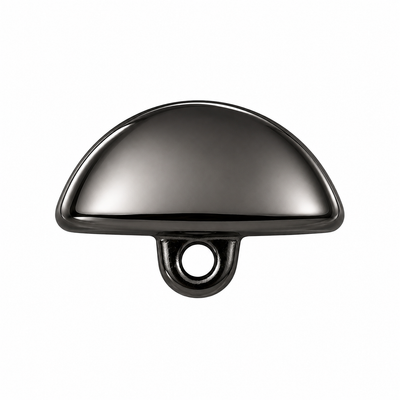
 MC 1772 crest metal buttons – Gun Metal 20 mm with shank for suits and jackets
 Gold buttons MC 2110 Col E109 – 22 mm with crest for suits and coats
Requirements by sector
| Sector | Typical garment | Button recommendation | Watch out for |
|---|---|---|---|
| Hotels and restaurants | reception jackets, waistcoats, doorman uniforms | shank metal buttons, 18–22 mm, gold or antique brass with a raised logo | finish wearing off at the rim; matching smaller sleeve buttons |
| Security and services | jackets, shirts, tactical trousers | gunmetal or black oxide, matt, no glare; snap fasteners on pockets | secure attachment; avoid shiny surfaces |
| Schools and sports clubs | blazers, waistcoats | 20 mm crest buttons on the front, 15 mm on cuffs | nickel-free finish for children; match with the embroidered badge |
| Airlines and transport | crew jackets and coats, conductors | brass or zinc alloy with emblem, gold or silver by rank | rank variants – plan them in a single mould where possible |
| Healthcare and kitchens | tunics, chef jackets | snap fasteners or removable buttons | high wash temperatures and disinfection |
Metal and finish: what survives the laundry
The two main materials are brass and zinc alloy. Brass resists corrosion better and suits garments washed frequently. Zinc alloy allows more intricate crest relief and costs less, but needs a good plating and lacquer. For uniforms that go through industrial machines, the most common choices are:
- antique brass and antique silver – the dark recesses hide small scratches and the relief stays legible;
- gunmetal and black oxide – practical, non-reflective, ideal for security and transport;
- polished gold – the most prestigious look, but it shows wear faster; ask for an extra protective lacquer.
For children's and school uniforms, insist on a nickel-free finish – the EU REACH regulation limits nickel release from items in prolonged skin contact to 0.5 µg/cm² per week.
Removable buttons: when they make sense
On some uniforms the buttons come off before cleaning – ceremonial jackets, doorman liveries or garments that are dry-cleaned. These use shank buttons held by a split ring or a toggle pin on the inside. The upside: buttons never meet the washing machine and can move to a new garment when staff change. The downside: they need disciplined handling and can go missing. For shirts and jackets washed weekly, sewn-on metal buttons or snap fasteners are more practical.
Logo: what can be read from two metres
Uniforms are seen from a distance. A detailed crest with lettering around the rim looks great on a drawing, but on a 20 mm button the text becomes illegible. Good practice:
- large buttons (20–25 mm) – the full crest or monogram;
- small buttons (15 mm and under) – a simplified version: just the symbol or initials;
- one button design for every role, with rank shown through finish (gold or silver) rather than different shapes. That way you pay for one mould instead of three.
Quantities and reorders
Across the industry, custom metal buttons often start from around 100 pieces per design plus a one-off mould fee. With uniforms, though, the real question is not the first order but the ones that follow. Plan like this:
- Work out annual demand: number of staff × buttons per set × sets per person.
- Add a 10–15% buffer for lost buttons and mid-year hires.
- Record the specification – model number, size in mm and ligne, finish, shank type – in a tech sheet that stays with you.
- Keep the approved sample as the reference for checking every new delivery.
- Order sleeve and front buttons together so they come from the same plating batch.
Tip: the exact shade of an electroplated finish can vary slightly between batches. For a large organisation it is better to order the year's quantity in one go rather than 50 pieces every month.
The uniform life cycle
On average a uniform jacket is replaced every two to three years, and shirts more often. When the time comes, the buttons are frequently in better shape than the fabric. If you chose removable shank buttons, they can move to the new set; if they are sewn on, budget for them as part of every new garment. Either way, a single fixed specification means old and new uniforms can stand side by side without any visible difference.
Checklist before you ask for a quote
- Sector and garment type, care method (washing, temperature, dry cleaning)
- Your logo as a vector file and the preferred technique – raised, debossed, enamel
- Sizes and number of buttons per garment
- Finish and any nickel-free requirement
- Estimated first-year quantity and expected reorders
Bul-tex and uniform projects
Bul-tex manufactures and supplies garment trims and takes orders for custom logo metal buttons for brands and organisations. Ready-made crest buttons in gunmetal, gold and black oxide are in our buttons collection, with coat and jacket options under coat buttons. For pockets and workwear see our snap fasteners. More on production and technical details is in our manufacturing articles. Send us your logo and quantities via the contact page and we can discuss your uniform project.