Choosing the right elastic for scrunchies is the hidden decision that determines whether a hair tie holds a ponytail all day or goes limp after a week. Scrunchies and fabric hair ties are a favourite product for small studios and handmade shops: they use up fabric offcuts, sell well and make a perfect add-on item at checkout. Everyone notices the fabric, the colour and the stitching, yet the elastic inside is often picked in a hurry, and that is exactly the part that drives comfort and returns. This guide covers which width works, how much to cut, how to join the ends and how to plan quantities if you sew in batches.
What width of elastic for scrunchies?
Most sewing tutorials recommend elastic around 6 mm (1/4 inch) wide, with 10 mm (3/8 inch) as the popular alternative. The difference comes down to feel and grip:
- 6–7 mm – thin, slides easily through a narrow fabric tube, good for mini scrunchies and fine hair.
- 10 mm – firmer grip, slower to relax over time and better for thick or heavy hair. It is also easier to stitch when joining, because there is more surface for the seam.
- 15 mm and wider – rarely used, except for oversized scrunchies in heavy fabric or flat headband-style ties where the elastic shows and the flat look is part of the design.
The narrowest elastic in the Bul-tex range is 1 cm, which is effectively the sweet spot for a standard scrunchie: slim enough to pass through a 3–4 cm tube and wide enough not to twist inside it.
 White knitted elastic band PEL 1001, 25 m roll
 Black knitted elastic band PEL 1002, 25 m roll
 Pink knitted elastic band PEL 1014 on a 25 m roll
Knitted or woven elastic?
| Type | Feel | Behaviour when stretched | Best for |
|---|---|---|---|
| Knitted elastic | Soft, flexible | Narrows slightly under tension, easy to sew | Standard scrunchies in satin, cotton or velvet; children's hair ties |
| Woven elastic | Firmer, denser | Keeps its width, stronger snap-back | Thick hair, sports hair ties, flat headbands |
| Braided elastic | Thin, rounded profile | Narrows noticeably when stretched | Very narrow tubes and budget runs |
The quality that matters most is recovery – the elastic's ability to return to its original length after repeated stretching. Elastics with an elastomer core (rubber or spandex) wrapped in polyester or cotton perform best. For a deeper look at the two core types, browse our other articles on elastics.
How long to cut the elastic
For a standard adult scrunchie, cut the elastic at roughly 20–25 cm. Here is a starting point for the three best-selling sizes:
| Size | Fabric strip (length × width) | Elastic (including overlap) |
|---|---|---|
| Mini | 35–40 × 6–7 cm | 16–18 cm |
| Standard | 50–55 × 10–12 cm | 20–22 cm |
| XL / "cloud" | 65–75 × 14–18 cm | 23–25 cm |
The rule of thumb: a longer fabric strip gives more gathers, but the elastic length barely changes, because it depends on how firmly the tie needs to hold hair, not on how puffy the scrunchie is. For children's hair ties, shorten the elastic by 2–3 cm.
Step by step: threading and joining the elastic
- Sew the tube. Fold the fabric strip lengthwise, right sides together, and stitch with a 1 cm seam allowance, leaving the short ends open. Turn it right side out.
- Thread the elastic. Attach a safety pin to one end and work it through the tube. Pin the other end to the fabric so it doesn't disappear inside.
- Overlap the ends. Overlap the elastic by 1–1.5 cm and stitch back and forth with a zigzag, or sew a small box with an X. A single straight seam is the first thing to fail.
- Close the fabric. Tuck one end of the tube into the other, fold the raw edge under by 1 cm and topstitch by machine or slip-stitch by hand.
- Test it. Stretch the finished tie 20–30 times. If the elastic seam pops or the ends shift, increase the overlap.
Tip: with very thin elastic some makers tie a double knot instead of stitching. It is quick, but the knot can be felt through thin satin and may work loose over time. With 1 cm elastic, a stitched join is the more reliable choice.
Colour: why matching the fabric pays off
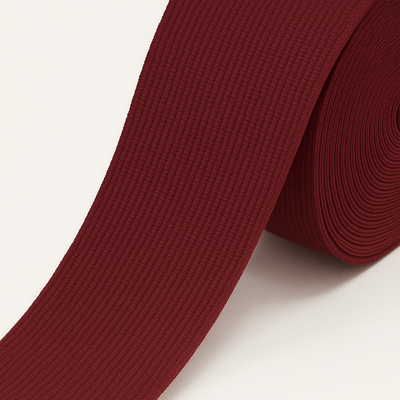
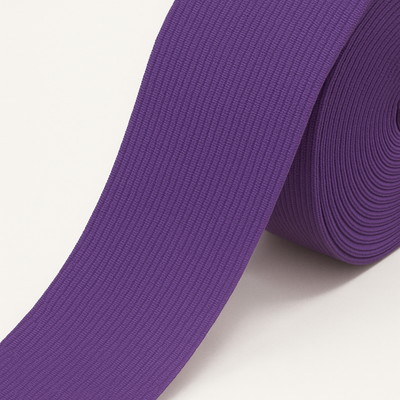
With lightweight fabrics such as satin, chiffon or silk, white elastic shows through, especially on dark colours. Elastic in a matching shade makes the piece look properly finished and stops customers from seeing a white core when they stretch it. Bul-tex knitted elastics come in close to twenty colours, from ecru and beige to burgundy, lilac and navy, so you can match the core to your best-selling collections.
Quantities: how many scrunchies per roll
The elastics in our elastics collection are sold in 25 m rolls. At 22 cm per scrunchie (overlap included), one roll gives about 113 pieces; at 17 cm for minis it gives about 147. That makes it easy to work out the elastic cost per piece and plan how many rolls you need for the season.
- Allow a 3–5% margin for samples and cutting mistakes.
- For markets and seasonal drops, stock 2–3 core colours (white, black, beige) plus 2–3 seasonal shades.
- Cut in batches using a template or a marked board – identical lengths mean every piece feels the same.
Common mistakes
- Elastic cut too long – the scrunchie looks lovely but won't hold. Test the first piece on real hair.
- Stretching the elastic while sewing – pulling it under the presser foot changes the length, so pieces come out inconsistent.
- Ironing directly on the elastic – high heat damages the elastomer. Press the fabric before threading.
- Cheap elastic with poor recovery – it relaxes within weeks and leads to returned orders.
FAQ
Can I use elastic wider than 1 cm?
Yes, but the fabric tube should be at least twice as wide as the elastic to gather nicely. Elastic of 1.5–2 cm works well for flat hair ties and headbands.
Which elastic is best for children's hair ties?
A soft knitted elastic cut a little shorter. For children's items, prefer OEKO-TEX certified elastic, such as the white and black woven elastics in our WE series.
How long does a scrunchie last?
With daily use, good elastic keeps its grip for many months. The most common reasons for sagging are over-stretching around very thick ponytails and drying on a radiator.
Making scrunchies and hair accessories in batches and looking for a steady elastic supplier? Browse the widths and colours in stock or get in touch about larger quantities – we ship across the EU with DHL Express.