Backpack hardware and outdoor apparel trims work in conditions a city garment never sees: 10–20 kg on the shoulders, rain, snow, salt water, dust, UV and temperatures from minus 20 to plus 40 degrees. Choosing every ring, buckle and cord lock is an engineering decision, not just a styling one. This guide covers which metal parts are used in backpacks, jackets and outdoor accessories, the trade-offs between weight and strength, and how different metals cope with salt, cold and sun.
The main metal parts and what they do
| Part | Function | Typical metals | Critical property |
|---|---|---|---|
| D-ring | Anchoring straps, shoulder straps, clips | Stainless steel, aluminium, Zamak, brass | Must not open under load |
| Round and rectangular ring | Joining webbing, hang points | Stainless steel, brass, Zamak | Seam or weld strength |
| Tri-glide (slider) | Adjusting strap length | Metal or plastic | Webbing must not slip |
| Cam buckle | Load securing, compression straps | Steel, aluminium | Grip on the webbing |
| Swivel snap hook | Detachable straps, key clips | Zamak, brass, stainless steel | Gate spring |
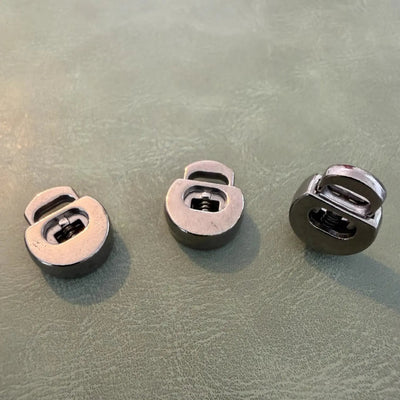
| Cord lock | Cinching hoods, hems, pack openings | Metal or plastic | Usable with wet gloves |
| Cord end | Protects cord tips, adds weight | Metal | Must not come off in the wash |
| Eyelets and rivets | Cord openings, reinforcing stress points | Brass, aluminium, stainless steel | Corrosion resistance |
Cam buckles are used on webbing from about 25 to 100 mm (1 to 4 inches) wide, for compression straps, roof racks and load securing.
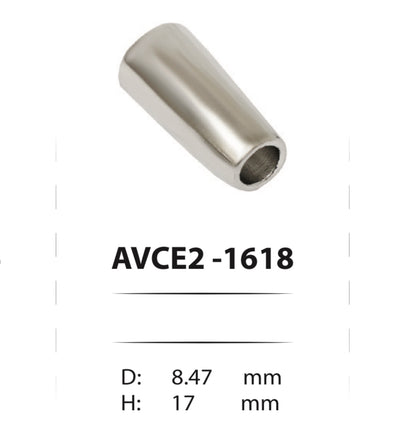
 Metal cord ends for cords and elastic bands 1618
 Metal buckle E-2312 Gold-tone 4 cm – Sea Snail Shape, Designer buckle for Belts and Clothing
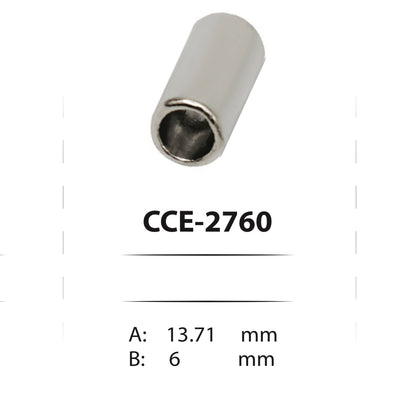
 Metal cord and elastic ends 2760
Weight versus strength
On a backpack every gram is felt after a few hours on the trail. Here is how the main outdoor hardware metals compare:
- Aluminium: about 2.7 g/cm³. The lightest, rust-free and anodisable in colour. High-strength alloys are used for lightweight buckles and rings, but ordinary aluminium is soft and gets worn by webbing.
- Stainless steel: about 7.9 g/cm³. The strongest and most corrosion-resistant, but heavy. Suited to high-load points and marine use.
- Zamak: about 6.6 g/cm³. Easy to cast into complex shapes and plates beautifully, but more brittle under impact and cold, and not suited to load-bearing points.
- Brass: about 8.5 g/cm³. Durable and handsome, but the heaviest. Used mainly on decorative and heritage-style packs.
Rule: any point that carries the pack's load (shoulder straps, hip belt, main haul loop) needs metal with a welded or one-piece construction, or high-strength plastic. Decorative and light-duty points can use Zamak or thin wire.
Salt water, damp and sweat
For sea kayaking, sailing and beach bags, 316 stainless steel is the preferred choice, because its molybdenum content gives better resistance to chlorides than 304. Brass copes well but tarnishes. Zamak and plated plain steel are risky: corrosion starts at the first scratch. Don't mix aluminium with stainless steel or brass at wet points; it forms a galvanic couple in which the aluminium corrodes quickly.
Cold
At low temperatures some plastics turn brittle and buckles snap on impact. Metal doesn't become brittle in the normal outdoor range, but it has another drawback: it is cold to the touch and sticks to wet hands. That is why zip pulls and cord locks on winter jackets often have a rubber or textile cover, or are large enough to grip with gloves.
UV
Sunlight degrades many plastics and fades coloured finishes. Metals are unaffected by UV, but anodised dyes and lacquers can fade in one or two seasons of strong sun. If hardware colour matters to the brand, test a sample in a window or a UV chamber.
Checklist for choosing backpack hardware
- Define the load: city pack up to 10 kg, trekking up to 20 kg, or expedition.
- Separate load-bearing points from decorative ones.
- Define the environment: city, mountains, sea, snow.
- Choose the webbing width and matching inner size for rings and buckles (20, 25, 30 and 38 mm are the most common).
- Pick metals without galvanic conflicts.
- Test a sample: load, soaking, salt, cold, repeated adjustment.
- Match the colour of all metal parts, with rings, buckles, cord locks and cord ends in one finish.
Common mistakes
- Fashion rings at load points. Bent wire without a weld opens under the weight of a full pack.
- Inner size too small. Webbing bunches in the ring, wears and weakens.
- Lacquered decorative parts touching webbing. The webbing rubs through the lacquer within weeks and the metal looks worn.
- Using fashion hardware for climbing or fall protection. Fashion snap hooks and rings are not personal protective equipment and must never be used to secure people.
Frequently asked questions
Metal or plastic for backpack buckles?
Good engineering plastic is light and very durable, which is why it dominates on trekking packs. Metal is chosen for extra strength at specific points, for style, or where plastic would crack on impact.
What hardware for a bag used at the beach?
316 stainless or brass for metal parts, with no Zamak and no plain steel. Rinse the bag in fresh water after use.
Can the same cord locks go on jackets and packs?
Yes, as long as the hole fits the cord diameter and the lock is easy to operate with gloves.
Outdoor hardware from Bul-tex
At Bul-tex you will find metal rings and D-rings in several sizes and finishes, buckles, and metal cord locks and cord ends in our accessories. For specific outdoor parts such as cam buckles, sliders or hardware for load points, contact us with a description of your product and we will check what we can offer. More on bags and backpacks is in our accessories category.