Stainless steel snaps and hardware are the obvious choice when a garment or accessory will live with salt water, sweat and rain: sailing gear, swimwear, workwear, tents and boat covers. But "stainless" isn't one material. The two grades you'll meet most often, 304 and 316, behave very differently by the sea. This guide explains the difference, compares them with brass and zinc alloy and shows when the price premium genuinely pays off.
What makes steel stainless
Stainless steel contains at least about 10.5% chromium. Chromium forms an invisible passive layer of chromium oxide on the surface that heals itself when scratched, as long as oxygen is present. The enemy is chlorides: salt, sweat and chlorinated pool water. They break through the passive layer at individual points and cause pitting corrosion, small brown dots that gradually become holes.
 Metal rings E-2315 Nickel – Buckle type, Oval model with beads – 2.5 cm
 Plastic bra sliders and rings
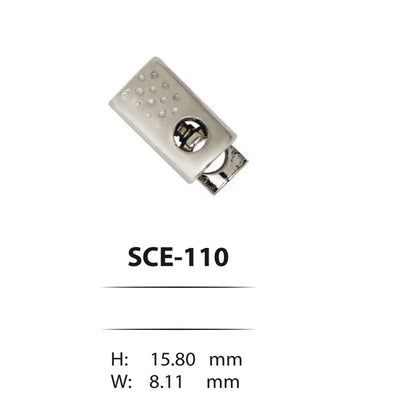
 Metal cord and elastic stoppers 110 – single hole (5 mm), dotted design
304 vs 316: it comes down to molybdenum
| Property | 304 (1.4301) | 316 (1.4401) |
|---|---|---|
| Chromium | about 18% | about 16–18% |
| Nickel | about 8% | about 10–14% |
| Molybdenum | none | about 2–3% |
| Chloride resistance | good in urban settings, limited by the sea | much higher; the marine standard |
| Price | baseline | higher |
| Typical use | workwear snaps, buckles, internal parts | sailing clothing and gear, boat covers, swimwear |
The molybdenum in 316 sharply improves resistance to pitting in salty environments, which is why the marine industry often calls 316 "marine grade". Near the coast, 304 usually develops a brownish film ("tea staining") within a season or two, while 316 stays clean for years.
Stainless vs brass vs zinc
| Material | In salt water | Pros | Cons |
|---|---|---|---|
| Plated zinc alloy | white corrosion once the plating wears | cheap, complex shapes, every colour | weakest in marine conditions |
| Brass | doesn't rust but tarnishes and turns green | easy to stamp and plate, traditional look | loses zinc after long immersion in seawater |
| Stainless 304 | pitting and staining over time | strong, no plating needed, hygienic | not ideal by the sea |
| Stainless 316 | very good | longest life in salt and chlorine | most expensive, limited shapes and colours |
When stainless hardware is worth it
- Sailing clothing and accessories. Foul-weather jackets, buoyancy aids, covers and awnings. Here 316 is standard.
- Swimwear and beachwear. Seawater and pool chlorine call for rings, sliders and clasps in 316 or in plastic.
- Workwear with industrial laundering. Repeated hot washes with aggressive detergents wear plating away; 304 is usually enough.
- Outdoor and hiking gear. Sweat, rain and mud favour stainless steel or plastic fasteners.
A good question to ask is how often the part will be wet with salt water or sweat, and for how long. A snap that gets rained on and dries out lives happily in brass. A snap on a boat cover that sits for weeks in damp, salty air needs 316.
For everyday jackets, shirts and jeans, stainless is usually overkill. Good brass or zinc alloy with the right plating will outlast the garment.
The trade-offs nobody mentions
Hard to stamp
Stainless steel is hard and work-hardens as it's formed. That means faster tool wear, simpler shapes and shallower relief. A complex logo that is easy in a zinc casting may be impossible or costly in stainless.
Limited colours
The natural colour is silver-grey: polished, satin or brushed. Electroplating stainless is difficult because of the passive layer. Black or gold usually means PVD, which raises the price further.
Nickel
Both 304 and 316 contain nickel, but it is tightly bound in the structure and release is usually low. Most standard stainless grades meet the nickel release requirements, but it isn't automatic: free-machining grades with added sulphur, such as 303, release considerably more. For skin-contact parts, ask for an EN 1811 test.
Galvanic corrosion
A stainless snap combined with an aluminium or zinc part forms a galvanic couple in salt water, and the more active metal corrodes fast. Use the same material for every part of the fastener.
Caring for stainless hardware
Even 316 likes fresh water. After sailing or the beach, rinse the garment or cover, especially around snaps where salt collects and dries into crystals. Don't use steel wool or wire brushes: particles of ordinary steel stay on the surface and rust, making it look as if the snap itself is rusting. If a brownish film appears, clean it with a mild detergent and rinse well. For stiff snaps, a drop of silicone lubricant helps; oil attracts sand.
How to specify stainless hardware
- The steel grade by EN (1.4301, 1.4401) or AISI (304, 316), for every part: cap, spring, base.
- Surface: polished, satin, brushed or PVD.
- Test requirements: EN 1811 for skin-contact parts, salt spray for marine use.
- Fabric compatibility: material thickness and attachment strength.
A common compromise is a plated brass cap with a stainless spring. It looks like a classic snap, but the most vulnerable part is protected. Spell it out explicitly in the quote.
Thinking about cost
Stainless hardware costs more per piece than plated brass or zinc, and 316 costs more than 304. In marine use, though, the comparison changes: a cheap snap gets replaced every season, a 316 snap after years. For a brand selling technical clothing with a durability promise, the pricier part is cheaper than returns.
FAQ
Is stainless steel magnetic?
Annealed 304 and 316 are almost non-magnetic, but they can become slightly magnetic after stamping. A magnet is not a reliable way to identify the grade.
Can 304 rust?
Yes, where chlorides are present and oxygen is short, for example salt water trapped under a snap cap. Rinse with fresh water after sailing.
Does Bul-tex offer stainless hardware?
Our standard range covers metal eyelets, snap fasteners, rings and accessories in plated finishes, including Nickel Free. For projects that need stainless steel, get in touch with your quantity and end use and we'll discuss the options.