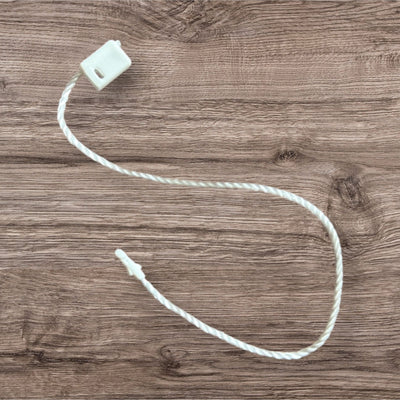
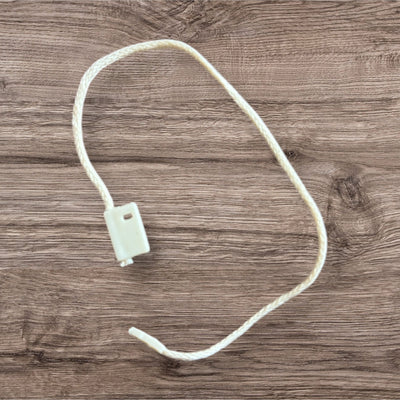
A hang tag seal is the small fastener at the end of a string that replaces the knot: the string goes through the garment and the tag, the seal clicks shut, and it can't be opened again without cutting. For mass retail that's about speed. For shoes, bags and expensive items it's about security. For premium brands it's also about branding, because the seal itself can carry a logo. This guide covers the types of seal, when they genuinely beat a knotted string, and how to choose the right solution for your products.
Glossary: types of fastening
String with seal (string lock, snap lock)
A thin cord with a plastic pin on one end and a socket on the other. The pin is pressed into the socket and clicks shut. Only scissors will open it. The most common seal for hang tags.
Bullet seal
Both parts are cylindrical and lock into each other along the line of the cord. It looks more compact and more upmarket than a flat seal.
Loop lock
A plastic strap or cord that closes into a loop and can't be opened without cutting. These seals are tamper-evident and are standard on shoes and bags, where the tag hangs from a lace, handle or strap.
Metal seal
A metal sleeve crimped with pliers over both ends of the cord. It looks industrial and solid – typical of premium denim and leather goods.
Branded seal
A plastic or metal seal with an embossed logo or in the brand colour. A small but memorable detail – the customer cuts it off, but sees it first.


Seal or knotted string?
| Criterion | Knotted string | String with seal |
|---|---|---|
| Attaching speed | Slow, especially hand-tied | Fast – one click |
| Consistency | Depends on who ties it | Every piece identical |
| Tamper resistance | Low – knots come undone | High – opens only by cutting |
| Feel | Natural, crafted | More commercial, unless branded or metal |
| Materials | Can be all cotton or jute | Usually includes plastic |
| Best for | Small runs, handmade, eco brands | High volume, shoes, bags, high-value items |
When a seal really is better
- Shoes and bags. The tag goes through a lace, handle or strap. A seal won't slip or come undone during try-ons.
- High-value items. A seal makes it harder to swap tags with a cheaper article in store.
- Returns policy. If you only accept returns with the tag still attached, an intact seal is visible proof the item hasn't been worn. Some brands use large sealed tags for exactly this, placed where the garment can't be worn without removing them.
- High volume. Across thousands of pieces, the time difference between tying a knot and clicking a seal adds up.
- Sets. Two or three items joined with one seal stay together on the shop floor.
When a knotted string is the better choice
- When the brand stands for handmade, natural materials or sustainability – a plastic-free cotton string is more consistent.
- On delicate fabrics and knitwear, where a seal can snag a loop.
- On small runs, where speed isn't the deciding factor.
- When the tag is meant to be kept – as a gift card, for example.
How to brand the seal
- Colour. A black seal with black string and a black tag looks clean; a seal in the brand colour adds an accent.
- Embossed logo. A small logo or initials on the flat part. It needs its own mould, so it makes sense for large, repeat orders.
- Metal look. A metal seal, or one with a metallised finish, matched to the garment's snaps, rivets and buttons.
- The cord. Even with a standard seal, the cord can be in the brand colour or have a woven-in tracer thread.
Tip: if you use a seal, route it through a seam, label or buttonhole – not through the main fabric. A hole in a delicate fabric stays after the seal is cut.
An alternative: knotted string plus eyelet
If you want secure attachment without a plastic seal, combine a good string with fused or knotted ends and a hang tag with a metal eyelet at the hole. The tag won't tear when pulled, the knot stays tight, and the whole set looks premium. For most garments that's entirely sufficient.
Seals and sustainability
Most seals are polypropylene or nylon and become waste the moment they're cut – across thousands of garments that's kilograms of plastic a year. If your brand talks about sustainability, you have three routes: a knotted cotton string, a seal in recycled plastic backed by supplier documentation, or limiting seals to the products where security really matters – shoes, bags and high-value items. Be careful with claims: since 27 September 2026, generic words like "eco" without evidence are banned in the EU.
FAQ
Can a seal be reused?
No. Its whole point is that it only opens by cutting – proof the tag hasn't been swapped.
How long should a sealed string be?
For clothing usually around 12–18 cm; for bags and shoes longer, to go around the handle or lace. The loop should let the tag hang freely and be cut off without risk to the fabric.
What we offer
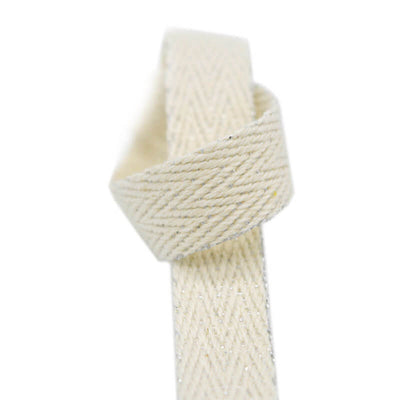
Bul-tex does not sell plastic seals or tagging guns. In our shop you'll find strings for hang tags in various colours, thicknesses and lengths, ribbons for a more luxurious tie, and metal eyelets to reinforce the hole. Custom hang tags are made to order – get in touch and we'll talk through the best way to attach them to your products. More practical articles are in the Labels section of our blog.