Finding a clothing manufacturer in Bulgaria is an increasingly serious option for European brands that want a shorter supply chain. Nearshoring – moving production closer to the market – is no longer just a buzzword: after years of delayed containers and unpredictable lead times, many brands are looking for a partner inside the EU that can turn round small runs quickly. This is a practical guide: why Bulgaria, which working models exist, how to find a factory and how to source trims locally.
Why Bulgaria: six advantages
- EU membership. No customs duties or clearance to the rest of the EU. Between VAT-registered businesses, the reverse charge applies.
- The euro. Bulgaria joined the eurozone on 1 January 2026 – no currency risk and no conversion costs for eurozone partners.
- Short transport. A truck reaches Central Europe in a few days; sea freight from Asia takes 30–45 days for the voyage alone.
- Experience. Decades of work for Western brands, from jersey to outerwear and tailoring. The sector employs around 86,000 people.
- Flexibility. Many small and mid-sized factories accept runs of a few hundred pieces per style – unthinkable at large Asian factories.
- Nearby suppliers. Labels, buttons, elastics and zips can be sourced locally, in days rather than after the ship docks.
 Metal buttons with a pink finish 6104047 Col 255 – 22 mm handmade
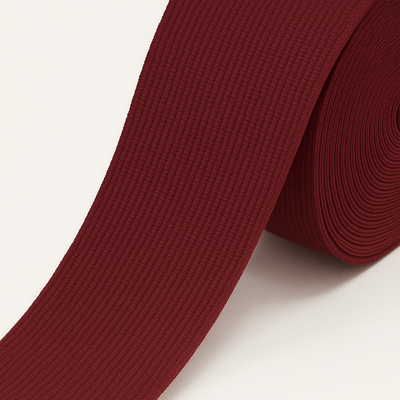
 Bordeaux knitted elastic band PEL 1013 on a 25 m roll
 Satin label 14 cm x 5 cm - satin print
Working models
| Model | What the factory does | What you supply | Best for |
|---|---|---|---|
| CMT (cut-make-trim) | Cutting, sewing, finishing | Fabric, trims, tech pack | Experienced brands with their own suppliers |
| Full package (FOB) | Buys materials and sews | Design and specification | Brands that want a single partner |
| Partial sourcing | Buys some materials, e.g. trims | The main fabric | The most common compromise |
CMT is the traditional model in Bulgaria. For a new brand with little sourcing experience, it's often easier to have the factory or a local supplier handle the trims.
How to find a factory
- The industry association (BATOK) – member listings and contacts with manufacturers.
- Trade fairs in Bulgaria and the wider region.
- Referrals from other brands and from fabric and trims suppliers – they know who makes what.
- Professional networks and direct searches by specialisation: knitwear, wovens, outerwear, lingerie.
Tip: ask the trims suppliers. They work with dozens of factories and know who sews well, who hits deadlines and who has spare capacity.
Vetting a factory: checklist
- Specialisation – knits and wovens need different machines and skills.
- Capacity – how many pieces a week of a style like yours, and is there room in your season?
- Minimums – per style and per colour.
- Sampling – lead time and cost per sample, number of correction rounds.
- Subcontracting – does it make everything in-house or pass work on?
- Social audits – if your brand requires them, ask about amfori BSCI, SMETA or similar.
- Quality control – does it have its own QC and work to AQL?
- A visit – proximity means you can see the factory in person, so do.
Trims: where nearshoring most often fails
The average lead time for trims from overseas suppliers is around a month. If you sew in Bulgaria but your labels and buttons come from Asia, the advantage of proximity is lost right there. So plan trims together with the factory:
- Branded trims – main label, care label, logo buttons, logo elastic – order from a local manufacturer so samples can be corrected quickly.
- Standard trims – zips, snaps, elastics, tapes – choose from stock so nothing waits.
- Deliver straight to the factory – it saves days and needless forwarding.
- A trim card – approved by you and held by the factory before production starts.
Common nearshoring mistakes
- An incomplete tech pack. Proximity doesn't replace a clear spec – missing measurements and trims cost you rounds of samples.
- Comparing on price per minute alone. The real advantage is lead time, flexibility and lower risk, not the lowest unit price.
- Ordering trims last. The factory is ready, the fabric is in, and the labels are still in transit.
- No forecast. Small factories plan capacity weeks ahead; give them an indicative volume for the season and they'll make room for you.
- Never visiting. One day at the factory tells you more than ten emails.
Sample timeline for a first run
- Weeks 1–2: contacting factories, tech pack, quotes.
- Weeks 2–4: proto sample and corrections; trims samples in parallel.
- Weeks 4–5: pre-production sample approval, fabric and trims ordered.
- Weeks 6–9: production, inline and final inspection.
- Weeks 9–10: transport to your EU warehouse.
These timings are indicative and depend on the factory and the season, but with good planning you get from idea to warehouse considerably faster than when ordering from Asia.
FAQ
Is it cheaper than Asia?
Per piece, usually not. In total, often yes, once you include freight, duty, surplus stock from high minimums and the cost of delays.
What minimum should I expect?
It depends on the factory and the product, but many manufacturers work with runs of a few hundred pieces per style.
How are factories usually paid?
Typically a deposit for materials and sampling, with the balance due when the run is ready. Terms are negotiable and often become more flexible in a long-term partnership.
What language do factories work in?
Most factories that work for foreign brands speak English; your tech pack should be clear and include measurements.
Trims from Bul-tex for production in Bulgaria
Bul-tex manufactures and supplies garment trims – labels, buttons, zips and elastics – and can ship them straight to your chosen factory in Bulgaria or elsewhere in the EU with DHL Express. For custom labels and trims, get in touch. More guides are in our production articles.