How polyester buttons are made is the story behind most of the buttons on our clothes. Polyester accounts for the largest share of button production worldwide because it is tough, light, survives washing and dry cleaning, and can imitate almost any material — horn, mother-of-pearl, marble, corozo. This article walks through the process step by step, from liquid resin to polished button, covering both main casting methods — sheets and rods — and explaining where the effects you see on a finished button come from.
The raw material: unsaturated polyester resin
The base is unsaturated polyester resin — a viscous liquid that cures irreversibly once a catalyst is added (a thermoset plastic). Before casting the resin is mixed with:
- Styrene — a diluent and cross-linking agent that controls viscosity and takes part in curing.
- Pigments — for solid colours, pearl effects, melange or stripes.
- Catalyst and accelerator — which set the curing speed.
- Fillers — which affect density, weight and opacity.
Because it is a thermoset, cured polyester doesn't melt when heated. That is why polyester buttons cope with ironing and pressing far better than thermoplastic buttons made from nylon or ABS.
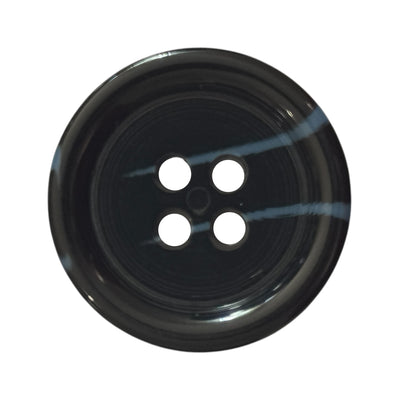
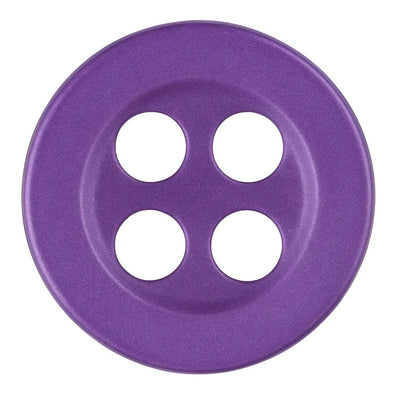
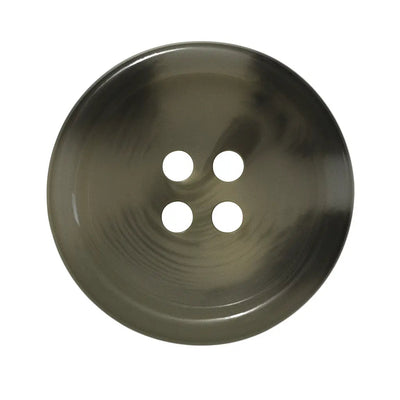
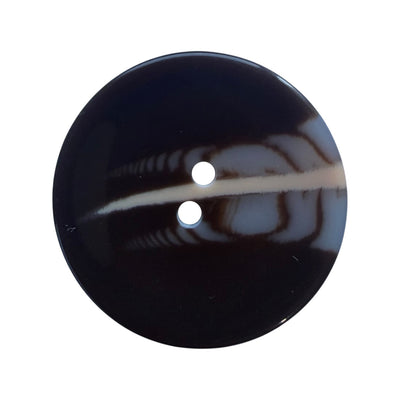
 Melange polyester buttons PG 265 Col 7 – shiny brown with a light pattern
 Brown buttons for men's suits PB0140
 Polyester buttons PPB 0043
Method 1: centrifugal sheet casting
- Spinning drum. The mixed resin is poured into a fast-rotating cylindrical drum. Centrifugal force spreads it into an even layer around the inner wall.
- Partial cure. After a few minutes the resin reaches a gel-like, leathery state — firm enough to cut but still flexible.
- Removing the sheet. The sheet is taken out of the drum and laid flat.
- Punching blanks. Round blanks the diameter of the future button are punched from the soft sheet. In this state they cut cleanly without cracking.
- Final cure. The blanks are post-cured with heat until fully hard.
Sheets allow effects that flow in a single plane: pearlescent lustre, two-colour layers, melange and waves. Because centrifugal force aligns the pigment particles, the pearl effect is especially deep.
Method 2: rod casting
- Filling tubes. Resin is poured into waxed aluminium tubes; the wax helps release the rod.
- Curing. The tubes are left until the resin is firm but can still be cut.
- Extracting and slicing. The rod is pushed out and sliced into thin discs, much like a salami. Each disc is a blank for one button.
In a rod, the pattern runs along its length, so each slice shows a cross-section. This produces effects such as concentric rings, a central "eye" or horn-like streaks. Rod casting is also convenient for thicker buttons.
Sheets vs rods compared
| Factor | Sheet casting | Rod casting |
|---|---|---|
| Blank shape | Punched disc | Sliced disc |
| Typical effects | Pearl lustre, layers, melange | Concentric rings, stripes, horn look |
| Waste | The punched skeleton | Minimal, from slicing only |
| Thickness | Set by the layer in the drum | Easily adjusted when slicing |
| Best for | Shirts, blouses, thin buttons | Jackets, coats, thick buttons |
From blank to button
CNC turning
The blank goes into an automatic lathe that cuts the profile: face, rim, dish and back. Programming creates rim styles, double rims, reliefs and engraved lines. This is also where thickness is set — typically 2–3 mm for shirts and 3.5–5 mm for coats.
Drilling
Holes are drilled simultaneously with precision bits — two or four holes, usually around 1.5–2 mm in diameter. Clean hole edges matter, so the button doesn't cut the thread when sewn on.
Polishing
Buttons are polished in rotating barrels with wood chips, ceramic media or abrasive compounds — sometimes for days — to achieve a high gloss or, with extra treatment, a matt finish.
Dyeing and finishing
Some buttons are cast in their final colour; others are dyed after turning so they can be matched precisely to a fabric swatch. Lacquer, laser engraving or printing may be added at the end.
Where the effects come from
- Pearl lustre — pearlescent pigments aligned by centrifugal force in sheets.
- Melange and marble — two or more colours mixed without being fully blended.
- Horn effect — layers or streaks of differing translucency, most often in rods.
- Two-tone rim — two layers in the sheet revealed by turning.
- Matt — abrasive polishing or a matt lacquer.
Tip: when ordering polyester buttons dyed to match, send a physical fabric swatch rather than just a Pantone number. Pearl and melange effects look different under different lighting.
Quality control along the way
Between stages, buttons go through checks the buyer rarely sees but which decide how they behave on the garment:
- Size and thickness — measured with callipers; size is given in mm or in ligne (1 L = 0.635 mm, so a 24 L button is about 15 mm).
- Holes — hole spacing is checked so it matches the button-sewing machine setup.
- Colour — compared with the approved sample under standard D65 light.
- Durability — samples are washed, ironed and dry cleaned to confirm they don't deform or bleed.
- Visual inspection — buttons with bubbles, cracks or uneven gloss are removed.
Why polyester is everywhere
Low cost, huge design freedom and stability in the wash have made polyester the standard in mass-market clothing. It doesn't melt under the iron, doesn't shatter in the washing-machine drum and keeps its colour. The downside is that it is a plastic and not biodegradable, so eco-focused collections often mix polyester with natural materials or look for buttons with recycled content.
Bul-tex supplies polyester buttons for shirts, trousers, jackets and coats, including matt and glossy melange designs. Browse our polyester buttons, shirt buttons and coat buttons. For buttons dyed to your swatch or carrying your logo, contact us. More articles on how trims are made are in our manufacturing section.