

Metal buttons for cardigans give knitwear a finished, expensive look, but they often bring an annoying problem: after a few wears the front sags, the button band ripples and a little pouch forms around each button. The cause is almost never the button alone; it is the combination of its weight, how it is sewn on and how much the knit stretches. This is a practical troubleshooting guide, from diagnosis to seven concrete fixes that work in an atelier as well as in production. General advice on choosing button materials and sizes for knitwear is in a separate article; here we focus only on metal buttons and sagging.
Diagnosis: why knits sag
Knitted fabric is made of loops that stretch in every direction. A woven jacket holds a button steady, while a knit gives way under any constant load. Three factors work together:
- Weight. Zinc alloy (Zamak) is dense, so its buttons are heavy. One solid 20 mm metal button can weigh several grams, and with six to eight buttons down the front the total reaches a few dozen grams concentrated on one narrow band.
- Hanging point. A two- or four-hole button sewn directly puts all its weight on two to four loops.
- A stretched buttonhole. If the buttonhole is larger than needed, the button tips forward and tugs the fabric with every movement.
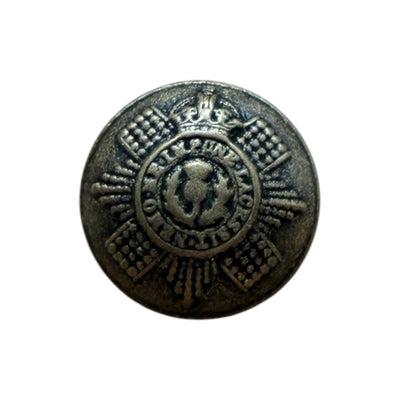
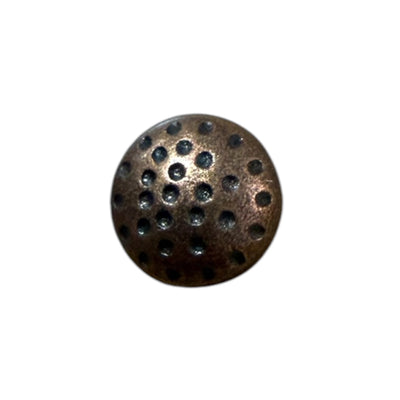
 Lightweight metal brass buttons 20-046078-22 Col 2551 – Antique brass 18 mm
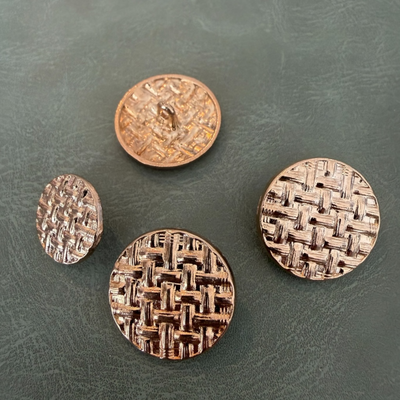
 Metal buttons ME-9001 gold with shank round shape for knitwear
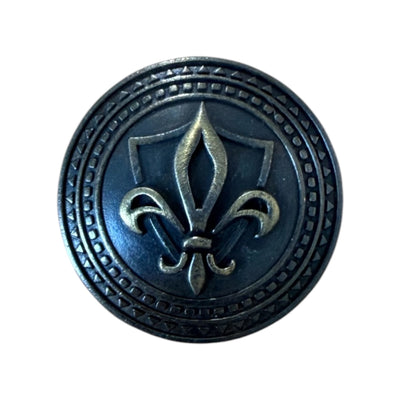
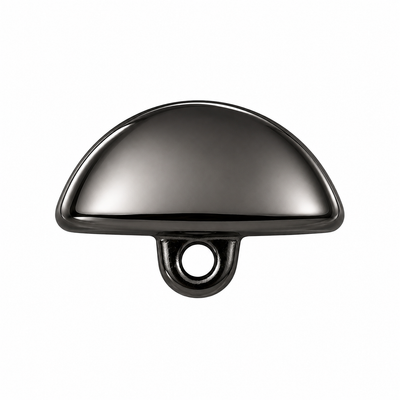
 Metal shank buttons 23972 Col 116 – Antique brass 22 mm
Quick diagnostic table
| Symptom | Likely cause | Fix (numbered below) |
|---|---|---|
| The whole front lengthens | Heavy buttons, unsupported band | 1, 4 |
| A pouch around each button | Sewn directly, no backing button | 2, 3 |
| The button droops forward | Loose sewing, no shank | 2, 5 |
| The band ripples between buttons | Uneven spacing or buttonholes | 6, 7 |
| The button slips out of the hole | Buttonhole too big | 6 |
Seven fixes
1. Choose a lighter metal button
Hollow stamped brass buttons are considerably lighter than solid cast Zamak buttons of the same diameter. If you want the metal look without the weight, look for models described as light or hollow, or made from thin brass sheet. The simple test is to weigh ten pieces on a kitchen scale; the difference is obvious.
2. Prefer a shank button
A shank button sits above the fabric, spreads the load better and leaves room for a thick knitted band. The shank also lets you sew through a backing button without thread showing on the front.
3. Sew with a backing button
On the inside, place a small flat button (10–12 mm, clear or matching the knit) and sew the face button through it. The backing button takes the load and spreads it over a larger area, so the loops don't stretch.
4. Reinforce the band with tape
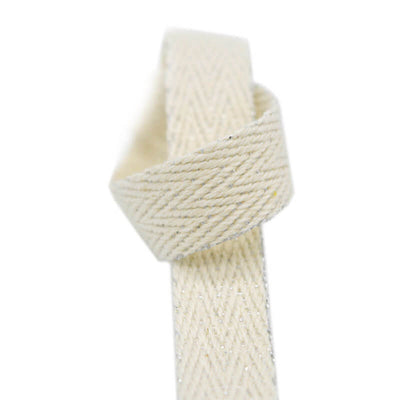
The most effective fix for production styles. A cotton tape, herringbone or grosgrain, 2–2.5 cm wide, is sewn along the full length of the button band on the inside. It stabilises the knit, stops it lengthening and supports the buttons. Buttonholes are cut or worked through the tape as well. Use a pre-washed tape so it doesn't shrink after the first wash.
5. Make a thread shank
If the button has holes, leave a 2–3 mm thread shank between button and fabric and wrap it a few times with the thread. The button stands upright and the loops aren't squeezed.
6. Make the buttonhole smaller
On woven fabrics the buttonhole is usually 2–3 mm longer than the button diameter. On a knit that stretches, it should be almost equal to the diameter or just 1 mm larger. The button then sits steady and doesn't slip out.
7. Reduce spacing or the number of buttons
With heavy buttons, closer spacing spreads the weight but increases the total. Sometimes the better answer is fewer buttons (five instead of seven) in a lighter model, with a reinforced band.
Production tip: make a sample with the actual buttons, leave the cardigan on a hanger for 48 hours, and measure the band length before and after. More than 1 cm of lengthening is your signal to reinforce the band or change the button.
An atelier example
A typical case: a chunky wool cardigan with eight solid 22 mm metal buttons, each sewn directly with four stitches. After a week of wear the front band is 2–3 cm longer than the back and there is a bulge around every button. The fix, without changing the design: a 2 cm cotton tape along the inside of the band, 11 mm backing buttons and a 3 mm thread shank. If the customer accepts a compromise, the eight buttons are replaced with six lighter shank buttons. The cardigan keeps its look and the front stays straight.
Which metal buttons suit knitwear best
- Hollow or stamped brass shank buttons, 15–20 mm.
- Buttons with a knitted or textured relief, which visually match the knit.
- Small 8–12 mm metal shank buttons for fine cardigans and skirts.
- Avoid large solid Zamak buttons over 22 mm on lightweight knits; they almost always sag there.
Frequently asked questions
Can I fix a cardigan that has already sagged?
Yes. Sew tape inside the band, re-sew the buttons with backing buttons and, if needed, close up the buttonholes with a few stitches. Knits often recover after washing and drying flat.
Are plastic buttons better for knitwear?
They are lighter but don't give the same look. With the right reinforcement, metal buttons work perfectly well on knits.
Should the tape match the knit colour?
Ideally, but it sits on the inside. A contrast tape can even be a design detail if the cardigan is worn open.
Buttons and tapes from Bul-tex
Bul-tex offers metal buttons in a range of sizes and weights, including light brass shank models, and cotton herringbone tapes for reinforcing button bands. For production knitwear collections, contact us and we will help you pick the button and tape and make a sample. Read more about buttons for knitwear in our buttons category.