This clothing label glossary exists because label manufacturing has its own language. Suppliers ask "taffeta or damask?", "end fold or mitre?", "heat cut or ultrasonic?", and designers nod and hope they understood. Below are the 40 terms that come up most often, grouped by topic. For each we give the English term and, where useful, the Spanish equivalent, since many European manufacturers publish their catalogues in Spanish. Bookmark it as a reference for your next order.
Materials and label types
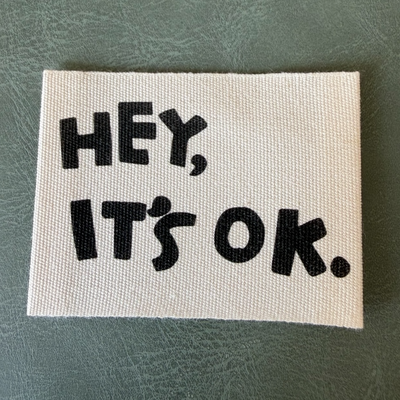
- Canvas label – a label made from a dense cotton or blended fabric, printed. Gives a natural, crafted look.
- Damask (damasco) – a high-density woven label made from fine polyester yarn of around 50 denier. Allows the finest detail and smallest text. The standard for brand labels.
- Heat transfer (transfer) – a print applied with heat and pressure directly onto the fabric. The basis of tagless garments.
- Jacquard label (etiqueta tejida) – a label whose design is woven on a jacquard loom rather than printed. An umbrella term covering damask, taffeta and satin.
- Metal label or plate – an alloy plate attached with prongs, rivets or stitching. Used outside on jeans, bags and hats.
- Patch (parche) – a larger label for exterior use: woven, embroidered, leather or PVC.
- Printed label (etiqueta estampada) – text and logo printed onto tape (satin, taffeta, cotton, nonwoven).
- Satin label (etiqueta de raso) – a soft, smooth label with a lustrous face. Can be woven or printed. Ideal for lingerie and babywear.
- Taffeta (tafetán) – a thin, cheaper base with lower detail. Often used for care labels.
- Woven label – any label produced by weaving, as opposed to printing.
 Printed canvas label LBL 0067 5.5 x 4 cm – with black letters, soft premium design, with logo
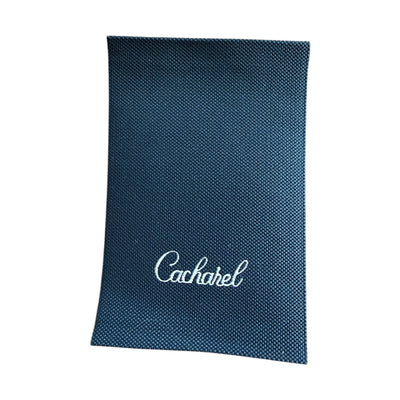
 Woven label 10 cm x 7 cm – print on fabric
 Jacquard woven label LBL 0046 5 x 5 cm – black background with gold letters, premium design, soft style, with logo
Technical parameters
- Denier – a measure of yarn fineness: grams per 9,000 m. Lower denier means a finer yarn and finer detail.
- Warp and weft (urdimbre y trama) – the lengthwise and crosswise threads. In labels the warp is usually uniform and the coloured wefts create the design.
- HD (high definition) – a label with extra-high weft density for very small text and hairlines.
- Colour count – how many different coloured yarns are used. Woven labels usually allow up to 8 including the base.
- Double-sided label – the design reads correctly on both faces. Needed for flags and scarves.
- Raised lettering – a technique where dense weaving makes letters stand above the background.
- Pantone reference – the colour code a supplier uses to pick yarns. For woven labels the closest available yarn is matched.
Folds and cutting
- End fold (doblez extremos) – both ends folded back. The label is stitched along its two short ends.
- Centre fold or loop fold (doblez medio) – the label is folded in half and both ends go into the seam. The classic neck position.
- Mitre fold (mitra) – ends folded at 45° so the label forms an L or T shape and is inserted into a side seam.
- Book cover fold – ends tucked under and the label folded once more in the middle, for a solid premium feel.
- Hanger loop – a label folded to form a hanging loop.
- Straight cut (solo corte) – labels cut to length with no fold.
- Heat cut (etiqueta fundida) – ends cut with a heated blade that melts and seals synthetic yarns. The edge is slightly firmer.
- Ultrasonic cut – cutting with ultrasound, which seals the edge more softly and is kinder to skin.
- Laser cut – contour cutting that allows round and shaped labels.
- Merrowed border – an edge wrapped in dense overlock stitching, typical of patches.
Attachment and placement
- Neck label – the main brand label in the back neck seam.
- Hem tag – a small flag in a T-shirt hem or side seam.
- Flag label – a centre-fold label that sticks out of a seam on the outside.
- Heat seal backing – an adhesive layer on the back activated with an iron or press.
- Care label (etiqueta de composición) – a label with composition, care symbols and often size. Usually in the left side seam.
- Hang tag – a card tag attached with a string or plastic pin and removed after purchase.
- Size tab – a small separate label carrying only the size, often next to the brand label.
Ordering and regulations
- MOQ (minimum order quantity) – the smallest quantity a supplier will produce. For jacquard labels it is tied to loom set-up; many ready designs start around 1,000 pieces.
- Sample (muestra) – a trial label made before bulk production.
- Artwork – the design file, ideally in vector format.
- Regulation (EU) 1007/2011 – the EU regulation on textile fibre names and composition labelling.
- ISO 3758 – the international standard for textile care symbols.
- OEKO-TEX Standard 100 – certification that a product has been tested for harmful substances; it also applies to labels as a garment component.
Tip: when you request a quote, always state five things – material (damask, satin, print), finished size in mm after folding, fold type, cut type and quantity. You will get an accurate quote first time.
How to use this glossary
Most misunderstandings in label orders come from three pairs of terms: woven versus printed, end fold versus centre fold, and heat cut versus ultrasonic cut. If you get these right in your brief, the rest is detail. When in doubt, send a photo of a label you like from another garment along with your artwork; suppliers can usually identify the construction at a glance.
Bul-tex manufactures woven, satin and printed labels; see examples in our labels collection, and for metal plates browse the accessories. If you have a question about any term or want a label to your own design, contact us. In-depth articles on each topic are in our label blog.