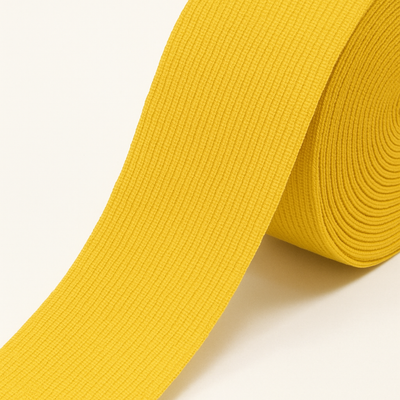
Elastic stretch, elongation and recovery are terms that confuse even experienced makers. The spec sheet says "elongation 150%", "recovery 95%", "rubber core, 9 ends" – and suddenly choosing between two elastics that look almost identical becomes a question of technical literacy. This glossary explains the key terms in plain language, shows how to read them on a specification and how to test elastic at home with nothing more than a ruler and a pen.
Core properties
Elongation
How far the elastic stretches relative to its original length, expressed as a percentage. A 10 cm piece that stretches to 25 cm has 150% elongation. The formula is: (stretched length − original length) / original length × 100. Most garment elastics sit in the 100–200% range.
Working elongation
The elongation at which the elastic actually works in the garment – usually well below the maximum. An elastic in a waistband that works at the limit of its range tires quickly.
Recovery
How well the elastic returns to its original length after stretching. If a 10 cm piece comes back to 10.3 cm, recovery is 97%. The higher the better – poor recovery means a baggy, saggy elastic.
Set
The opposite of recovery: the permanent extension left after loading. It is measured after a set number of cycles or after holding the elastic stretched.
Modulus or power
The force needed to stretch the elastic to a given elongation, usually in newtons or centinewtons. A high-modulus elastic is "strong" – right for waistbands and shapewear. A low-modulus elastic is "soft" – for babywear and pyjamas. Two elastics with the same elongation can have very different power.
Hysteresis
The difference between the force on stretching and the force on release. In practice, some energy is lost as heat. An elastic with high hysteresis feels "lazy" as it returns.
Creep
Gradual extension under a constant load – an elastic in a waistband that sits stretched all day, for example. It decides whether your trousers start slipping by mid-afternoon.
 Wide white knitted elastic band
 Turquoise knitted elastic band PEL 1016, 25 m roll
 Gray knitted elastic band PEL 1003 on a 25 m roll
Construction
Woven elastic
Made on a loom with warp and weft yarns. It keeps its width under tension, does not roll and is more stable. Good for waistbands and anywhere the elastic is visible or sewn directly.
Knitted elastic
Made on a knitting machine. Softer and lighter, but it narrows when stretched. Good for casings, underwear and kidswear. This is a key spec difference: if width under tension matters, choose woven.
Braided elastic
Made by braiding; it narrows a lot under tension and is usually narrow. Inexpensive, good for casings.
Core
The elastic yarns inside the tape – natural rubber or polyurethane (elastane, spandex). Rubber is cheaper and powerful; elastane is finer, more chlorine-resistant and suitable for people with latex allergy.
Covered yarn
An elastic yarn wrapped in polyester or nylon. The covering protects it and provides colour and handle. It can be thermo-fusible or non-fusible.
Ends
The number of elastic yarns across the width. More ends at the same width generally means more power.
Gauge
A measure of rubber thread thickness in which a higher number means a finer thread. Values somewhere in the 30–40 range are common.
Denier and dtex
Linear density of yarn: denier is the weight in grams of 9,000 m, dtex the weight of 10,000 m. For elastane, a higher dtex means a thicker, stronger yarn.
Picks per centimetre
The weft density of woven elastic. A denser weave is more stable and feels firmer.
Processing
Heat-setting
The elastic is treated with heat at a target elongation ratio to stabilise its stretch and "memory". Well heat-set elastic does not shrink or distort in the first wash.
Twisting and rolling
An elastic's tendency to flip over in a casing or curl at the edge. Woven elastics and denser constructions are less prone to it.
More useful terms
- Latex-free – elastic with an elastane core instead of rubber; important for allergy sufferers.
- Chlorine resistance – the ability to keep stretch in pool water; critical for swimwear.
- Width tolerance – the permitted deviation, usually ±0.5–1 mm; important when feeding a casing by machine.
- Picot – a decorative edge of small loops on lingerie elastics.
- Plush back – a brushed, soft inner face for contact with skin.
- Wash shrinkage – the change in length after washing; minimal on well heat-set elastic.
How to read a spec sheet
| Parameter | Example | What it tells you |
|---|---|---|
| Width | 30 mm ±1 mm | Whether it fits the casing |
| Construction | Woven | Will not narrow under tension |
| Composition | Polyester / rubber | Price, power, latex |
| Elongation | 150% | How far it stretches |
| Recovery | ≥ 95% | Whether it will sag |
| Power | N at 50% elongation | How firmly it grips |
For laboratory testing of the elasticity of narrow elastics and fabrics, the standard used is EN ISO 20932-1. For large runs, ask your supplier for data measured to it.
A five-step home test
- Cut a piece of elastic and mark exactly 10 cm with a pen.
- Stretch it until you feel it stop, without forcing, and measure between the marks. Work out the elongation.
- Hold it stretched for 1 minute.
- Release, wait 1 minute and measure again. Work out recovery: 10 / new length × 100.
- Repeat five times and compare – a good elastic barely changes.
Tip: with knitted elastic, measure the width under tension too. If 30 mm becomes 22 mm, you will see why it twists in the waistband.
The Bul-tex elastics collection includes flat woven and knitted elastics in widths from 1 to 10 cm, including woven elastics with OEKO-TEX certification. For more on elastic types and how they are made, see the Elastics section. If you need elastic made to your specification, get in touch.