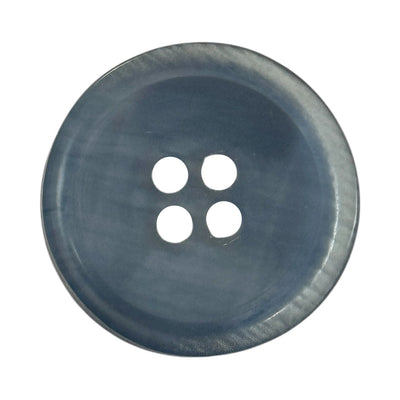
Recycled polyester buttons with GRS certification are the natural next step for brands already using recycled fabrics and labels. But "recycled" can mean very different things: a button made with PET bottles, a button made from factory scrap, a button with 20% or with 60% recycled content. And since 27 September 2026, EU rules on environmental claims require every such claim to be provable. In this B2B guide we explain what actually gets recycled into buttons, what GRS and RCS really certify, and the paper trail you should ask your supplier for.
What "recycled" can mean in a button
rPET from bottles
rPET is polyethylene terephthalate recovered from collected and reprocessed plastic bottles. In buttons it is used as part of the polyester mix. One example on the market: buttons with around 25% recycled content from PET bottles under the REPREVE brand.
Production waste (pre-consumer)
The skeletons left after punching sheets, rejected buttons and lathe shavings are ground and returned to a new mix. This way some makers reach about 60% recycled polyester. It's worth knowing this is pre-consumer waste — valuable, but not the same as recycling used products.
Bio-based additives
Some recycled buttons also contain biomass, such as sugarcane fibre (bagasse). That isn't "recycled" in the strict sense, but it reduces the share of fossil raw material.
 PB-292 COL 6 – Matte ecru polyester button with 2 holes
 Polyester buttons PPB 0030
 Blue polyester buttons PB0001
Typical recycled content
| Button type | Source | Typical share | Note |
|---|---|---|---|
| Polyester with rPET | PET bottles (post-consumer) | around 20–30% | Limited by strength and polishing requirements |
| Polyester from factory waste | Skeletons, rejects, shavings (pre-consumer) | up to around 60% | Colours are more limited, often dark and melange |
| Urea / mixed | Ground waste plus binder | 20–50% | Varies by maker |
| Metal | Recycled brass or zinc alloy | varies | Metals recycle easily, but documentation is still needed |
Why not 100%? Because recycled material affects transparency, colour and mechanical strength. Above a certain level the button becomes more brittle or loses its gloss. An honest figure is worth more than a maximal one.
There is a practical reason too: recycled feedstock varies from batch to batch. The maker has to adjust pigments at every casting to keep colour consistent, which is easier with a moderate share of recycled content.
GRS and RCS: what they certify
- GRS (Global Recycled Standard) verifies recycled content and its traceability through the supply chain, and adds social, environmental and chemical requirements for production. A product carrying the GRS label must contain at least 50% recycled material; for chain-of-custody purposes the standard applies from 20%.
- RCS (Recycled Claim Standard) verifies recycled content and traceability only, without the extra social and environmental criteria. It also works for lower percentages, from 5% upwards.
Both rely on third-party audits. Crucially, the certificate covers a specific company and specific products, and each shipment comes with a transaction certificate (TC) proving that this particular batch has the stated content.
The paper trail: what to ask your supplier for
- A copy of a valid scope certificate — check the company name, the validity dates and that buttons are within scope.
- A transaction certificate (TC) for your delivery — without it you can't use the standard's logo on your product.
- A declaration of the percentage and type of recycled content (pre- or post-consumer).
- Chemical safety data — REACH compliance and, where available, OEKO-TEX Standard 100.
- A technical spec — size, thickness and wash test results, so you know the recycled button performs like a standard one.
Tip: without a transaction certificate, don't write "GRS" on the label or in product copy. You can say "the buttons contain 25% recycled polyester according to the supplier's declaration", but you can't use the logo.
How to word the claim legally
Directive (EU) 2024/825 on empowering consumers for the green transition applies from 27 September 2026. It bans generic environmental claims without recognised excellent environmental performance, and bans claims about a whole product when they only concern part of it. For buttons, that means:
- Good: "Buttons made with 25% recycled polyester from PET bottles."
- Good: "Buttons contain 60% recycled polyester from production waste (GRS certified)." — only with a TC in hand.
- Risky: "Eco buttons" or "sustainable buttons" with nothing specific behind them.
- Misleading: "Recycled jacket" when only the buttons are recycled.
The full text of the directive is available on EUR-Lex.
Recycled or natural?
Recycled polyester reduces the use of virgin raw material, but the button is still plastic. Natural materials — corozo, coconut, wood, shell — are plant-based or mineral and biodegradable, but come with their own limits on washing and price. Many brands combine both: natural buttons where they're on show, recycled polyester for functional uses such as shirts and workwear.
Frequently asked questions
Do recycled buttons look different from standard ones?
Usually not. With high levels of production waste the colour range is narrower — dark, melange and marbled tones dominate, because the ground particles carry mixed colours.
Do they stand up to washing and dry cleaning like standard buttons?
Good recycled buttons are tested with the same methods as conventional ones — washing, ironing, dry cleaning and pull strength. Ask for the results before approving a run.
Can a small brand order recycled buttons?
Yes, but minimum quantities for buttons dyed to a swatch are usually higher than for stock designs. Choosing a colour from the maker's existing range keeps things simpler.
Do I have to state recycled content on the label?
No, but if you do — on a sewn label, a hang tag or online — the claim must be specific and provable.
Bul-tex manufactures and supplies garment trims and takes custom orders from brands. If you are looking for recycled buttons or want to check the documentation for a specific run, get in touch. In the meantime, browse our polyester buttons and natural buttons, and for sustainable labels see our labels section.