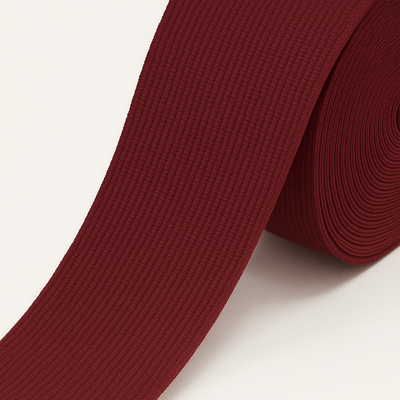
Trims cost per garment is where costings usually go wrong – not the fabric, which everyone calculates carefully. The surprises come from labels ordered at a minimum quantity, elastic calculated for a size M rather than XL, or freight nobody spread across the units. Trims typically add around 8–15% to the cost of a garment – enough to wipe out your margin if they're costed badly. Here is a step-by-step method to get them right.
The formula
For each line in the bill of materials (BOM), the trim cost per garment is:
Cost per garment = unit price × consumption per garment × (1 + wastage %) + one-off costs ÷ units + freight ÷ units
Add up every line and you have the trim budget for the style. Let's go through each part.
 Satin label 14 cm x 5 cm - satin print
 Jacquard woven label LBL 0041 4.5 x 3.5 cm – branded design with woven letters, soft premium style, with logo
 Metal zipper closed-end brown / gold teeth T5 PMZ1008
1. Unit price – in the right unit
Buttons are often quoted per gross (144 pieces), elastics and tapes per metre or per roll, labels per 1,000 and zips per piece at a given length. Before comparing quotes, convert everything into the unit that actually goes into the garment: one piece or one centimetre.
2. Consumption per garment – by size
This is the step most often skipped. Waist elastic for an XS and a 3XL can differ by 20–30 cm; a jacket zip by several centimetres. Work out consumption for every size and use the weighted average across the order's size ratio. Example for waist elastic with a 1-2-3-3-1 ratio (XS–XL):
| Size | Units | Elastic per garment (cm) | Total (cm) |
|---|---|---|---|
| XS | 10 | 62 | 620 |
| S | 20 | 66 | 1,320 |
| M | 30 | 70 | 2,100 |
| L | 30 | 74 | 2,220 |
| XL | 10 | 78 | 780 |
| Total | 100 | average 70.4 | 7,040 |
Add the seam allowance too – usually 2–3 cm per elastic.
3. Wastage
Some trims are lost in fitting, some turn out defective, some go on samples and tests. Indicative rates:
- Labels, buttons, snaps: 2–5% (closer to 5% for press-set metal snaps).
- Elastics and tapes by the metre: 3–5%.
- Zips: 1–2%.
Wastage gets paid for either way – if it's not in the costing, it comes out of the margin.
4. One-off costs and minimums
A mould for logo buttons, a woven label set-up, a printing plate – these are paid once but must be spread across the units. The same goes for the minimum order quantity: if you ordered 1,000 labels for a run of 300 garments, the real cost per label used in that run is the total divided by 300 – unless you're confident the other 700 will be used in later runs.
Good practice: spread one-off costs across the volume you expect over 12 months, not just the first run – but write the assumption down so you can check it later.
5. Freight and "hidden" costs
Shipping, duty on imports from outside the EU, bank charges for paying in another currency, time spent receiving and inspecting. Divide the total by the number of garments the delivery serves. On small orders from distant suppliers, freight can cost more than the trims themselves.
Worked example: a hoodie, run of 300
Placeholder values, purely to show the method:
| Trim | Consumption | Wastage | One-off | Per garment |
|---|---|---|---|---|
| Main woven label | 1 pc | 3% | — | a |
| Care and size label | 1 pc | 3% | — | b |
| Metal cord aglets | 2 pcs | 4% | — | c |
| Cuff and hem elastic | avg 1.35 m | 4% | — | d |
| Metal eyelets | 2 pcs | 5% | — | e |
| Hang tag with string | 1 pc | 2% | design / plate | f |
a + b + c + d + e + f is your trim budget. Compare it with the cost of fabric and making: if trims go above about 15% of the total, find out which line weighs the most.
Where to save and where to invest
Not every cent spent on trims is equally visible to the customer. Think along two axes: how visible the detail is, and how often the customer touches it.
- Invest in the main label, visible metal hardware, the zip pull and the hang tag – they make the first impression and justify the price.
- Optimise the invisible: elastic inside a casing, inner care labels, stock colours instead of custom dyeing.
- Standardise – the same buttons, eyelets and care label across several styles push up volumes and bring down unit prices.
Remember the markup effect: with typical retail pricing, every euro of cost turns into several euros on the shelf. So €0.20 more for a better main label can be your best investment, while €0.20 on an invisible detail can be your worst.
Common mistakes
- Costing the whole size range on a size M.
- No wastage in the BOM.
- One-off costs "forgotten" after the first run.
- Comparing quotes in different units.
- Treating freight as an overhead instead of spreading it per unit.
Bul-tex trims for your costing
Bul-tex manufactures and supplies labels, buttons, zips and elastics with prices shown on the site, which makes costing easier. For custom trims – logo labels, branded hardware – send us an enquiry with your quantities and we'll quote for your costing. More guides are in our production articles.
FAQ
Do hang tags and packaging count as trims?
Yes, if every unit gets them. Some brands put them on a separate "packaging" line, but what matters is that they sit in the unit cost, not in overheads.
How often should I recalculate the budget?
With every new quote, and whenever the size ratio or quantity changes. The same garment in a run of 100 and a run of 1,000 has a different trim cost.
What do I do with leftover trims?
If they're standard items, book them into stock and use them on the next run. If they're branded with a date or season, write them off against the current run's costing.