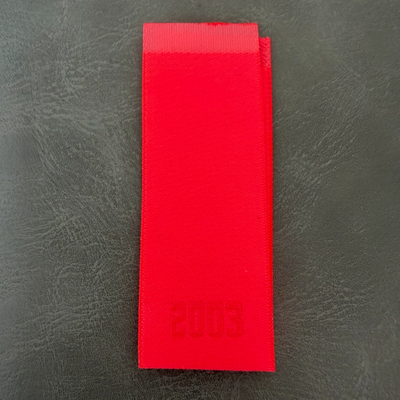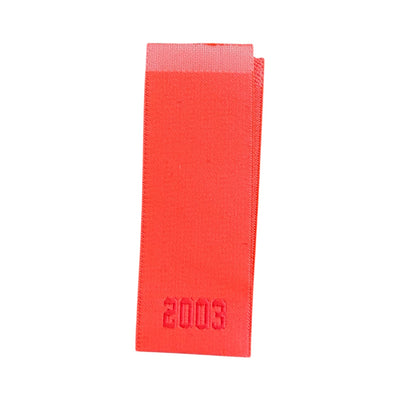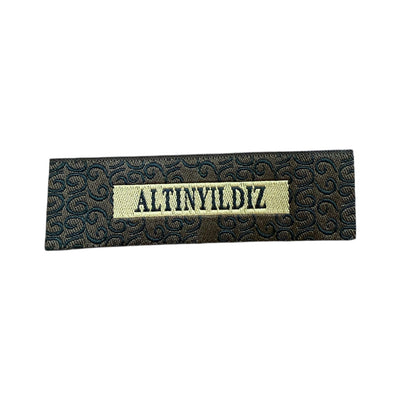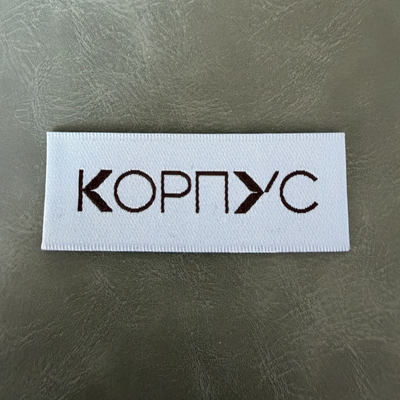


Woven edge vs cut edge labels look almost identical in a product photo – until you touch them. A woven edge is soft, smooth and cannot fray, because the edge was formed on the loom itself. A cut edge comes from slitting a wide cloth of labels apart, and however well it is sealed, it is still an edge. The difference comes down to the machine: a broadloom or a needle loom for narrow fabrics. This article explains how each one works, what you gain and lose, and how to choose for your brand.
How broadloom weaving works
A broadloom jacquard machine weaves a cloth roughly a metre wide, with labels arranged in columns side by side – dozens across and hundreds along the length. These are rapier, shuttleless looms with a computerised jacquard head that lifts every warp thread individually. That gives enormous freedom: any size, any shape, fine detail, text down to 5–6 pt at high density, and up to around 8–12 weft colours.
After weaving, the cloth is slit into strips and individual labels. The long sides of each label are cut – ultrasonically or with a hot knife that melts the polyester yarns and seals the edge. We covered cutting methods and why the edge matters so much for comfort in a separate guide to ultrasonic, hot and laser cutting; here we focus on the loom itself.
 Jacquard woven label LBL 0031 8.5 x 1.7 cm – multicolor style, soft premium design, with logo
 Woven label 8.5 cm x 1.7 cm - clothing labels
 Woven label 10 cm x 2.5 cm - decorative label
How needle loom weaving works
A needle loom is a narrow-fabric machine – the same family used to make ribbons, tapes, elastics and webbing. Instead of a shuttle, the weft is carried by a needle that swings back and forth through the shed, while a latch needle on the far side locks each loop and forms the edge. The result is a tape with a true woven selvedge on both long sides, like a ribbon. Makers such as Jakob Müller build these machines with many tapes running in parallel, and with a jacquard module they can weave a logo too.
The tape comes off the machine on a roll and is only cut across its width. With an end fold or centre fold, even those short cut ends disappear into the seam, so only woven edges touch the skin.
Comparison: broadloom vs needle loom
| Criterion | Broadloom (cut edge) | Needle loom (woven edge) |
|---|---|---|
| Edge | Cut and sealed; can scratch if poorly cut | Woven, soft, cannot fray |
| Width | Virtually any | Limited – narrow tapes, typically up to a few centimetres |
| Shape | Rectangles plus die-cut or laser-cut shapes | Rectangle (tape) only |
| Detail and colours | High density, many colours, HD detail | Simpler artwork, fewer colours, larger text |
| Softness | Depends on cutting and density | Usually softer at the edges |
| Look | Modern, clean rectangle | Classic, vintage, ribbon-like |
| Best for | Complex logos, small detailed labels, shaped labels | Neck labels for underwear and kidswear, scarves, knitwear, heritage ranges |
So why are most labels made on broadloom?
Three reasons. First, design freedom: modern logos often have thin lines and small type that a needle loom struggles to reproduce. Second, size flexibility: a broadloom can weave labels of different widths in one set-up, whereas a needle loom is tied to a given tape width. Third, efficiency on complex orders: several designs for the same brand can share one cloth. A well-cut broadloom label, especially one cut ultrasonically and then folded, is perfectly comfortable. The "itchy label" complaint almost always comes from cheap cutting, stiff taffeta or poor placement, not from the technology itself.
When a woven edge is worth it
- Next-to-skin garments – underwear, nightwear, baby and children's clothing, where every edge is felt.
- Knitwear and scarves – soft knits rub against a cut edge and, over time, can pill or fray around it.
- Vintage and heritage looks – the ribbon-like edge is typical of classic tailoring and instantly says craftsmanship.
- Loop-fold hanger labels – a woven edge holds the loop shape better.
Practical middle-ground options
If you like the softness of a woven edge but need broadloom detail, there are compromises:
- End fold – hides the short cut ends; the long sides stay cut but are smooth when ultrasonically cut.
- Centre fold – hides one long side; the label is doubled, denser and softer to the touch.
- Satin ground – a woven label with a satin-weave ground is softer than taffeta and less scratchy.
- Detailed woven label on the outside only – put the detailed label outside (hem tab or flag label) and use soft printed satin inside.
Tip: when you ask for a quote, ask directly "cut edge or woven edge?" and request a physical sample. The difference is obvious in the hand but hard to see in a photo.
What Bul-tex offers
In our labels collection you will find jacquard woven labels from the LBL series – including slim, long designs suited to folding into a seam – plus printed canvas and satin labels. Bul-tex manufactures labels to the customer's design; if you are unsure which edge suits your garment, describe it to us through the contact page. For decorative narrow fabrics – ribbons and tapes woven on the same family of machines – see our ribbons collection.
FAQ
Is a woven edge more expensive?
It depends on the artwork and quantity. With a simple design and a standard width the difference is small; with a complex logo, broadloom is often more efficient.
Can a woven-edge label have a custom shape?
No. It is always a tape – a rectangle of fixed width. Shapes such as circles, shields or diamonds come from broadloom with laser cutting.
How can I tell a woven edge from a cut edge?
Look at the long edge: on a woven edge the weft threads turn around and travel back, like the edge of a ribbon; a cut edge shows a faint melted line.