When you start a clothing brand today, the trims question arrives fast: you can launch with 50 or 100 pieces per style, far fewer than a decade ago, but most branded trims come with minimum order quantities that seem to clash with a small run. A woven logo label, a metal button with an engraved name or a jacquard elastic with your brand on it are made in hundreds or thousands. So how does a new brand look professional without freezing its budget in a box of trims? Here are the steps most successful small brands follow.
Step 1: Split trims into "branded" and "standard"
Not every trim needs your logo. Customers notice the main label, the hang tag and the packaging; those are the first three brand touchpoints. A shirt button, the elastic inside a casing and a side-seam zipper rarely get a second look. Divide the list in two from day one:
- Branded (made to order): main label, hang tag, perhaps a packaging sticker.
- Standard (from stock): buttons, zippers, elastics, snaps, thread, cord ends, care labels.
Standard stock trims keep both the minimum quantity and the lead time low, which makes them ideal for a small run.
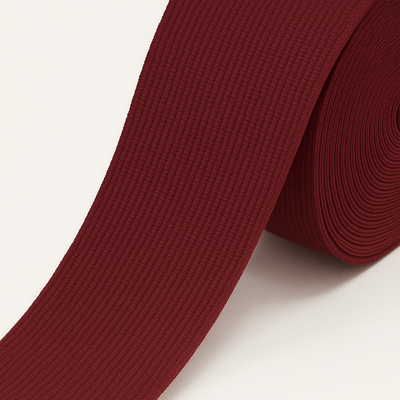
 Bordeaux knitted elastic band PEL 1013 on a 25 m roll
 Satin label 14 cm x 5 cm - satin print
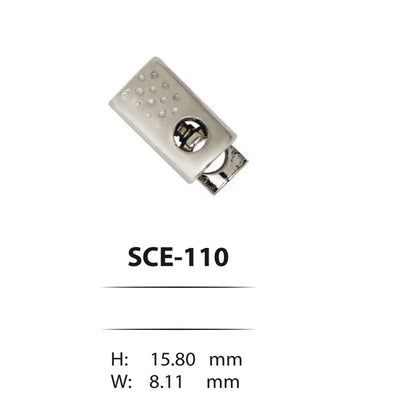
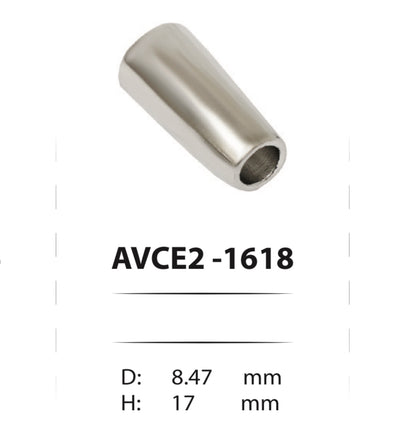
 Metal cord and elastic stoppers 110 – single hole (5 mm), dotted design
Step 2: Choose your main label wisely
The main label is the first thing worth branding. You have three main routes:
| Option | Typical minimum | Best for |
|---|---|---|
| Jacquard woven label | usually several hundred to 1,000 per design | Several styles and a settled logo |
| Printed satin or woven-tape label | lower; small quantities possible | Test runs and a quick start |
| Printed canvas label | low | A natural, crafted look |
One logo label can serve every style, so 1,000 jacquard labels cover ten styles of 100 pieces. If needed, size and composition can go on a separate label. Our range includes labels printed with your logo as well as jacquard designs with a 1,000-piece minimum.
Step 3: Buy standard trims from stock
With standard trims, a small brand has an advantage: it can buy exactly what it needs. Work out the quantity like this:
Pieces per garment × number of garments + 5–10% spare = order
Example: a hoodie with two metal aglets and two eyelets, run of 80. You need 160 aglets and 160 eyelets, plus about 10 spare, so order 170–180 of each. The spare covers losses during setting and future repairs.
See our snap fasteners and elastics on the roll, which you can order without large minimums.
Step 4: Run a 50–100 piece sample batch
Low MOQ in apparel usually means 25 to 100 pieces per style. The sample batch is where you find problems before they become expensive: a button that pulls off in the wash, a zipper that jams in heavy fabric, a label that scratches the neck. Use it to:
- Wash at least three to five pieces according to the care label.
- Check that snaps and rivets suit the fabric; fine jersey needs reinforcement.
- Put the product in front of 10–20 real customers and collect feedback.
- Measure the actual thread, elastic and tape consumption per piece.
Step 5: Work with a nearby producer
A trims manufacturer and a sewing unit close to you give a small brand what distant suppliers struggle to: short lead times, the chance to see samples in person and a direct conversation. When delivery takes days rather than weeks, you can order in smaller batches and avoid holding big stock. From Bulgaria we ship across the EU with DHL Express.
Step 6: Plan the next layers of branding
Once sales prove a style, add branded details gradually where customers see and touch them:
- Metal aglets or a metal logo badge on hoodies and bags.
- Buttons or rivets with an engraved logo on jeans and jackets.
- Jacquard elastic with your name for underwear and activewear.
- A logo zip puller.
These trims carry higher minimums and longer lead times, so it makes sense to order them once you know which styles will repeat.
Common mistakes new brands make
- A different main label for every style. It multiplies minimums and budget, and customers will not notice the difference.
- Ordering branded metal hardware before the sample batch. If the style changes, you are left with hundreds of buttons or rivets that no longer fit.
- No spare quantity. On a run of 100, five missing buttons means five garments you cannot sell until the next delivery arrives.
- Forgetting composition and care labels. Without them the garment cannot legally be sold in the EU.
- Fashion colours for standard trims. Neutral zippers and elastics carry over to the next collection; a seasonal shade rarely does.
FAQ
How much do trims cost per piece for a small brand?
It depends heavily on the style and quantity. As a guide, trims are a small share of the cost of a T-shirt, while on jeans and outerwear the share is larger because of metal hardware. Cost it out for each specific style.
Do I need a composition label if I only sell online?
Yes. Regulation (EU) 1007/2011 applies to every textile product placed on the EU market, whatever the sales channel.
Can I use one main label for all styles?
Yes, and it is the most sensible way to start. Size can sit on a small separate label, with composition and care on the side-seam label.
Bul-tex manufactures and supplies trims and accepts custom orders to a brand's design. If you are starting your own label, send us the number of styles and your planned run and we will suggest a realistic package. Read more about branding in the Labels section.