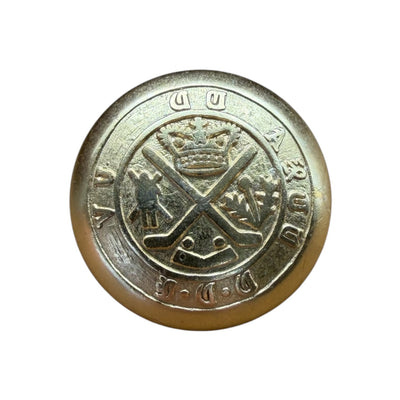
Removable buttons with split rings are an old but very clever solution. The button isn't sewn on; its shank passes through a small hole in the fabric and is locked on the inside with a split ring, a cotter pin or a metal clip. That means the button comes off in seconds before dry cleaning, polishing or moving to another garment. It is standard on ceremonial uniforms, livery, hotel and security uniforms, and increasingly on expensive coats with decorative metal buttons. This guide explains how the system works, when it is worth using, and how to fit it step by step.
How a removable button works
The system has three elements:
- A shank button. At the back there is a metal loop, soldered or formed onto the back. Without a shank the system doesn't work.
- A hole in the garment. A small eyelet or finished opening through which the shank passes from the face to the inside.
- A retainer on the inside. Most often a split ring, like a tiny key ring wound through the shank loop. Alternatives are a cotter pin (a bent split pin), a T-shaped clip or a dedicated spring clip for uniform buttons.
With the ring in place the button sits snugly against the fabric and can't come out. Wind the ring off and the button lifts out in seconds.
 MC 1772 crest metal buttons – Gun Metal 20 mm with shank for suits and jackets
 Gold buttons MC 2110 Col E109 – 22 mm with crest for suits and coats
 Metal coat of arms buttons 6-Z538 Col 292 – Gun Metal 22 mm with shank
Why uniforms and luxury coats use them
Dry cleaning
Solvents and pressing in dry cleaning can damage enamel, lacquer, patina or gilding. Buttons with hand-applied enamel or an antique finish should come off before cleaning. A removable system saves unpicking and re-sewing after every clean.
Polishing
Brass buttons on ceremonial uniforms are polished regularly. Polish leaves marks on wool, so the buttons are removed, polished separately and put back.
Swapping and reuse
The same crest buttons can move from a summer to a winter uniform, or from an old jacket to a new one. For institutions paying for logo buttons, that is a real saving.
History
In military uniforms, shank buttons inserted through holes in the cloth became common after the First World War. The removable system let one uniform carry different insignia buttons.
Types of retainer
| Retainer | Pros | Cons | Best for |
|---|---|---|---|
| Split ring | Cheap, secure, won't open by itself | Slower to fit; needs a fingernail or tool | Uniforms, coats, jackets |
| Cotter pin / bent clip | Flat, invisible, sits under the lining | Metal fatigues with frequent changes | Ceremonial uniforms with many buttons |
| T-clip | Fastest removal | Bulkier, can be felt | Livery, stage costumes |
| Safety pin | Improvised | Not professional, can come undone | Temporary use only |
How to fit removable buttons, step by step
- Choose the button. The shank must be long enough to pass through every layer: cloth, interfacing, facing. For a heavy coat, look for a button with an extended shank.
- Mark the position. Use the same marking as for a sewn button. On double-breasted garments, check that both rows line up horizontally.
- Reinforce the spot. On the inside, fuse or stitch a small patch of interfacing or firm fabric, about 2 × 2 cm. Without it the hole stretches under the weight of a metal button.
- Make the opening. Options: a small metal eyelet with an inner diameter about 1 mm larger than the shank loop; a hand-worked opening like a mini buttonhole; or a punched hole with a bound edge. On wool and tweed, a hand-worked opening is the most elegant.
- Pass the shank through. Insert it from front to back and check the orientation of the crest or motif; it should stand upright.
- Lock it. Wind the split ring through the loop until it closes completely. With a cotter pin, pass it through and bend the ends.
- Test. Pull the button forward and sideways. It should sit firmly without wobbling.
Tip: if the lining is closed, leave a small opening or a zip behind the facings so you can reach the rings without unpicking. On uniforms this is standard practice.
Removable buttons on civilian clothing
The system isn't only for uniforms. Here are a few civilian uses where it adds real value:
- A coat with jewellery buttons. Buttons with crystals, enamel or hand patina often cost more than the cloth. Removable fitting protects them at the dry cleaner and lets them move to the next coat.
- Stage and historical costumes. One set of buttons can serve several costumes, and the costumes can be cleaned without risk to the buttons.
- Waistcoats for suits. Historically, waistcoats often had removable buttons so they could be changed for the occasion: evening, everyday or mourning.
- Brand limited editions. A brand can offer a button set as a separate accessory that the customer fits themselves.
What to watch when ordering
- Shank loop size determines the size of the hole and ring. Measure loop width and thickness with calipers.
- Shank length must suit the thickness of the cloth at the fastening point.
- Ring material: stainless steel or brass. A cheap steel ring rusts and stains the inside.
- Spare sets. Rings get lost more easily than buttons; plan at least 10% extra.
Frequently asked questions
Can any button be made removable?
Only shank buttons. Two- and four-hole buttons have to be sewn. A compromise is to sew them onto a small backing plate, but it rarely looks good.
Is a removable button weaker than a sewn one?
No, as long as the hole is reinforced and the ring fully closed. A metal loop and ring hold more than thread.
Do I need to remove the buttons for every clean?
For dry cleaning it is recommended with enamelled, gilt or patinated buttons. With ordinary nickel-plated buttons it isn't essential, but it protects both buttons and fabric.
Shank buttons from Bul-tex
Bul-tex offers a wide range of metal shank buttons, with crests, plain and designer styles, plus coat buttons that suit a removable system. For retainers and for logo buttons for uniforms, contact us; we take custom orders from institutions and brands. Read more about button types in our buttons category.