Woven patch vs embroidered patch vs woven label: the three get mixed up constantly, because all of them carry a brand logo and all of them get sewn onto clothing. The differences matter, though. They are made with different processes, have different thicknesses, render detail differently and are attached differently. The choice affects how the product looks, how it feels and how much it costs at volume. This article puts them side by side and gives clear rules for when to use which.
The three products in brief
Woven label
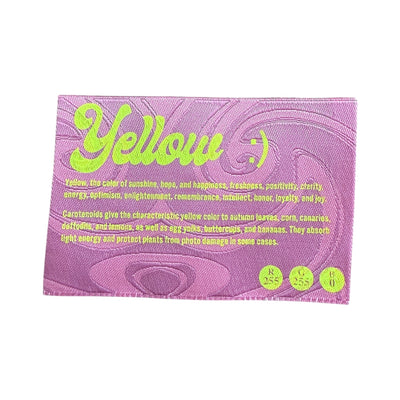
A woven (jacquard) label is produced on a jacquard loom from fine polyester yarns. The design is part of the fabric itself rather than applied on top. It is thin, around 0.3–0.5 mm, and soft, and it goes inside the garment at the neck, in a side seam, or as a small flag outside. Its main job is brand name, size or care information.
Woven patch
A woven patch uses the same technology but is meant for the outside of the product. It is larger, often on a denser base, with a finished edge (heat cut, ultrasonic cut, or a merrowed overlock border) and sometimes with a heat-seal backing. Essentially it is a woven label that has moved to the face of the garment.
Embroidered patch
An embroidered patch is made on an embroidery machine: thick threads are stitched one by one onto a twill or felt base. It is raised, 1.5–3 mm thick, and has the crafted look familiar from uniforms, sports clubs and workwear brands.
 Woven label 8 cm x 3 cm - brand and logo
 Jacquard woven label LBL 0030 6 x 3 cm – black style with white letters, soft premium design, with logo
 Woven label 5 cm x 5 cm – logo for brands
Side-by-side comparison
| Criterion | Woven label | Woven patch | Embroidered patch |
|---|---|---|---|
| Process | Jacquard weaving | Jacquard weaving | Machine embroidery |
| Thickness | 0.3–0.5 mm | 0.5–1 mm | 1.5–3 mm |
| Smallest legible text | about 1.5–2 mm | about 1.5–2 mm | about 4–5 mm |
| Colours | usually up to 8 | usually up to 8 | up to 12–15 threads |
| Look | Flat, fine | Flat, graphic | Raised, textured |
| Placement | Inside or small flag | Outside | Outside |
| Unit cost at high volume | Lowest | Low | Higher |
Detail: why weaving wins on small lettering
Jacquard weaving uses far finer yarns than embroidery, so woven labels and patches reproduce thin lines, small letters and complex logos much more accurately. Embroidery thread is thick; below 4–5 mm text height the letters start to merge, counters in "e" and "a" close up and fine serifs disappear. If your logo has hairlines, a dotted gradient or a tagline in a small font, a woven patch is the right call.
Embroidery wins where you want relief and a crafted feel: big letters, simple shapes, bold solid colours. Varsity logos, crests and club names usually look better embroidered.
Attachment: stitching or heat-seal backing
Both woven and embroidered patches can be attached in two ways:
- Sew-on. The most durable option. The patch is stitched around its perimeter 1–2 mm from the edge. It survives any number of washes and the corners never lift.
- Iron-on (heat seal). A layer of thermoplastic adhesive on the back is activated with an iron or heat press. It is quick to apply and handy for home users, but with frequent washing, especially above 40 °C, the corners begin to peel.
- Both. Many manufacturers heat-press the patch to fix its exact position and then stitch it. Nothing shifts during sewing and durability is maximal.
Rule of thumb: for garments that are washed often (hoodies, workwear, kidswear), always stitch. Iron-on alone is fine for accessories and items that rarely see a washing machine.
Cost and volume
With woven products you mainly pay for loom set-up; once running, metres of label tape are woven quickly, so at a few thousand pieces the unit price drops noticeably. With embroidery every patch takes a fixed number of stitches and machine time scales with size and density, so the price falls more slowly as quantity grows. A rough rule: the larger the run and the finer the detail, the more sense a woven solution makes.
How to prepare your artwork for a patch
Whichever process you choose, the file decides half the result. Send the logo as a vector (AI, EPS, PDF or SVG) and state the finished size in millimetres. Limit colours: in weaving each colour is a separate yarn and in embroidery a separate thread change, so six colours instead of twelve nearly always look cleaner. Remove gradients and shadows; neither a loom nor an embroidery machine reproduces them well, and weaving can only imitate them with a dot pattern. Check the thinnest line in the logo: for woven products it should be at least 0.5 mm, for embroidery at least 1 mm. Finally, think about the edge: round and shaped patches need laser cutting or a merrowed border, while for rectangles heat-cut or folded ends are the most economical option.
When to choose which
- Inside brand, size, care – woven label (or satin for maximum softness).
- Outside logo with fine detail or small text – woven patch.
- Large, raised logo with a vintage or sporty character – embroidered patch.
- Stretch fabrics (knitwear, jersey) – woven patch, as it is thinner and more flexible.
- Denim, jackets, backpacks – both work; for an even more premium look consider a metal label.
FAQ
Can a woven label be used as an outside patch?
Yes. A square or rectangular jacquard label with heat-cut or folded ends, stitched to a pocket or sleeve, is the simplest woven patch there is. Many small brands start exactly this way.
Does a patch need fibre composition information?
No. Labels and badges are listed in Annex V of Regulation (EU) 1007/2011, so they are not labelled themselves. The garment they are sewn on still needs its own composition label.
How many washes does a woven patch survive?
A sewn-on polyester woven patch keeps its colour and shape through normal domestic washing and usually outlives the garment.
Bul-tex manufactures jacquard woven labels to the customer's design; browse ready examples in the labels collection. For a metal accent see our accessories, and for a patch with your logo in a non-standard size, contact us. More on label types is in our blog.