

Ultrasonic cut labels are the reason some labels feel soft along the edge while others scratch like a tiny saw. When a customer cuts the label out of a garment, the culprit is usually not the material but the edge. The cutting method is one of the most important factors behind label itch. This comparison looks at the three main methods (hot cut, ultrasonic cut and laser cut), the edge each one leaves, where each is used, and how to pick the right one for your garment.
Why the edge needs sealing at all
Woven and satin labels are produced as a long tape that is then cut into individual pieces. If you simply snip polyester tape with scissors, the threads at the end start fraying immediately. So with synthetic labels, cutting is combined with sealing: the threads at the edge are melted and fused. The difference between methods is exactly how that melting happens, and therefore what kind of edge you get.
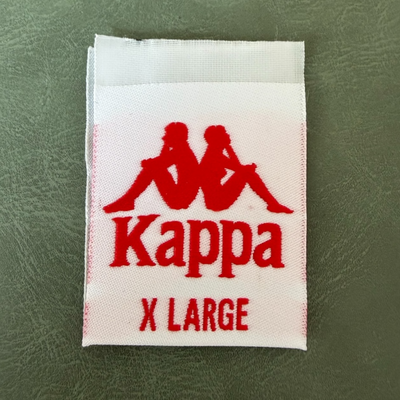
 Jacquard woven label LBL 0052 10 x 4 cm – double-sided white with red letters, soft premium design, with logo
 Woven label 8 cm x 4 cm – jacquard, folded
 Woven label 9 cm x 4.5 cm – for brands
The three methods at a glance
| Method | How it works | Edge | Shape | Best for |
|---|---|---|---|---|
| Hot cut | A heated blade melts through the tape | Hard, sometimes sharp, with a visible melted strip | Straight line | Labels inside seams, away from skin; workwear; accessories |
| Ultrasonic cut | High-frequency vibration creates heat only along the cut line | Soft, smooth, finely sealed | Straight or shaped with a die | Neck labels, underwear, childrenswear, shirts |
| Laser cut | A laser beam vaporises and fuses material along the outline | Sealed and precise; can be slightly firm or darkened on pale colours | Any shape | Shaped labels, appliques, patches |
Hot cut: cheap, with a trade-off
Hot cutting is the simplest and fastest method. A heated blade passes through the tape and melts it. The catch is that melted polyester cools into a thin, hard plastic strip. If the blade is not perfectly set, small "teeth" are left along the edge too. That is what creates the prickly feeling when the label rests against skin.
Hot cut works well where the edge never touches skin: labels fully hidden in a seam, end-fold labels where the cut edge is turned under, or labels on bags and accessories.
Ultrasonic cut: the comfort standard
With ultrasonic cutting, the tool vibrates at very high frequency. Friction generates heat only along the narrow contact line, so melting is minimal and controlled. The result is an edge sealed against fraying that stays soft and flexible, with no hard plastic strip.
With a suitable die, ultrasonic tools can also cut simple shapes such as rounded corners and ovals. That makes it the most common choice for neck labels, underwear, and children's and baby clothing. If you are getting complaints about itchy labels, switching from hot cut to ultrasonic is the first thing to try.
Laser cut: freedom of shape
A laser can cut an outline of any complexity: a logo shaped like an animal, a star, a letter, an asymmetric silhouette. The beam itself seals the edge, so shaped labels do not fray. Spanish and Western European label makers often list it as a separate option specifically for shaped labels.
There are two caveats. First, on very pale colours the laser can leave slight darkening along the edge. Second, with the wrong settings the edge can end up firmer than an ultrasonic one. So laser cutting is best suited to exterior labels and patches rather than labels lying directly against skin.
How to choose: a decision tree
- Does the label touch skin (neck, waistband, underwear)?
- Yes: ultrasonic cut, or a fold that hides the edge.
- No: go to question 2.
- Is the label shaped (not a rectangle)?
- Yes, a complex outline: laser cut.
- Yes, just rounded corners: ultrasonic with a die.
- No: go to question 3.
- Are the cut ends hidden in a seam or folded under?
- Yes: hot cut is an economical, acceptable choice.
- No: prefer ultrasonic.
Tip: when a label is end-folded or centre-folded, the cut edge is partly or fully hidden. We cover fold types and how they affect comfort in our other articles about labels.
How to specify it on your order
The cutting method is rarely assumed. If you do not specify it, the manufacturer may choose the cheapest. State clearly on your request:
- cut type: hot, ultrasonic or laser;
- shape: straight, rounded corners (give the radius, for example 2 to 3 mm) or shaped to the outline in your file;
- fold: none, end fold, centre fold, mitre;
- where the label will be sewn: neck, side seam, outside;
- who the garment is for: adults, children or babies, since babywear sets the highest bar for edge softness.
That last point lets the manufacturer warn you if the chosen edge does not suit the position. Ultrasonic cut plus rounded corners is the safest combination for a label that sits directly against skin.
What about cotton labels?
Cotton does not melt; it burns. That is why cotton and canvas labels cannot be heat-sealed by any of the three methods. The solutions are folding the ends, overlocking the edge, or sewing the label so the cut edges stay inside the seam. Poly-cotton blends with enough synthetic content can be sealed.
Troubleshooting: the label itches
- The edge is hard and sharp: probably hot cut; request ultrasonic on your next order.
- The corners prick: ask for rounded corners or an end fold.
- The whole label is stiff: the issue is the material or finish; consider satin or a finer yarn.
- The label frays: the edge is not sealed, or it is cotton without a fold.
- It is sewn with harsh thread: check the thread; soft polyester thread helps. See our threads.
Bul-tex manufactures woven, satin and printed labels to customer designs. Browse the labels in our catalogue, and if you are unsure which cutting method suits your garment, drop us a line and we will advise.