Urea vs polyester buttons: in a photo they can look almost identical, but in production and in wear they behave differently. Urea (urea-formaldehyde resin) is compression-moulded in heated tools and is exceptionally resistant to heat and chemicals. Polyester is cast, colours freely and can imitate almost any material. Which should you choose for shirts, trousers, workwear or coats? Here is a side-by-side comparison and a simple decision guide.
What urea and polyester are
Urea buttons are made from urea-formaldehyde resin, a thermoset. A powdered mix of resin and filler (usually cellulose) is pressed in heated moulds, where it cures irreversibly. The finished button cannot be melted again and cannot be dyed after moulding: colour goes into the raw material. To get a natural look, such as horn or nut, layers of different colours are built up before pressing.
Polyester buttons are made from unsaturated polyester resin, which cures at room temperature with a catalyst. The liquid resin is cast into sheets or rods, from which buttons are cut and turned. Colour can be adjusted freely with pigments, pearl effects, layers and clear zones. Polyester can also be dyed after turning, which makes fast colour matching to fabric possible.
 White urea shirt buttons PUB 2638 Col 0001 – 9, 10 and 11 mm
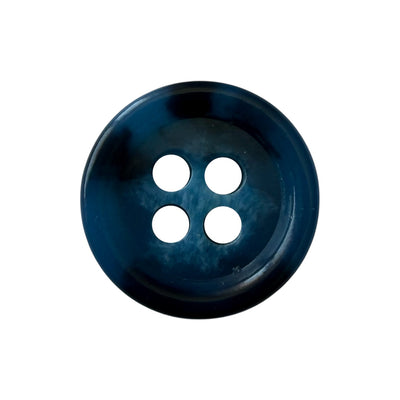
 Blue urea shirt buttons PUB 2638 Col 0044 – 9, 10 and 11 mm
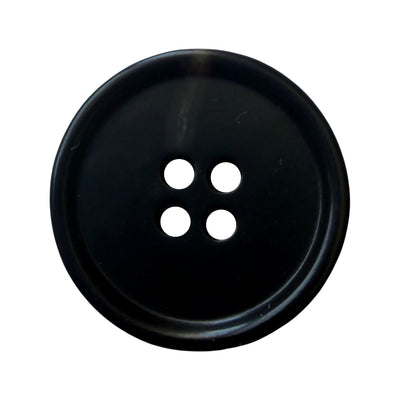
 Black urea shirt buttons PUB 2638 Col 0016 – 9, 10 and 11 mm
Comparison by criteria
| Criterion | Urea | Polyester |
|---|---|---|
| Production | compression moulding in heated tools | casting sheets and rods, then turning |
| Colouring | in the raw material only; not after moulding | free, including after turning |
| Look | solid, opaque, matte to semi-gloss | clear to pearlescent, marbled, horn and shell effects |
| Heat resistance | excellent; handles ironing and pressing | good, but prolonged contact with a very hot iron can dull or distort it |
| Chemical resistance | excellent; industrial laundering, dry cleaning | good under normal care |
| Impact and weather resistance | very good | good |
| Design flexibility | limited; each model needs a mould | very high; new models without new tooling |
| Typical use | workwear, trousers, shirts, uniforms | fashion, shirts, jackets, coats, knitwear |
Why workwear loves urea
Urea offers excellent resistance to weathering, impact, chemicals and heat. That is why it is traditionally used for workwear and bottoms: trousers, jeans and overalls. These garments are washed often, sometimes industrially, at high temperatures and with strong detergents, and then go through pressing machines. A polyester button in that regime can lose its shine, while a urea button stays almost unchanged.
Urea is also favoured for shirts that are ironed heavily, in hotels, restaurants and hospitals, and for uniforms, where every button replacement costs time.
Why fashion runs on polyester
Fashion wants variety, short lead times and exact colour. Polyester delivers all three. Dozens of different models can be turned from one cast sheet, and the colour can be adjusted until it matches the fabric. Pearl pigments and layered casting imitate shell, horn, corozo and marble, with a consistent look from batch to batch. That is why most buttons on the market, from shirts to coats, are polyester.
Decision guide
- Will the garment be industrially laundered or washed at 60–90 °C? Urea.
- Will it go through a pressing machine after every wash? Urea.
- Do you need an exact Pantone or fabric match? Polyester.
- Do you want a pearl, clear or marbled effect? Polyester.
- Want a horn look for a jacket? Polyester for fashion collections, urea for uniform jackets that get heavy care.
- Need a new model in a small quantity? Polyester, as it needs no new mould.
- A classic white shirt for everyday wear? Both work; urea stands up better to ironing, polyester offers more looks.
Tip: if you sell workwear or uniforms, ask your supplier for wash colourfastness data and check the button after 10–20 cycles in the customer's real laundry regime. That way, problems surface before the production run.
What about formaldehyde?
Urea-formaldehyde resin contains formaldehyde in its chemical structure, so it is sensible to ask your supplier to confirm compliance with free formaldehyde requirements. OEKO-TEX STANDARD 100, for instance, sets limits for free formaldehyde in articles with skin contact and stricter ones for baby articles. A well-cured urea button releases very little, but the paperwork is good practice, especially for childrenswear.
Urea and polyester buttons at Bul-tex
In our button collection you will find PUB 2638 urea shirt buttons in 9, 10 and 11 mm (14L, 16L and 18L), 4-hole, in white, grey, green, beige, blue, dark red and black, plus suit buttons in 15 and 20 mm in ten shades. Our polyester buttons run to hundreds of models: gloss and matte, mottled, pearl-effect, for shirts, suits and coats, alongside shirt buttons in various materials. If you are preparing a workwear or uniform run, get in touch and we will help you pick the material. You will find more comparisons in our button articles.
Frequently asked questions
How can I tell urea from polyester?
Not easily by eye. Urea is usually fully opaque, with a dense, almost ceramic look, and feels heavier in the hand. Polyester often has a pearly sheen, clear zones or a marbled pattern, and its rim can look slightly translucent against the light. The reliable way is to ask your supplier or check the model's specification.
Is urea more expensive than polyester?
For standard models, prices are comparable. The difference shows with new designs: urea needs a press mould, which makes small runs more expensive, while polyester can be turned into a new shape without new tooling.
Can urea buttons be used on fashion garments?
Yes. Classic urea shirt and suit buttons look clean and elegant. The limitation lies in the range of effects rather than the look itself; for pearl, clear or marbled buttons, choose polyester.
Can polyester buttons be ironed?
Yes, with normal home ironing. Problems arise with prolonged contact with a very hot iron or with industrial presses, where urea is the safer choice.