

Velcro vs snaps is the question every maker of babygrows, kids' jackets or adaptive clothing for older people and those with limited mobility ends up asking. The two closures, along with classic buttons, differ hugely in how much strength and precision they demand from the fingers, how they cope with washing and how safe they are. Here we compare them on five criteria and make a concrete recommendation for each garment.
The three contenders in brief
- Velcro (hook-and-loop) – two tapes, one with hooks and one with loops, that grab when pressed together. Closed with the palm, no precise movement needed.
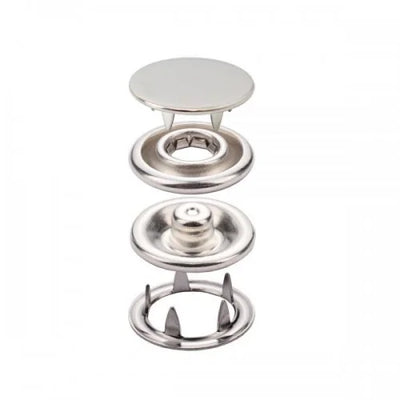
- Snaps (press studs) – two parts, male and female, that click together under pressure. They come as sew-on, metal press-fitted and plastic types (POM/polyacetal "Chico"-style).
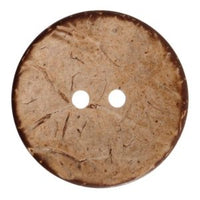
- Buttons and buttonholes – the classic, needing the most fine motor control, but with the best look.
 Chic MF AL 78 Snap Fasteners – 7.8 mm Gun Metal
 Gold metal buttons with black enamel 34027 Col 0220 – 22 mm designer model
 Snap fasteners E-2278 Gun Metal 40 mm – 4 pieces, "Teardrop" design, Luxury model
Side-by-side comparison
| Criterion | Velcro | Snaps | Buttons |
|---|---|---|---|
| Fine motor skill needed | Minimal | Moderate (needs a firm press) | High |
| Strength needed | Low to close, moderate to open | Moderate, depends on model | Low |
| Washing | Collects lint, hooks snag other clothes | Excellent if the metal resists corrosion | Excellent |
| Durability | Loses grip over cycles | Thousands of cycles | As long as it's well sewn |
| Noise | That ripping sound when opened | Quiet click | Silent |
| Comfort against skin | Hooks can scratch | Good with a smooth back | Good |
| Look | Sporty, "functional" | Clean, can be hidden | Classic |
Durability: what a "cycle" means
Hook-and-loop makers talk about cycle life – the number of openings and closings after which the tape has lost about half its original strength. Interestingly, stronger grades often have a shorter cycle life, because stiffer hooks break sooner. On a child's garment fastened four or five times a day, that means a noticeable loss of grip within months. Sew-on hook-and-loop survives laundering and dry cleaning well, but the loops fill up with lint and dust.
Snaps don't suffer from that kind of fatigue; fitted correctly, they work as long as the garment lasts. Their weak point is fitting: a badly set metal snap can tear out along with a piece of fabric.
Safety in children's clothing
- Secure attachment. Any small part that can come off is a choking hazard. Metal snaps must be set with the correct die and pass a pull test; sewn buttons need doubled thread and reinforcement.
- Nickel. Metal parts in prolonged skin contact must meet the REACH nickel-release limit of 0.5 µg/cm² per week. On a bodysuit the snap sits right against the baby's skin, so ask for nickel-free metal or plastic snaps.
- A smooth back. Choose models whose inner side doesn't scratch. Plastic snaps are light and warm to the touch.
- No cords at the neck – EN 14682 restricts them for young children, so snaps or buttons are the safe alternative.
Adaptive clothing: matching closure to ability
With adaptive clothing, the right choice depends on which movement the wearer finds hard:
- Limited fine motor control (arthritis, tremor, after a stroke) – hook-and-loop is easiest, as it closes with the palm. A light-action snap is a good compromise if it's large, with a raised cap that's easy to find by touch.
- Weak grip – beware of stiff snaps; choose models with a softer spring, or sew-on snaps that open more easily.
- Dressing with a carer's help – snaps along the shoulder or side seam allow dressing while lying down.
- Low vision – larger, contrasting buttons and snaps are easier to find than hook-and-loop tape in the fabric colour.
Tip: keep adaptive clothing looking "normal". Many brands fit snaps behind decorative buttons on a shirt – from outside it looks like a classic shirt, inside it closes in one movement.
Recommendations by garment
- Baby bodysuit – plastic or nickel-free metal snaps at the crotch and shoulder. Hook-and-loop scratches and collects lint.
- Kids' trousers and dungarees – snaps along the inside leg seam for quick nappy changes.
- Kids' jacket – a zip plus snaps on the storm flap; hook-and-loop only really makes sense at the cuffs.
- Kids' shoes and accessories – here hook-and-loop is the clear winner.
- Adaptive shirt – hidden snaps, or sew-on snaps behind decorative buttons.
- Adaptive trousers – snaps along the side seam; hook-and-loop only where the wearer can't press a snap.
Common mistakes
- A metal snap on thin jersey without reinforcement – it tears the fabric at the first strong pull.
- Hook-and-loop on a garment washed with other clothes – it snags and ruins knitwear.
- Stiff snaps for wearers with weak hands – the garment is "adaptive" only on paper.
- Mixing snap types in one run – the opening force varies from piece to piece.
Snaps and buttons from Bul-tex
Bul-tex offers a wide range of snap fasteners – sew-on, metal, plastic Chico-style, mini and hidden models – as well as buttons for every kind of garment. We don't sell hook-and-loop tape, but we're happy to help you choose a snap solution for a specific garment. For production runs of children's or adaptive clothing, contact us. There's more practical advice in our snap fastener articles.
FAQ
Plastic or metal snaps for babywear?
Both work if they're fitted correctly. Plastic snaps are lighter, contain no nickel and don't feel hot or cold against the skin. Metal snaps hold better in heavier fabrics and look more premium.
How much force does it take to open a snap?
It depends on the model and its spring. For adaptive clothing, test the snap with the actual wearer's hand – a difference of a few newtons is huge for someone with arthritis.
Can we replace hook-and-loop on a finished garment with snaps?
Usually yes, if the area is reinforced. Fit two or three snaps where the tape was and back the fabric with interfacing.