Welded rings and non-welded (bent) rings look almost identical in the box, but under load they behave completely differently. A bent ring has a tiny gap that gradually opens under strain until the strap or leash slips out. A welded ring is a closed loop and takes many times more force. Between them sit two more types, cast rings and stamped rings, each with its own strengths and weaknesses. In this comparison of welded vs non welded rings you will see how each is made, how it fails, how to spot the seam with the naked eye, and which one to choose for a bag, belt, strap or leash.
Four ways to make a ring
1. Bent (non-welded) wire ring
Metal wire is coiled around a form and cut. The two ends butt against each other but aren't joined. It is the cheapest method, used for decorative and light-duty rings. Under load the ends move apart: first a gap appears, then the ring opens into a C shape.
2. Welded wire ring
The same coiled wire, but the ends are joined by resistance (electric) welding. The seam is then ground and the ring plated. The result is a closed loop in which the weak point is no longer a gap but the quality of the weld. A good weld is almost as strong as the wire itself.
3. Cast ring
Molten metal, most often zinc alloy (Zamak), is poured into a die. There is no seam, the shape can be complex (with relief, a logo or an unusual profile), and the plating looks great. The weak side: zinc alloy is more brittle than steel wire, so under excessive load or impact the ring can crack instead of bending. Porosity in the casting is another potential weak spot.
4. Stamped (cut) ring
Cut from metal sheet. The result is a flat, seamless ring of uniform thickness. Strength depends on the thickness and material of the sheet. Flat rings suit webbing because the strap lies flat.
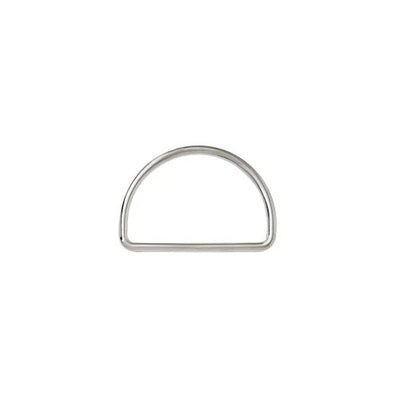
 Metal half-rings – PMR 0002 round
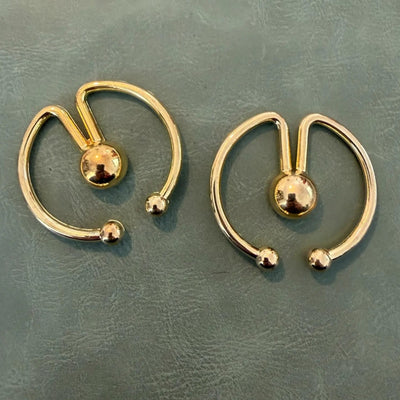
 Metal Rings E-1917 Nickel – Open design with beads, Designer – 4.5 cm
 Lightweight metal rings 092060 Col 0144 – 3.3 cm Gun Metal
Comparison table
| Type | Seam | How it fails | Strength | Cost | Typical use |
|---|---|---|---|---|---|
| Bent wire | Open | Gradually spreads open | Low | Low | Decoration, key rings, light charms |
| Welded wire | Closed, ground | Bends only at very high load | High | Medium | Bags, straps, belts, leashes |
| Cast (Zamak) | None | May crack on impact | Medium | Medium to high | Fashion bags, designer details |
| Stamped | None | Bends if thin | Medium to high | Medium | Flat webbing, swimwear straps |
How to spot the seam
- Look under a loupe. A bent ring shows a visible line or gap, often with a small step between the two ends. A welded ring shows a slight band or change in texture, sometimes a slightly thicker spot.
- Use a fingernail. On a bent ring, your nail catches in the gap.
- The twist test. Grip the ring with two pairs of pliers on either side of the seam and twist gently. A bent ring opens straight away; a welded one doesn't move. (Do this on a sample, not the product.)
- No seam at all. Then the ring is cast or stamped. Cast rings are usually chunkier with rounded edges; stamped rings are flat with clean cut edges.
- Magnet. If the ring is magnetic it is probably steel wire; non-magnetic rings are brass, Zamak or stainless steel.
Caution: plating can hide the seam. A thick electroplated or powder layer fills the gap on a bent ring and makes it look closed. The twist test on a sample is the most reliable check.
Which ring for which job
Bags and handles
A bag handle carries the full contents plus sudden jerks. Use welded rings, or quality cast or stamped rings of adequate thickness. Bent rings don't belong here.
Belts
On double D-ring belts, the rings take the belt's tension every time it is cinched. Use welded or solid cast rings.
Dress and swimwear straps
The load is low, but the ring touches skin and water. Flat stamped or cast rings with smooth edges and a finish that withstands chlorine and salt are a good fit.
Pet leashes
A dog can pull with much more force than its own weight. Only welded stainless steel rings of suitable thickness should be used here, and the finished product should be tested. Fashion hardware is not designed for this.
Decoration and charms
Bent rings are perfectly fine for key rings, decorative chains and zip charms.
How to test a ring before production
A simple in-house test: attach the ring to the webbing exactly as in the product, hang a gradually increasing weight (water bottles work) and leave it for 24 hours. Check whether the gap has opened, whether the webbing has deformed the ring and whether the plating has cracked. For load-bearing points, ask the supplier for strength data or a lab test.
Size and thickness
The ring's inner size must match the webbing width; 20, 25, 30 and 38 mm are the most common. Wire or profile thickness matters as much as the ring type: a 2 mm welded wire ring is weaker than a solid 4 mm cast ring. So when comparing, always look at both.
Frequently asked questions
Is a welded stainless ring always best?
For strength and corrosion resistance, usually yes. But it is heavier and costlier, and not always necessary. For decorative uses, brass or Zamak looks better.
Can I weld a bent ring myself?
Jewellers can solder small rings, but the plating burns off and has to be restored. For production it makes more sense to order welded rings.
My ring keeps opening. What should I do?
Close it temporarily with pliers and replace it with a welded or solid ring. A bent ring that has opened once is already weakened.
Rings from Bul-tex
At Bul-tex you will find metal rings and D-rings in round, flat, rectangular and designer shapes, in nickel, gunmetal, gold and nickel-free finishes, plus buckles for belts and bags. If you are unsure whether a particular model suits a load-bearing point, ask us about its construction and intended use before you order. Read more about bag hardware in our accessories category.