A barcode for clothing becomes essential the moment a brand starts selling through retailers, online marketplaces or even its own warehouse with more than a few dozen items. Without one, a shop can't scan the product at the till and you can't track stock by size. The good news is that the system is logical: one standard (EAN-13), one organisation that issues the codes (GS1), and one simple rule – every size and every colour gets its own code. Here is a step-by-step guide.
Step 1: Understand EAN-13 and GTIN
GTIN (Global Trade Item Number) is the global identifier for a trade item. EAN-13 is the most widely used barcode that encodes it – 13 digits with black and white bars above them. It's the barcode you'll find on almost every clothing tag in Europe.
The 13 digits have a structure:
- GS1 prefix – codes issued by GS1 Bulgaria start with 380. It shows which national GS1 organisation issued the number, not where the product was made.
- Company prefix – unique to your business.
- Item reference – which you assign to each product.
- Check digit – calculated automatically to catch scanning errors.
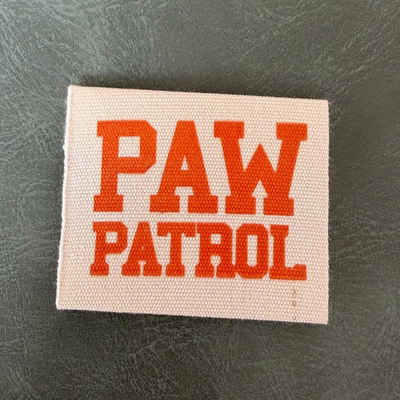
 Printed canvas label LBL 0064 4 x 4 cm – with orange letters, soft premium design, with logo
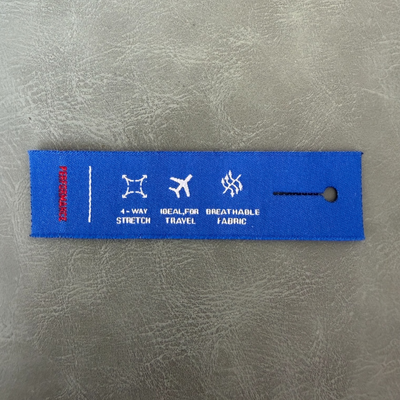
 Jacquard woven label LBL 0043 8 x 2 cm – unique design with buttonhole, woven lettering, soft premium style, with logo
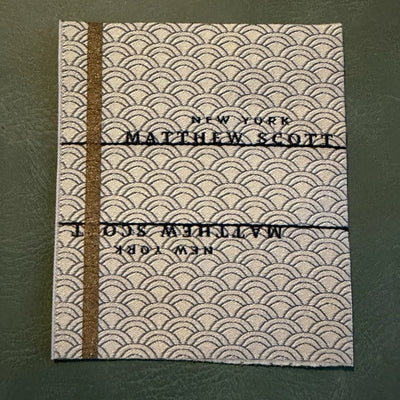
 Jacquard woven label LBL 0022 7 x 6 cm – wavy design, customized with logo
Step 2: Get legitimate codes from GS1
The only reliable source of EAN-13 codes is GS1, the global standards organisation, which is represented in Bulgaria by GS1 Bulgaria. When you join, you receive a company prefix and capacity for a set number of codes – for example 10, 100 or 1,000 – depending on your needs.
Why not buy cheap barcodes online? Resold codes are registered to another company. Major retailers and marketplaces increasingly check codes against GS1's global registry, and if a code isn't in your name the products get rejected or blocked. The saving is rarely worth the risk.
Tip: check your retailer's requirements before you order codes. Some chains have extra rules on barcode size and placement.
Step 3: Work out how many codes you need
The rule is simple: every style × colour × size combination is a separate product and needs its own GTIN. The shop has to know whether it sold a black tee in M or a white one in L.
The formula:
styles × colours × sizes = number of codes
For example, 10 styles in 5 colours and 6 sizes = 10 × 5 × 6 = 300 codes. If some styles come in only two colours, calculate them separately and add up.
| Range | Calculation | Codes |
|---|---|---|
| Small capsule collection | 4 styles × 2 colours × 5 sizes | 40 |
| Seasonal collection | 12 styles × 3 colours × 6 sizes | 216 |
| Jeans with waist and leg | 3 styles × 2 washes × (8 waists × 3 legs) | 144 |
| One-size accessories | 20 styles × 4 colours × 1 | 80 |
Add a buffer of at least 20–30% for future seasons. A GTIN is never reused for a different product, so codes run out faster than you'd expect.
Step 4: Put your codes in a spreadsheet
Before printing anything, build a sheet with columns for GTIN, SKU, style, colour, size and description. It becomes the backbone of your stock system, your online shop and the file you send to the printer. Number items sequentially and never reassign a code that has been used.
Step 5: Print the barcode properly
Size
The nominal size of an EAN-13 (100%) is about 37.29 × 25.93 mm including quiet zones. The standard allows scaling from roughly 80% to 200%. On a hang tag, 80% – around 30 × 21 mm – is usually the floor below which scanning gets unreliable.
Quiet zones
The barcode needs blank white margins with no text or graphics: about 11 modules on the left (≈3.6 mm at 100%) and 7 on the right (≈2.3 mm). If a logo or frame touches the bars, the scanner can't find where the code begins.
Height
Don't trim the bar height to save space. Truncated barcodes are much harder to read.
Contrast and colour
- Safest: black bars on a white background.
- Dark blue, dark green and dark brown bars also work.
- Never red bars – most scanners use red light and simply don't see them.
- Kraft and dark board reduce contrast; place the barcode on a white panel or a white sticker.
Placement
On the back of the tag, away from the string hole and any fold. Don't place a barcode over foil, spot UV or embossing – reflections and uneven surfaces confuse scanners.
Print on the tag or use a sticker?
With many sizes and colours, printing a different barcode on every hang tag is costly and fiddly. The most common solution is one shared tag design plus a white sticker carrying the barcode, size and colour, printed on a thermal transfer printer. One run of tags covers the whole collection and stickers are printed as needed.
Troubleshooting
- The scanner won't read it: check the quiet zones, the scale (not below 80%) and the bar colour.
- The wrong product comes up: the same code has probably been assigned to two variants. Check your spreadsheet.
- A marketplace rejects the code: it isn't registered to your company with GS1, or the product data hasn't been filled in.
- The bars look fuzzy: uncoated board absorbs ink; use a smooth board or a sticker.
The barcode is part of a complete label system
The barcode lives on the hang tag or sticker, while composition and care go on the sewn-in label. A tidy label system – sewn-in label, hang tag, sticker – is a hallmark of a professional brand. Browse our woven, satin and metal labels, and see how ribbons can be used to attach your hang tags.
Bul-tex manufactures and supplies labels and garment trims and accepts custom orders for brands. If you're preparing your first collection and have questions about labelling, get in touch. You'll find more useful reading in our manufacturing section.