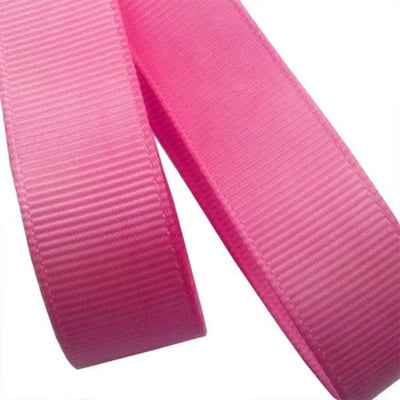
Grosgrain ribbon is a firm woven ribbon with distinct crosswise ribs, and it holds its shape far better than smooth satin. That is why you find it on hats, skirt waistbands, bags, uniforms and any bow that needs to stand up on its own. In this guide we explain what grosgrain actually is, how it compares with satin ribbon, which width works for which job and how to handle it so your finished piece looks professional.
What is grosgrain ribbon?
The name comes from the French gros grain, meaning "coarse grain". During weaving the crosswise threads are thicker than the lengthwise ones, creating fine ribs you can feel with your fingertip. The result is a matte or softly lustrous ribbon with a dense hand and stable, firm edges. Most modern grosgrain, including the ribbons at Bul-tex, is made from polyester, which resists fading and creasing and copes well with washing.
- Structure: crosswise ribs, usually identical on both sides.
- Body: stiffer than satin, so bows keep their volume.
- Surface: matte and non-slip, which makes it easy to sew.
- Edges: woven selvedges that do not fray along the length.


Grosgrain vs satin ribbon – which one to choose
The two are often confused, but they do different jobs. Satin is smooth, shiny and soft, perfect for delicate bows and gift wrapping. Grosgrain is sturdier and more practical, ideal when the ribbon becomes part of the garment or accessory itself.
| Feature | Grosgrain | Satin |
|---|---|---|
| Look | Matte, ribbed | Smooth, glossy |
| Stiffness | Medium to high | Soft, drapes freely |
| Slipping when sewing | Minimal | Slippery, needs pins |
| Typical use | Hats, waistbands, bags, uniforms | Gifts, wedding decor, lingerie |
For decorating a present, satin is cheaper and shinier. If the ribbon will be stitched on, worn and washed, go for grosgrain.
What grosgrain ribbon is used for
- Hat bands – the classic band on a fedora or straw hat is grosgrain, 2.5–4 cm wide.
- Waistband facing – sewn inside a skirt or trouser waistband to stop it stretching.
- Trims and stripes – decorative bands on sleeves, pockets and uniforms.
- Bag straps and flaps – combined with buckles and rings.
- Hair bows and clips – 1–2.5 cm, because they keep their shape.
- Medal ribbons and lanyards – widths of 2–3.5 cm.
Widths and colours
At Bul-tex grosgrain ribbon comes in 12 widths from 0.3 cm to 7 cm (0.3, 0.6, 1, 1.5, 2, 2.5, 3, 3.5, 4, 5, 6 and 7 cm) and in classic and fashion shades: white, cream, beige, black, navy, burgundy, khaki, turquoise and more. For fine accents on children's clothing 0.6–1 cm is enough, hair bows look best at 1.5–2.5 cm, and hats or wide waistbands call for 3.5–5 cm.
How to handle and care for grosgrain
- Cutting: use sharp scissors and cut at an angle or in a "V" so the ends do not fray.
- Sealing: polyester ribbon can be sealed with a quick touch of a flame or an anti-fray liquid.
- Sewing: use polyester thread matched to the ribbon and a 2.5–3 mm stitch.
- Ironing: low to medium heat, through a cotton pressing cloth.
- Washing: up to 30–40°C, no harsh bleach.
Keep in mind that classic grosgrain has straight edges and does not curve easily. For oval hat crowns or rounded necklines, choose a narrower width or ease it into shape gradually with steam.
Frequently asked questions
Is grosgrain the same as ribbed ribbon?
Yes. "Ribbed ribbon" describes the texture, while "grosgrain" is the standard trade name for the same woven ribbon.
Can grosgrain ribbon be washed?
Yes, polyester grosgrain handles washing at 30–40°C. If you are sewing a dark ribbon onto a white garment, test a scrap for colour bleeding first.
What width should I choose for a hair bow?
For small bows and children's clips, 1–1.5 cm. For a classic full bow, 2.5–4 cm.
Browse all sewing and craft ribbons in our ribbon collection and pick the colour and width you need.