How to choose ribbon width is one of the most common questions when ordering ribbon online. On screen, 1.5 cm and 2.5 cm look almost the same, but in a real project the difference is huge. Too narrow and the ribbon disappears; too wide and it looks heavy and is hard to tie. Below you will find a practical chart by use, tips on proportions and advice on which ribbon type to pick so you get it right the first time.
How ribbon width is measured
Width is the distance between the two edges of the ribbon, measured across. At Bul-tex sizes are listed in centimetres: 0.3, 0.6, 1, 1.5, 2, 2.5, 3, 3.5, 4, 4.5, 5, 6 and 7 cm (the range depends on the ribbon type). Elsewhere you will often see millimetres or inches: 6 mm ≈ 1/4", 10 mm ≈ 3/8", 15 mm ≈ 5/8", 25 mm ≈ 1", 38 mm ≈ 1 1/2".
Quick trick: hold a ruler against the item you are decorating and sketch the ribbon in pencil. If its width is roughly one tenth of the item's height, the proportion usually works.


Chart: ribbon width by use
| Width | Use | Recommended type |
|---|---|---|
| 0.3 cm | Cards, invitations, doll clothes, tiny boxes | Satin, grosgrain |
| 0.6 cm | Lingerie, baby clothes, fine bows, loops | Satin, herringbone tape |
| 1 cm | Favour boxes, small gifts, sleeve trims | Satin, organza |
| 1.5–2 cm | Gift boxes, bouquets, hair bows | Satin, organza, grosgrain |
| 2.5 cm | Apron ties, cake ribbons, classic bows | Grosgrain, herringbone tape, satin |
| 3–4 cm | Hats, waistband facing, large gifts | Grosgrain, satin |
| 5–7 cm | Dress sashes, chair bows, wreaths, baskets | Satin, grosgrain |
Which ribbon type to choose
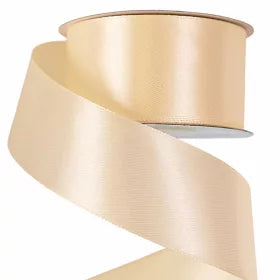
- Satin ribbon – smooth and glossy, with the widest range of widths (0.3–7 cm). Great for gifts, wedding decor and sashes.
- Grosgrain ribbon – matte and ribbed, keeps its shape. For hats, waistbands, bags and bows that need to stand up.
- Organza ribbon – light and sheer, 1–3 cm. For favours, bouquets and festive decor.
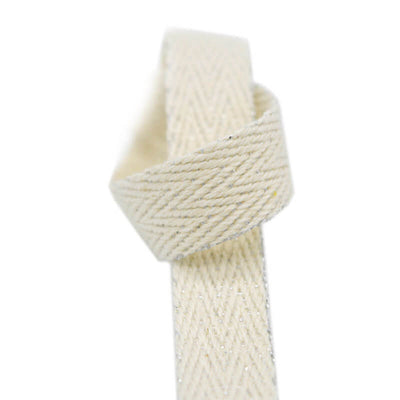
- Cotton herringbone tape – strong and non-stretch, 0.6–5 cm. For ties, loops and seam stabilising.
If you need something that stretches, look at our elastic instead – there are options suitable for waistbands and cuffs.
How many metres to order
Measure around the item or along the seam and add a margin: about 50 cm for each bow and 3–5 cm for turning under the ends when sewing onto clothing. For a gift box, calculate 2 × (length + width) + 4 × height and then add the bow. When decorating many identical items, such as favours or chairs, multiply the amount for one by the number of items and add 10% extra.
Tips on proportion
- Small items, narrow ribbon. An 8 × 8 cm box looks best with 1–1.5 cm ribbon.
- Wider ribbon makes a bigger bow. A 4 cm ribbon gives a bow roughly 12–15 cm across.
- Combine two widths. For example, 2.5 cm satin underneath with 1 cm organza on top adds depth.
- Go narrower on clothing. A decorative band on a hem or sleeve is rarely wider than 2 cm, otherwise it looks heavy.
- Cakes: around the base of a 10 cm tall cake, 2.5–4 cm ribbon is the usual choice.
Frequently asked questions
What is the most versatile ribbon width?
2–2.5 cm. It can wrap a gift, decorate a bouquet and make ties or a hair bow.
How many centimetres is 1 inch ribbon?
One inch is 2.54 cm, so the closest metric option is 2.5 cm ribbon.
What ribbon should I use for a skirt waistband?
For waistband facing, use 3–4 cm grosgrain, close to the width of the finished waistband.
Explore every width and colour in our ribbon collection and pick the exact size for your project.