How do you choose metal accessories for a collection so that they look right and survive washing, wear and thousands of openings and closings? Eyelets, snap buttons and cord ends are small details, but the wrong size shows immediately: an eyelet that splits during setting, a snap that pops open on its own, or a cord end that falls off after the first wash. In this guide we show you how to match the size of each accessory to the thickness of the fabric and the cord, and where to find exact measurements for free.
Start with the material, not the catalogue
The most common mistake is to pick an accessory from a photo and only then think about the fabric. The right order is the opposite. Before you open any catalogue, answer three questions:
- How thick is the material at the fitting point? Count every layer – shell fabric, lining, interfacing, hem.
- What will pass through the hole or be attached? A cord, a lace, a flat tape or nothing at all.
- What load will the part carry? A decorative eyelet on a blouse and an eyelet on a backpack or tarpaulin work under completely different conditions.
Write these figures into the garment's tech pack. With them, the choice becomes almost mechanical.
 Snap fasteners E-2278 Gun Metal 40 mm – 4 pieces, "Teardrop" design, Luxury model
 Metal eyelets PE 0001 dome
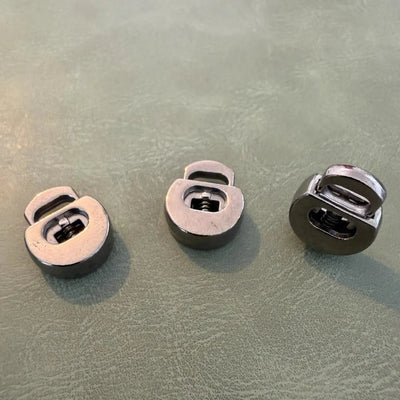
 Metal cord and elastic stoppers 110 – single hole (5 mm), dotted design
Eyelets: three measurements that decide everything
Every eyelet is described by three dimensions: inner hole (d), shank height (H) and outer flange diameter (D).
Inner hole to suit the cord
The hole should be slightly larger than the cord or lace that runs through it – usually by about 0.5–1 mm. If it is exactly the size of the cord, the cord will rub and stick; if it is much larger, the eyelet looks empty.
Shank height to suit the thickness
The shank must pass through all the layers and leave enough length to roll over. On thin jersey a standard height is enough, while on denim, leather or multi-layer areas you should look for a long-shank model. Avoid setting an eyelet right on a seam or hem – the difference in thickness is a frequent reason why the shank does not roll evenly.
Flange to suit the look and the load
A wider flange spreads the force over a larger area and is the better choice for leather, canvas and stretched fabrics. For flat tapes and belts choose an oval eyelet – the tape runs through without folding.
If you want to compare series and dimensions before ordering, the eyelet sizes by series list the suitable materials and exact measurements for each series. At Bul-tex you will find metal eyelets – domed, flat and oval – in several sizes for garments, bags and shoes.
Snap buttons: the system matters more than the size
With snap buttons the diameter is a question of looks, but the system decides whether the snap will hold. The general rule looks like this:
| Fabric | Suitable system | Typical garments |
|---|---|---|
| Thin jersey, stretch fabrics | prong (ring) snaps | bodysuits, baby and children's wear |
| Thin and medium wovens | 54 system | shirts, denim shirts, poplin |
| Heavy fabrics, denim, wool, leather | 61 system | jackets, coats, denim jackets |
| Delicate or multi-layer materials | sew-on snaps | dresses, knitwear, lined garments |
Prong snaps do not require a pre-punched hole – the prongs pass through the fabric without cutting it. On thin and stretchy materials reinforce the spot with interfacing, and for thicker areas choose longer prongs. Never mix parts from different systems: the male and female parts must come from the same set, otherwise the click is weak and the snap opens by itself. Ready-to-use models for shirts, jackets and kidswear are in our snap buttons collection.
Cord ends: opening, shape and length
A cord end stops the end of the cord from fraying and makes it easier to thread through eyelets and channels. Choosing one follows the same logic – measure the cord first.
- Measure the cord diameter with a caliper, not by eye. The cord end opening should be slightly larger – usually by about 0.3–0.5 mm if the end will be glued or crimped.
- Pick the shape to suit the cord. Round and cone models are for round cords, flat models are for flat cords and tapes, and their width should match the width of the tape.
- Set the length to suit the style. Short cord ends suit delicate items, long ones suit sportswear and streetwear collections where the detail should stand out.
- Think about fitting. Metal cord ends are fixed by crimping with a suitable tool or with glue, depending on the model and the cord material.
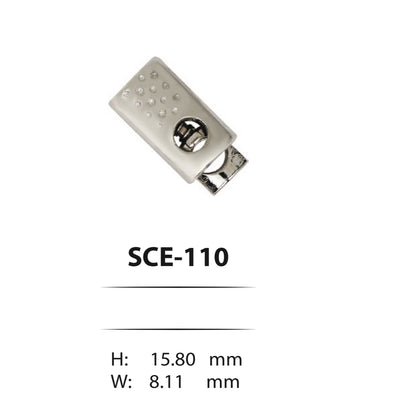
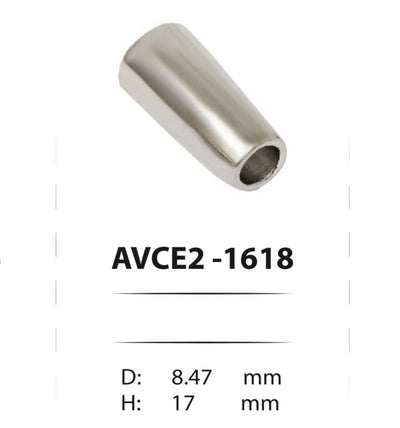
A handy starting point is the metal cord end size chart, where every model has a code, dimensions, approximate opening and profile. In our accessories collection you will find metal cord ends and cord stoppers in nickel and gun metal for hoodies, jackets and joggers.
Finish and colour: match the whole set
When a garment has eyelets, snap buttons, cord ends and a zip, they should look like a set. Choose one finish – for example nickel, gun metal or antique brass – and keep it for every metal part. For children's wear and sales in the EU, look for nickel-free finishes. Always ask for a sample before the production run: the colour in a photo is only indicative, and the tone can vary slightly between metals.
A free resource: technical size tables
You do not have to work everything out yourself. The producer Polkom – with more than 30 years of experience in accessories for fashion, furniture, footwear and bags – publishes detailed size tables and PDF technical sheets for eyelets, snap buttons and cord ends on its new, faster and more modern website. You can download them for free and attach them to the tech pack so that the designer, the technologist and the factory floor all work with the same data.
Checklist before you order
- The material thickness at the fitting point has been measured.
- The cord diameter or tape width has been measured with a caliper.
- A series or system suitable for the fabric has been chosen.
- The finish is the same for all metal parts.
- The press die matches the size of the accessory.
- A test fitting has been done on the real fabric.
Frequently asked questions
Which eyelet should I choose for a 5 mm cord?
Look for an eyelet with an inner hole of about 5.5–6 mm. The cord will then run freely without rubbing. Next, check the shank height against the thickness of the material.
Can snap buttons be fitted on jersey?
Yes – prong snaps that do not cut the fabric are the best choice. Reinforce the spot with interfacing or tape so that the fabric does not stretch when the snap is closed.
How do I attach a metal cord end without a machine?
For small quantities many models can be fixed with glue and careful pressing. For series production it is better to use a crimping tool so that every garment is finished the same way.
Browse the metal accessories at Bul-tex, and for trade quantities and logo accessories get in touch with us.