Working out the right waist elastic length seems easy until a garment ends up too tight or keeps sliding down. The good news is that one simple formula works for skirts, trousers, pyjamas and joggers alike. Below you will learn how to measure, how much to take off the body measurement and how the type of elastic changes the maths.
How to take the right measurement
Measure where the finished waistband will actually sit, not necessarily at the narrowest point. For pyjamas and low-rise bottoms this is often just below the natural waist; for high-waisted skirts it is right on it.
- Wrap a tape measure around the body over light underwear without pulling it tight.
- Keep the tape level at the front and the back.
- Write the number down – this is your circumference (C).
- Also note your hip measurement: an elastic waistband has to stretch over the hips when you dress.
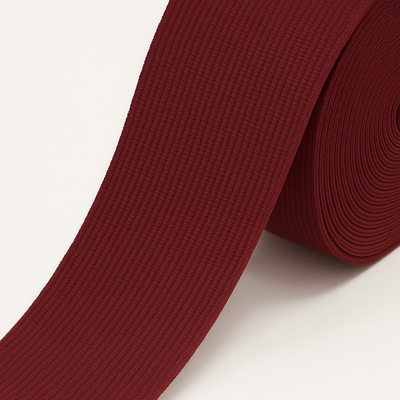
 Bordeaux knitted elastic band PEL 1013 on a 25 m roll
 Wide white knitted elastic band
 Red knitted elastic band PEL 1008 on a 25 m roll
The formula: how much shorter than the body
The elastic must be shorter than the body to hold. A ratio between 0.85 and 0.92 is the most common:
- Knitted elastic – softer and stretchier, so it is cut shorter: about C × 0.85–0.88.
- Woven elastic – firmer, with stronger recovery: about C × 0.90–0.92.
- Wide elastic (5 cm and up) – grips over a larger area, so C × 0.92–0.95 is enough.
Add 2–3 cm to the result for overlapping the ends when you join them. For very wide elastic, allow 3–4 cm.
Sample chart for knitted elastic (ratio 0.87)
| Waist | Elastic without overlap | Cutting length (+2 cm) |
|---|---|---|
| 50 cm (child) | 43.5 cm | 45.5 cm |
| 60 cm | 52 cm | 54 cm |
| 70 cm | 61 cm | 63 cm |
| 80 cm | 69.5 cm | 71.5 cm |
| 90 cm | 78 cm | 80 cm |
| 100 cm | 87 cm | 89 cm |
| 110 cm | 95.5 cm | 97.5 cm |
Treat the chart as a starting point. Every elastic stretches a little differently, so always test before the final stitching.
The fitting test that saves unpicking
- Cut the elastic using the formula but do not sew it yet – hold the ends together with a safety pin.
- Put it around your waist, then sit, bend over and take a deep breath. If it leaves a mark or digs in, add 1–2 cm.
- Stretch it fully and check it passes over the hips. If not, choose a softer knitted elastic or reduce less.
- For children allow a little more ease (a ratio of around 0.9) and never squeeze the tummy.
Which width to choose
For pyjamas and kids' bottoms, 2–2.5 cm is usually enough. Everyday trousers and skirts feel comfortable with 3–4 cm, while leggings and yoga-style waistbands look best with 5–6 cm or more. The wider the elastic, the less it rolls and the more evenly it spreads the pressure. At Bul-tex you'll find knitted and woven elastics from 1 to 10 cm wide on 25 m rolls, in white, black and plenty of colours.
Frequently asked questions
How much shorter than my waist should the elastic be?
Usually 8–15% of the circumference, depending on the type. Knitted elastic is shortened more, woven elastic less. Then add 2–3 cm for the overlap.
Is the formula the same for casings and sewn-on elastic?
Yes, the length is the same. The only difference is that sewn-on elastic is divided into quarters and stretched evenly while you stitch.
What if I cut the elastic too short?
Do not force it to stretch – it will lose recovery. Cut a new piece, or insert a short extra section of the same elastic at the join.
Need elastic in an exact width? Browse elastics at Bul-tex, and for casings and bindings take a look at our ribbons and tapes. We ship with DHL Express across the EU.