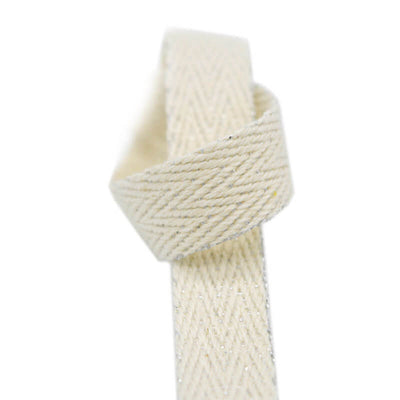
Knowing how to stop ribbon fraying makes the difference between packaging or a garment that looks polished and one that looks careless. Cut ends go fuzzy, threads pull loose and every touch makes it worse. The good news is that the fix is simple, as long as you match the method to the ribbon. A technique that works perfectly on polyester satin can melt organza or do nothing at all on cotton. Here are five proven methods, plus a table showing which one suits which ribbon.
Why ribbon frays
Every woven ribbon is made of lengthwise (warp) and crosswise (weft) threads. Along the sides, the ribbon is closed by the woven selvedge, but once you cut it, the crosswise threads are loose and start to slip out. The smoother and slipperier the yarns, as with satin and organza, the faster the cut edge frays. Dense grosgrain and cotton tapes fray more slowly but still need treatment.


Method 1: The diagonal cut
The simplest option. Cut the end at an angle of about 45°. A diagonal cut exposes fewer loose threads, and they hold together better. Use sharp scissors; blunt blades crush the yarns and fraying starts immediately.
Best for: all ribbons, as a first step. On its own it is enough for packaging that will be opened soon.
Method 2: The V cut (fishtail)
Fold the ribbon end in half lengthwise and cut from the edges towards the fold at an angle. When you unfold it, you have a neat V notch. It looks professional and reduces fraying, because both cuts are on the bias.
Best for: wide ribbons over 15 mm, bows and decorations.
Method 3: Heat sealing
Synthetic fibres such as polyester and nylon melt, so heat fuses the cut ends together. Pass the cut end quickly near the flame of a lighter or candle without touching it, or use a hot knife for textiles. The yarns melt slightly and form a thin sealed edge.
- Work fast and keep a few millimetres away; too close and the edge darkens and hardens.
- Test on an offcut of the same ribbon first.
- Don't use this method on cotton, linen, silk or viscose; they don't melt, they burn.
- Organza is very thin and melts quickly, so keep the flame even further away.
Best for: polyester satin, grosgrain, organza and other synthetic ribbons.
Safety first: work on a non-flammable surface, away from paper and wrapping materials, and never leave a flame unattended. If you are finishing a lot of ribbon at once, a hot knife is both safer and faster.
Method 4: Anti-fray liquid or clear nail polish
Dedicated anti-fray liquids (such as Fray Check) and fabric glues form a clear, flexible film that locks the threads in place. Apply a thin layer to the cut edge only and leave it to dry. Clear nail polish is the household alternative: it works well but can leave a stiff, slightly shiny edge, and on pale ribbons it may yellow over time.
Best for: cotton ribbon, silk and blends, where heat isn't an option.
Method 5: Hem or fold and stitch
The most durable method for ribbon that will be washed, such as trims on garments, bags or children's toys. Fold the end over twice by 3–5 mm and stitch it by hand or machine. If the ribbon is sewn into an item, the end can simply be hidden in the seam.
Best for: ribbon on garments, straps, ties and cotton herringbone tape that will be laundered.
Which method for which ribbon
| Ribbon | Best method | Alternative | Avoid |
|---|---|---|---|
| Polyester satin | Heat plus diagonal or V cut | Anti-fray liquid | Blunt scissors |
| Grosgrain | Heat | Hem | Holding the flame too close |
| Organza | Gentle heat from a distance | Anti-fray liquid | Nail polish, which leaves marks |
| Cotton herringbone tape | Hem or stitch | Anti-fray liquid | Flame, since cotton burns |
| Silk | Anti-fray liquid | Narrow hand hem | Flame |
| Webbing tape | Heat (if synthetic) or hem | Stitch into the item | Leaving it untreated |
How to tell what your ribbon is made of
If you don't know the fibre, do a burn test on a small offcut over a sink. Polyester and nylon melt, form a hard black bead and smell of plastic. Cotton and linen burn with a yellow flame, leave soft ash and smell like paper. Silk burns slowly and smells like singed hair. The test tells you whether heat sealing is an option.
Mistakes that make fraying worse
- Straight cuts with blunt scissors. The yarns get crushed and separate at the first touch.
- Too much glue. A thick layer spreads into the ribbon, leaves a dark patch and stiffens the end. A thin line along the cut is enough.
- Flame on blends. If the ribbon contains cotton or viscose, the synthetic part melts while the natural part scorches, leaving a ragged brown edge.
- Pulling loose threads. A pulled thread puckers the ribbon and the fraying spreads. Snip it off instead.
Quick wrapping tips
- Trim the ribbon only after you've tied the bow, so you can judge the length of the tails.
- Keep a pair of scissors for fabric only; cutting paper blunts them fast.
- Store rolls in a box or on a holder, because loose ends fray from rubbing.
- For a big batch of gifts, seal all the ends in one session at one table with a hot knife.
FAQ
What's the fastest way to stop fraying?
On synthetic ribbon, a diagonal cut and a quick heat seal. It takes seconds.
Can I use nail polish on satin?
Yes, but in a thin layer on the cut edge only. Test first, as on some colours it leaves a dark line.
What ribbons do you stock?
Our ribbon collection includes satin, grosgrain, organza and cotton herringbone tape in many colours and widths. For branded packaging ideas, see our ribbon articles, and for larger quantities get in touch.