A fitted sheet with elastic is much easier to sew than it looks – and if you have a flat sheet that keeps slipping off, you can convert it in an afternoon. All you need are accurate mattress measurements, some elastic and a straight-stitch machine. Here is how to calculate the fabric, how much elastic to buy and how to shape the corners.
Measurements: mattress, depth and allowance
Measure the length, width and depth of the mattress (including any topper or protector). Then add the following to every side of the fabric:
- the mattress depth;
- 10–15 cm to tuck under the mattress;
- 2–3 cm for the elastic casing.
Formula: fabric size = mattress size + 2 × (depth + tuck-under + casing).
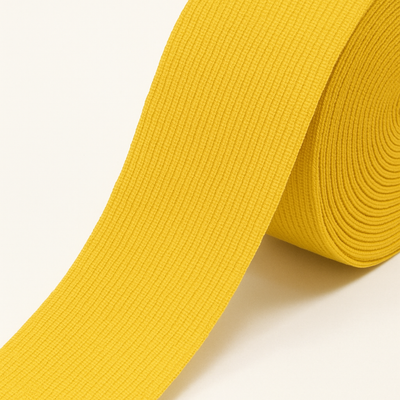
 Yellow braided elastic band PEL 1006 on a 25 m roll
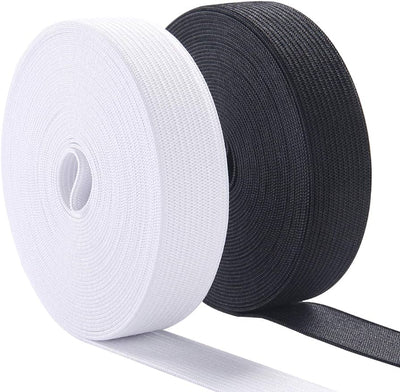
 Pink knitted elastic band PEL 1014 on a 25 m roll
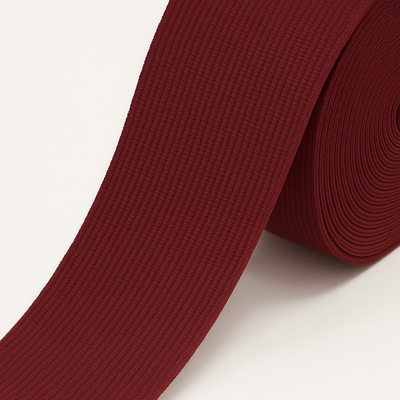
 Green braided elastic cord PEL 1009 on a 25 m roll
Chart for a 20 cm deep mattress
| Mattress | Allowance per side | Fabric size |
|---|---|---|
| 90 × 200 cm | 20 + 12 + 2.5 = 34.5 cm | 159 × 269 cm |
| 140 × 200 cm | 34.5 cm | 209 × 269 cm |
| 160 × 200 cm | 34.5 cm | 229 × 269 cm |
| 180 × 200 cm | 34.5 cm | 249 × 269 cm |
For a deeper mattress (25–30 cm), add the difference on each side. Remember that cotton may shrink in the first wash, so pre-wash the fabric before cutting.
Shaping the corners
- Cut a square from each of the four corners, with sides equal to the allowance (34.5 cm in the example).
- Bring the two cut edges of each corner right sides together and stitch with a 1 cm seam. This forms a box that wraps the mattress corner.
- Finish the seam with a zigzag or overlocker so it does not fray.
How much elastic you need and how to insert it
There are two approaches:
- Corner elastic only. Measure 30–35 cm either side of each corner seam. Into that 60–70 cm stretch, insert or sew about 30–40 cm of elastic. The whole sheet needs roughly 1.2–1.6 m. Economical and enough for most mattresses.
- Elastic all the way round. The sheet sits tightest and is easiest to put on. The elastic is cut much shorter than the edge – start at about two thirds of the perimeter and adjust after a test fit. For a double bed this is often 4–5 m.
Flat elastic 1–1.5 cm wide works best. Make the casing 0.5 cm wider than the elastic, thread it through with a safety pin, overlap and stitch the ends, then close the opening.
Converting a flat sheet
If the flat sheet has at least 30 cm of overhang on each side, cut out the corners and follow the same steps. With a smaller sheet, use corner elastic only, as it gathers less fabric. Instead of a casing you can also zigzag the elastic straight onto the edge. The same method works for mattress protectors, cot mattress covers and fitted tablecloths.
Frequently asked questions
What is the best elastic for a fitted sheet?
Flat elastic 1–1.5 cm wide. Woven elastic copes better with frequent bedding washes, while knitted elastic is softer and easier to sew on.
How much elastic do I need for a fitted sheet?
About 1.2–1.6 m for corner elastic only, and roughly 4–5 m for elastic around the whole edge of a double sheet.
Why does my fitted sheet pop off at the corners?
Usually the elastic has gone slack or the depth allowance is too small. Replace the elastic and check that the fabric tucks at least 10 cm under the mattress.
Buy elastic by the roll from Bul-tex elastics – 25 m is enough for several sheets. For bindings and decorative edges, see our ribbons and tapes.