Learning how to sew elastic with a sewing machine directly onto fabric is quicker than making a casing and gives a flatter, sportier finish – ideal for leggings, underwear, kids' clothes, sleeves and hems. The secret lies in the right stitch, the right needle and even stretching. Here is a step-by-step guide for an ordinary home machine.
What you need
- Elastic – knitted elastic is the easiest to sew straight onto fabric because it is soft and does not ripple when stitched through. For firmer waistbands, choose woven.
- Needle – stretch or ballpoint, size 75–90. The rounded tip pushes threads aside instead of cutting them.
- Thread – polyester, which is stronger and slightly stretchier than cotton.
- Safety pins or clips, a tape measure and tailor's chalk.
 Brown braided elastic band PEL 1005 on a 25 m roll
 Dark grey knitted elastic band PEL 1018 on a 25 m roll
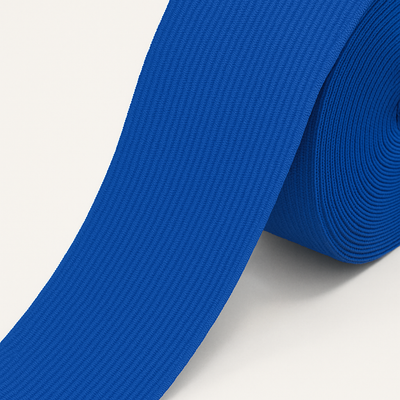
 Blue knitted elastic band PEL 1010 on a 25 m roll
Machine settings
| Stitch | Width | Length | When to use |
|---|---|---|---|
| Zigzag | 3–5 mm | 2–3 mm | All-rounder for 1–3 cm elastic |
| Three-step zigzag | 5–6 mm | 1–1.5 mm | Wide elastic and lingerie, the stretchiest |
| Straight stitch (casing) | – | 3–4 mm | Only when the elastic is not stretched while sewing |
Test your settings on a scrap of the same fabric and elastic. Once stitched, the seam should stretch with the elastic without any thread snapping.
Step by step
- Cut and join the elastic. Overlap the ends by 1.5–2 cm and stitch them with a dense zigzag in a square.
- Divide into quarters. Mark the elastic into 4 equal parts, then mark the garment opening into 4 parts. The elastic join usually goes at the centre back seam.
- Pin. Match the marks and clip them together. The fabric will be longer than the elastic between the clips – that is expected.
- First pass. Sew with the elastic on top, stretching only the elastic to match the fabric between two clips. Do not pull the fabric through – let the feed dogs do the work.
- Fold and topstitch. Turn the elastic to the inside and stitch again with a zigzag or three-step zigzag, stretching evenly once more.
The most common mistakes
- Skipped stitches – almost always caused by a universal needle. Switch to a stretch needle.
- Wavy elastic after sewing – the stretch was uneven, or the needle cut the rubber threads.
- Thread snapping when you dress – a straight stitch was used on stretched elastic.
- Twisting elastic – use more clips or choose a wider, more stable elastic.
If you own an overlocker or a coverstitch machine you can attach elastic with those, but a domestic zigzag gives a perfectly durable result.
Sewn-on elastic or a casing?
Sewn-on elastic lies flatter, does not twist and does not slide around inside the waistband, which is why it is preferred for leggings, underwear and activewear. The downside is that replacing it means unpicking the whole seam. Elastic in a casing is easier to swap and adjust, though narrow elastic can flip over inside it. If in doubt, use a casing for kids' clothes and pyjamas and sew the elastic on for close-fitting garments. Either way, match the width to the job: 1–2 cm for sleeves and hems, 2.5–4 cm for waistbands.
Frequently asked questions
Should elastic be stretched while sewing?
When sewing it directly onto fabric, yes – evenly between the marks. When threading it through a casing, no: the elastic goes in after the casing is stitched.
Which needle should I use for elastic?
A size 75–90 stretch needle for knits, or a ballpoint needle for thicker elastic. Neither will cut the rubber threads.
Can I sew elastic with a straight stitch?
Only when the elastic is relaxed, for example to secure the ends inside a casing. On stretched elastic a straight stitch will break.
Pick the right knitted or woven elastic from 1 to 10 cm and add matching polyester thread. You will find other sewing essentials among our accessories.