How is elastic made? From the outside it looks simple, just a tape that stretches, but behind it sits a chain of precise processes. The choice of elastic core, covering it with textile yarn, then weaving, knitting or braiding it and finally heat-setting it: each stage decides how firmly the elastic grips, whether it rolls, whether it narrows when stretched and how many washes it survives. Here is the whole process, step by step, from a manufacturer's point of view.
Step 1: The elastic core
Every elastic contains two families of yarn: elastic yarns, which supply stretch and recovery, and rigid (non-elastic) yarns, which supply structure, appearance and strength. The elastic part is one of two things:
- Rubber thread, made from natural or synthetic rubber, extruded or cut into round or square filaments. It gives strong retractive power and costs less, but it is sensitive to heat, UV, oils and sweat.
- Elastane (spandex, Lycra), a polyurethane filament. It is finer and lighter, contains no latex and delivers a softer pressure at the same width.
Under EU Regulation No 1007/2011 on textile fibre names, the two are labelled differently in a fibre composition: rubber as "elastodiene" and polyurethane filament as "elastane".
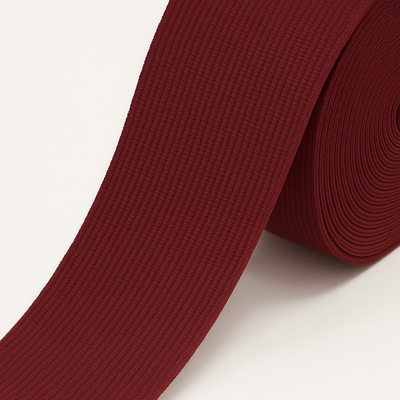
 Bordeaux knitted elastic band PEL 1013 on a 25 m roll
 Wide white knitted elastic band
 Red knitted elastic band PEL 1008 on a 25 m roll
Step 2: Covering the core
Bare elastic thread is tacky, vulnerable and unpleasant against the skin. So it is usually wrapped in polyester or nylon yarn on dedicated covering machines, either single or double covered. The wrap protects the core, allows dyeing and makes the elastic soft. In some products, such as shirring thread, the covering is visible; in others it is hidden inside the structure of the tape.
Step 3: Forming the tape, three main methods
| Method | Machine | Structure | When stretched | Typical use |
|---|---|---|---|---|
| Weaving | Narrow-fabric loom (needle or shuttle) | Elastic yarns locked between warp and weft | Keeps its width, does not roll | Waistbands, belts, medical and workwear |
| Knitting | Crochet knitting machine | Looped chains with elastic yarns laid in | Narrows slightly, feels soft | Underwear, pyjamas, kidswear, masks |
| Braiding | Braiding machine | Yarns interlaced diagonally | Narrows considerably | Sleeves, cuffs, narrow casings (2–12 mm) |
Woven elastic
Narrow looms weave dozens of tapes side by side. The warp yarns, elastic ones included, run lengthwise, and the weft locks them crosswise. That is why woven elastic is stable, doesn't roll inside a casing and holds its width even under heavy stretch. It feels firmer and denser, which makes it ideal for waistbands and anywhere you need real holding power. In our elastic range, woven styles come in widths from 1 to 10 cm.
Knitted elastic
Crochet machines build chains of loops into which the elastic yarns are laid lengthwise. The result is softer, lighter and cheaper, and it is easy to sew with a zigzag or overlock machine. The downside is that it narrows slightly when stretched and can twist in very narrow casings. Its big strength is versatility: knitting machines easily produce picot edges, buttonholes and decorative patterns.
Braided elastic
In braiding, the yarns cross over each other at an angle, like a plait. Braided elastic is narrow (typically up to about 12 mm), narrows a lot when stretched and loses power if you stitch straight through it. That is why it is mostly threaded through casings.
Step 4: Heat-setting
Straight off the loom or knitting machine, the tape is "restless", full of internal tension and uneven stretch. It is pulled to its target elongation and run through heated rollers or a chamber. Heat-setting stabilises the stretch and the elastic's memory, meaning its ability to return to its original length. Skipped or poorly controlled heat-setting is the most common reason elastic goes slack after just a few washes.
Step 5: Dyeing and finishing
Elastic can be made from pre-dyed yarns or dyed as a finished tape. Finishing steps include:
- Brushing, for a soft, plush back on lingerie elastic.
- Silicone coating, for grip on skin or fabric.
- Printing, for logos, lettering and patterns.
- Winding and cutting, onto rolls (for example 25 m) or to exact lengths on request.
Step 6: Quality control
Good elastic is checked against several criteria:
- Elongation: how far it stretches under a given force, usually somewhere between 80% and 200%.
- Recovery: whether it returns to its starting length after repeated stretching.
- Width and thickness: tolerances must be tight, especially for automated sewing.
- Colourfastness to washing: crucial for dark colours sewn onto light fabrics.
- Safety: REACH compliance and, where needed, OEKO-TEX Standard 100 certification for items worn against the skin.
Selection tip: if the elastic will be sewn straight onto fabric under stretch, choose knitted or woven. If it is going into a casing, woven is the safest choice because it won't roll.
Why width changes how elastic behaves
With the same construction, a wider elastic carries more elastic yarns and therefore pulls harder. A 1 cm tape with 6–8 elastic ends suits cuffs and necklines, while a 4–5 cm waistband may hold several dozen and support heavy trousers. So when you change the width in a pattern, you also need to rethink the cut length: wide elastic is usually cut with less reduction relative to the body measurement than narrow elastic. Very wide tapes of 6 to 10 cm call for a woven structure to keep the edges flat; knitted versions at those widths feel softer but are more prone to rolling in wear.
Yarn gauge matters as well. Fine elastane ends produce a thin, flexible tape for lingerie, while heavier rubber ends make a dense, powerful elastic for workwear and belts.
What this means for you as a buyer
If you sew lingerie or children's clothes, you will appreciate soft knitted elastic. For trousers, skirts and sports waistbands that need stability, woven is the better pick. If you are producing a run and need a specific width, colour or a logo elastic, Bul-tex takes orders to specification, so send us your requirements. You will find more practical advice in our elastic articles.