Hang tag cost is one of the first questions every new brand asks, and the answer is almost always "it depends". It depends on concrete, measurable things, though: quantity, size, board, number of colours, finishes, cut shape and attachment. Once you understand how each of these moves the price, you can get a tag that looks expensive without paying for things you do not need. This article walks through the price drivers, the logic behind minimum order quantities and a few proven ways to bring the unit price down.
Why quantity is the biggest factor
Every print run carries fixed costs that do not depend on the number of tags: file preparation, printing plates or machine set-up, a cutting die, a proof, and start-up waste. At 200 pieces those costs are spread over very few tags, so each one is expensive. At 10,000 pieces the same costs almost vanish from the maths.
As a rough guide, in the Bulgarian market small, simple tags (about 5 × 6 cm, single-sided colour print on standard board) cost in the region of a few euros per hundred on a short run, while at tens of thousands of pieces the price drops to around 2–3 euro cents each. Treat these as approximate market benchmarks – a real quote depends on every factor below.
What the price curve looks like
| Run size | What happens to the price | Who it suits |
|---|---|---|
| 100–300 pcs | High unit price – fixed costs dominate; often digital print | Brand tests, capsule drops |
| 500–2,000 pcs | Unit price falls sharply; the sweet spot for small brands | Seasonal collections, ateliers |
| 5,000–20,000 pcs | Offset print, low unit price; material becomes the main cost | Established brands, core lines |
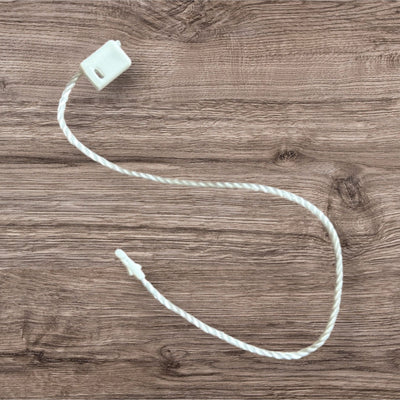
 String fasteners for cardboard tags 01
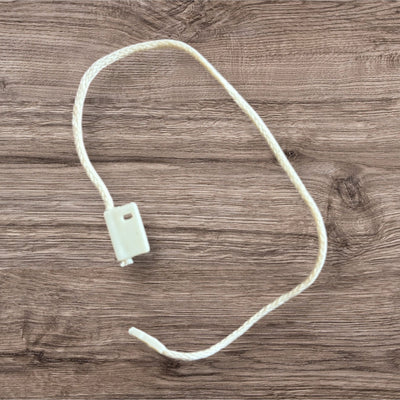
 String ties for cardboard tags 02
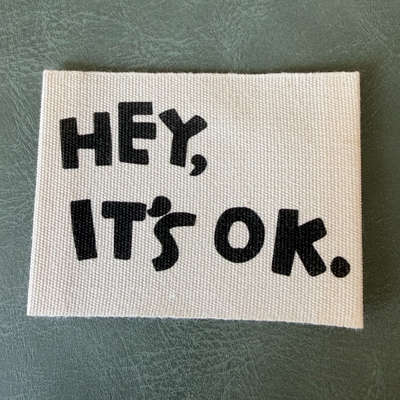
 Printed canvas label LBL 0066 4 x 2.5 cm – with black letters, soft premium design, with logo
The other cost drivers
Size and shape
Printers gang tags up on a large sheet. The smaller the tag, the more fit on a sheet and the cheaper each one is. Standard rectangles with square or rounded corners are cut with an existing die. A custom shape – a shield, a circle, a silhouette – needs a new cutting die, a one-off cost that hurts most on short runs.
Board
Standard coated board at 300–350 gsm is the most economical option. Kraft and recycled boards are usually close in price. Textured designer boards, duplex board over 600 gsm or seed paper can multiply the cost.
Colours and sides
With digital printing, the number of colours barely matters. With offset and screen printing, every extra Pantone colour adds a plate and a set-up. Double-sided printing almost always costs more than single-sided, but it is usually cheaper than ordering separate stickers for the back.
Finishes
- Hot foil stamping (gold, silver) – needs a die and a separate pass.
- Embossing or debossing – also needs a die.
- Soft-touch lamination – a velvety feel, but extra material and an extra step.
- Spot UV – striking, but one more set-up.
Each finish adds both a fixed and a per-unit cost. Pick the one that does most for your brand instead of stacking three.
Strings and attachment
A tag without a string is only half the bill. The string, an eyelet for the hole, tying and attaching the tag to the garment are separate costs. Ready-made hang tag strings save time in the workroom. If you attach tags with plastic barbs, budget for a tagging gun.
Minimum order quantities: what to expect
For digital printing, many printers accept orders from 100 pieces, some even fewer. For offset, the sensible minimum usually starts at 500–1,000 pieces, because below that the fixed costs make each tag uneconomical. Foil and embossing also have a practical minimum because of the die.
Tip: ask for a quote at three quantities, say 500, 1,000 and 2,000. The difference in the total between 500 and 1,000 is often small, while the unit price nearly halves.
Seven ways to lower the unit price
- One tag for the whole collection. Instead of a design per style, create a shared tag and combine the run.
- Blank fields for price and size. Fill them with a price sticker or a stamp, so the tag does not date when prices change.
- Standard size and shape. No new cutting die needed.
- One finish instead of three. Foil on the logo alone is often enough.
- Fewer colours. One-colour print on coloured or kraft board looks premium and is cheap in offset.
- Order two seasons at once if the design will not change.
- Print-ready artwork. Correct bleed, CMYK and a vector logo avoid pre-press fees.
Tag cost versus garment cost
It helps to see tags as part of the branding cost of a single garment. The hang tag, the string, the sewn-in woven or satin label and the care label together are usually a small share of the cost price, yet they have an outsized effect on perceived quality. Saving a few cents on board rarely pays off if the tag ends up looking cheap.
FAQ
Digital or offset printing?
Below roughly 500 pieces, digital is almost always cheaper and faster. Above 1,000–2,000 pieces, offset gives a lower unit price and more accurate Pantone colours.
How long does production take?
Digital runs are usually ready within a few working days of an approved proof. Offset with foil or embossing takes longer because of the dies, so plan at least two weeks before your collection launches.
Is the string included in the price?
Not always. Ask explicitly whether the quote covers tags with strings attached, tags with loose strings, or the tag alone.
Find more branding ideas in our labels section. Bul-tex manufactures and supplies trims for brands and accepts orders made to your design – if you would like a quote for a specific quantity, contact us. We ship across the EU with DHL Express.